
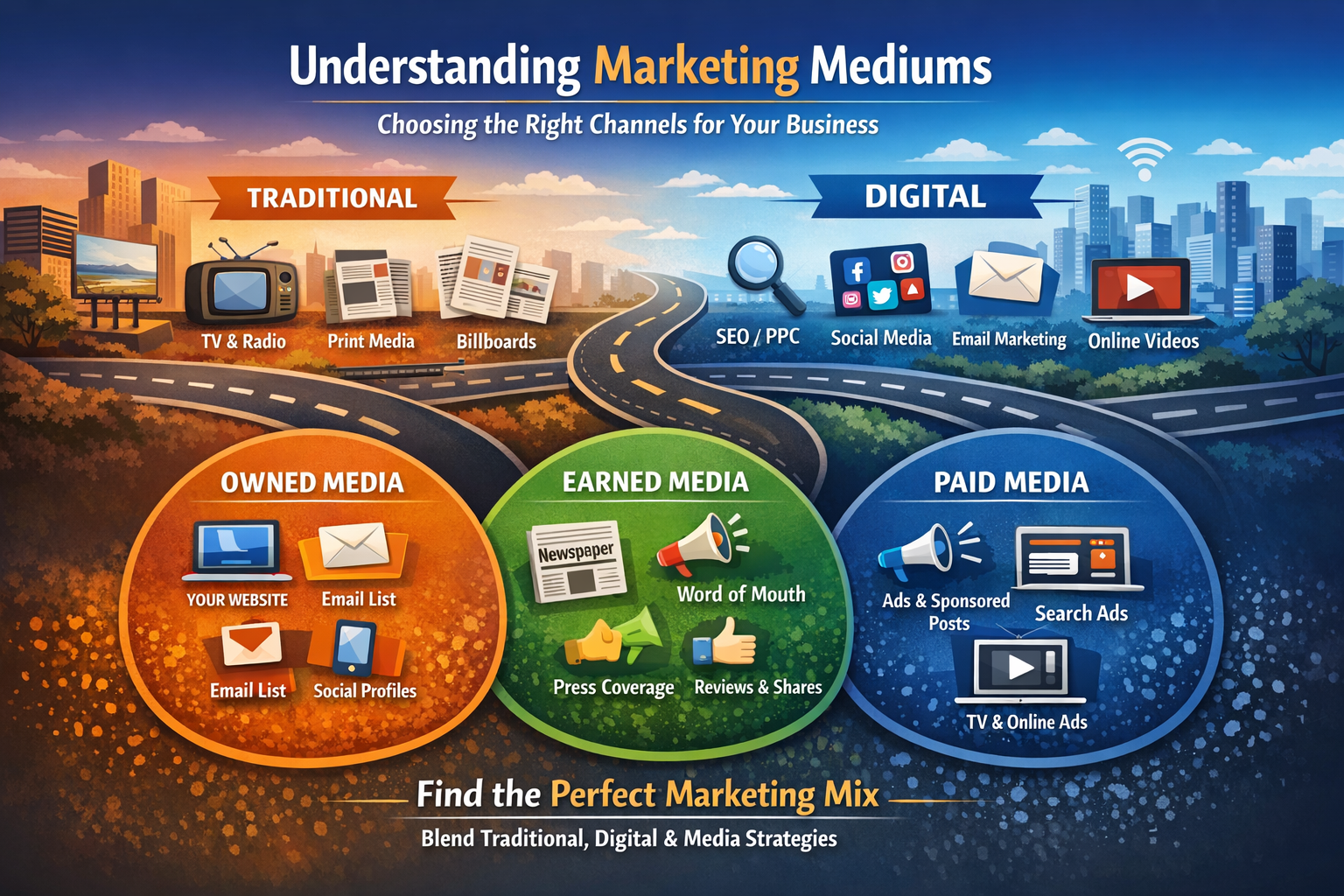
When people talk about “doing marketing,” they often focus on tactics—posting on Instagram, running Google Ads, sending emails. But beneath all those tactics sits a simple idea: the marketing medium. That’s just the channel you use to deliver your message to your audience—like a road connecting your brand to your buyer.
Pick the right road, and your message arrives quickly and clearly. Choose the wrong one, and it’s like shouting in an empty room. In this guide, we’ll break down what marketing mediums are, why they matter, and how you can choose the perfect mix for your business without wasting time or money.
Understanding Marketing Mediums In Simple Terms
A marketing medium is the platform, channel, or method you use to communicate with your audience. It’s how your message travels from you to them.
Some classic examples of marketing mediums include:
-
Television and radio
-
Newspapers and magazines
-
Social media platforms
-
Search engines
-
Email
-
Websites and blogs
-
Outdoor advertising (billboards, transit ads)
Think of your marketing message as a letter. The medium is whether you send it by email, courier, or hand it over in person. The letter might be brilliant—but if the delivery method is wrong, it may never be read.
Traditional vs Digital Marketing Mediums
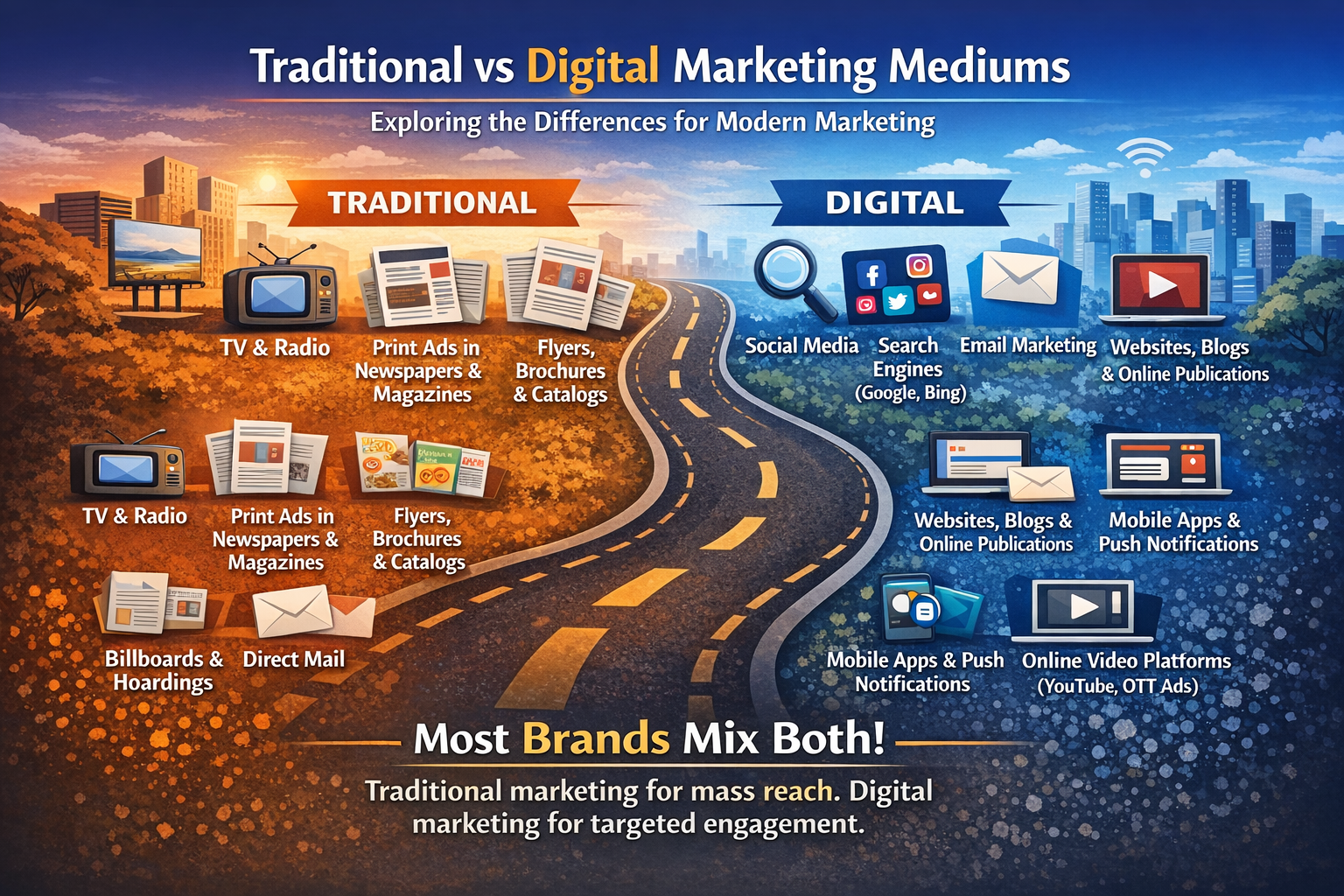
You’ve probably heard people separate marketing into “traditional” and “digital.” That divide mainly comes down to where and how your audience consumes information.
Traditional marketing mediums include:
-
TV and radio commercials
-
Print ads in newspapers and magazines
-
Flyers, brochures, and catalogs
-
Billboards and hoardings
-
Direct mail (physical letters or postcards)
Digital marketing mediums include:
-
Social media (Facebook, Instagram, LinkedIn, X, etc.)
-
Search engines (Google, Bing)
-
Email marketing
-
Websites, blogs, and online publications
-
Mobile apps and push notifications
-
Online video platforms (YouTube, OTT ads)
Traditional mediums often reach broad audiences and are great for mass awareness. Digital mediums tend to be more targeted, measurable, and interactive. In today’s world, most brands don’t choose one or the other—they mix both.
Owned, Earned, And Paid Media: The Three Big Buckets
To really understand marketing mediums, it helps to group them into three categories: owned, earned, and paid. These aren’t separate platforms; they’re different ways your message appears.
-
Owned media
These are channels you control.-
Your website
-
Blog
-
Email list
-
Mobile app
-
Social media profiles (though algorithms are controlled by platforms, the content is yours)
-
-
Earned media
This is exposure you gain organically when others talk about you.-
Press coverage
-
Word-of-mouth
-
Online reviews
-
Social media shares and mentions
-
User-generated content
-
-
Paid media
These are channels where you pay to reach more people.-
Search ads (Google Ads)
-
Social media ads
-
Display and banner ads
-
Sponsored content and influencer collaborations
-
TV, radio, and print advertising
-
A strong marketing strategy doesn’t rely on just one bucket. You use owned to build a foundation, earned to build trust, and paid to accelerate reach.
Key Types Of Digital Marketing Mediums
Digital mediums deserve special attention because they’re where most of the action is today. Let’s walk through the major ones you’ll deal with.
1. Search Engine Marketing (SEO & PPC)
-
SEO (Search Engine Optimization) is about earning visibility in search results without paying for each click. You create helpful content, optimize your pages, and build authority so people find you when they search.
-
PPC (Pay-Per-Click) ads are the sponsored results at the top and bottom of search pages. You bid on keywords, and you pay when someone clicks.
Search is a powerful medium because it catches people with intent—they’re already looking for what you offer.
2. Social Media Platforms
Social media networks act as huge digital marketplaces for attention:
-
Facebook and Instagram for broad audiences and visual brands
-
LinkedIn for B2B and professional services
-
X (Twitter), Threads, and others for real-time conversation
-
TikTok and short video platforms for younger, highly engaged users
You can use social media organically (posting content, engaging followers) and through paid campaigns (ads, sponsored posts).
3. Email Marketing
Email remains one of the most underrated marketing mediums. It’s direct, personal, and sits in a space people check daily.
-
Newsletters
-
Promotional offers
-
Product announcements
-
Nurture sequences and onboarding
Unlike social media, you’re not at the mercy of algorithm changes. Your email list is an asset you truly own.
4. Content Marketing (Blogs, Articles, Guides, Video)
Content marketing isn’t just a tactic—it’s a medium in itself. You create valuable content that attracts and educates your audience.
-
Blog posts and long-form articles
-
Ebooks and whitepapers
-
Case studies and success stories
-
Videos, webinars, and podcasts
The content lives on your owned channels but can be distributed through many other mediums (social, email, search).
5. Display And Video Advertising
These mediums rely on visual impact:
-
Banner ads on websites
-
In-app ads on mobile
-
Video ads on YouTube or streaming platforms
They’re great for awareness and remarketing—reminding people of your brand after they’ve visited your site or engaged with you.
Traditional Marketing Mediums That Still Matter
Just because digital is booming doesn’t mean traditional mediums are dead. For many brands, especially in local or mass markets, traditional channels still do heavy lifting.
-
Television: Ideal for mass awareness and emotional storytelling. Great for large consumer brands.
-
Radio: Cost-effective for local and regional campaigns. Useful for commuters and drive-time slots.
-
Print media: Newspapers and magazines can be powerful in specific niches and local regions.
-
Outdoor advertising: Billboards, posters, and transit ads create repeated exposure in high-traffic areas.
-
Events and sponsorships: Trade shows, conferences, sports sponsorships act as live mediums for engagement.
The trick is simple: go where your audience actually spends time—not where you feel “modern.”
How To Choose The Right Marketing Medium For Your Business
This is where many brands get stuck. There are so many channels that it’s easy to spread yourself thin. So how do you choose?
Ask yourself a few key questions:
-
Who is my ideal customer?
-
What is their age, profession, and location?
-
Where do they spend time online and offline?
-
-
What is my main goal?
-
Brand awareness?
-
Lead generation?
-
Direct sales?
-
Customer retention?
-
-
What is my budget and timeline?
-
Do I need fast results, or can I play the long game?
-
Can I afford ongoing ad spend, or do I need low-cost organic channels?
-
-
What strengths do I already have?
-
A strong website?
-
A good email list?
-
Loyal social media following?
-
If your audience is B2B decision-makers, LinkedIn and email might be your primary mediums.
Matching Mediums To The Customer Journey
Not every marketing medium serves the same purpose at every stage. A smart marketer uses different mediums for different stages of the customer journey: awareness, consideration, and decision.
-
Awareness: The goal is to get noticed.
-
Best mediums: TV, social media ads, YouTube videos, display ads, outdoor, viral content.
-
-
Consideration: The goal is to educate and build trust.
-
Best mediums: Blogs, guides, comparison pages, webinars, email sequences, case studies.
-
-
Decision: The goal is to convert interest into action.
-
Best mediums: Search ads with high intent keywords, retargeting ads, product pages, limited-time offers via email or SMS.
-
Imagine your marketing as a relay race. Different mediums take turns carrying the baton, moving your prospect closer to a purchase.
The Power Of An Integrated Multi-Channel Strategy
Using one marketing medium in isolation is like playing music with just one instrument—it can work, but a full band sounds better. When your mediums work together, they amplify each other.
Here’s how an integrated approach might look:
-
A prospect sees your YouTube ad (awareness).
-
Later, they search your product on Google and click your SEO result (consideration).
-
They read your blog, sign up for your newsletter, and receive emails (nurture).
-
Finally, a remarketing ad on social media offers a discount and they buy (decision).
The magic isn’t in any single channel. It’s in the orchestration across mediums.
Measuring The Effectiveness Of Each Marketing Medium
You can’t improve what you don’t measure. Different mediums demand different metrics, but the goal is always to understand: Is this channel moving us closer to our business goals?
Common metrics include:
-
Reach and impressions: How many people saw your message.
-
Clicks and engagement: How many people interacted with it.
-
Leads and conversions: How many took the action you wanted (sign up, purchase, download).
-
Cost metrics: Cost per click (CPC), cost per lead (CPL), cost per acquisition (CPA).
-
Return on ad spend (ROAS) and overall ROI.
Digital mediums make tracking easier, but you can also track traditional channels using unique URLs, QR codes, offer codes, and dedicated phone numbers.
Common Mistakes When Choosing Marketing Mediums
Even experienced businesses fall into a few predictable traps:
-
Jumping on trends blindly
-
Trying every new platform because it’s “hot,” without checking if your audience is there.
-
-
Ignoring audience behavior
-
Spending heavily on a medium your customers barely use.
-
-
Being everywhere but weakly
-
Spreading budget and effort across too many channels with no real impact on any.
-
-
Not testing and optimizing
-
Running campaigns without A/B testing creative, messaging, or audiences.
-
-
Relying on one single medium
-
Building everything on a rented platform—like social media—without strengthening owned channels like your website and email list.
-
Choosing marketing mediums should feel like designing a portfolio: diverse enough to spread risk, focused enough to be manageable.
Building A Sustainable Marketing Medium Mix
So how do you move from confusion to a clear, sustainable mix of mediums? Here’s a simple path:
-
Start with your audience and goals
-
Define who you want to reach and what you want them to do.
-
-
Pick 2–4 primary mediums
-
For example: SEO, email, Instagram, and Google Ads.
-
Avoid trying 10 channels at once in the beginning.
-
-
Develop consistent messaging across mediums
-
Keep your tone, promise, and visual identity aligned.
-
-
Create content that can be reused
-
Turn one strong piece (like an in-depth guide) into blog posts, social posts, email series, and videos.
-
-
Test, measure, and adjust
-
Track results for each medium and shift budget and effort toward the ones that move the needle.
-
Over time, you can add more channels or deepen your presence on existing ones, but the foundation stays the same: audience-focused, goal-driven, and data-informed.
Conclusion
The marketing medium you choose doesn’t just carry your message—it shapes how people experience it. A story told in a 6-second video feels different from the same story in a long-form blog. A testimonial on your website hits differently than one read in a newspaper.
That’s why choosing the right mediums is not a side decision; it’s central to how effective your marketing will be. When your message, your audience, and your medium line up, everything feels smoother: your costs drop, your results improve, and your brand feels more coherent across every touchpoint.