

Marketing Fundamentals are the core principles that help businesses understand customers, deliver real value, and grow sustainably. Marketing Fundamentals strip away all the buzzwords, fancy dashboards, and viral tactics, marketing is actually simple: understand people, offer real value, and communicate that value clearly and consistently. That it. But in the race for rapid growth, many brands lose sight of these basics and end up with random campaigns instead of a solid, scalable strategy.
This guide takes you back to the foundations—then pulls them into the modern, digital world. Think of it as your blueprint for building a Marketing Fundamentals engine that doesn’t just “go viral” once, but drives reliable results over the long term.
What Are Marketing Fundamentals?
Marketing fundamentals are the core principles that guide how a business understands, reaches, and serves its customers. They’re the timeless rules underneath every successful strategy—no matter which platform, trend, or tool you use.
At their heart, these fundamentals are about:
-
Understanding what your customers actually need and want
-
Creating offers that genuinely solve problems or deliver benefits
-
Communicating that value clearly, repeatedly, and consistently
When you follow these basics, you don’t rely on luck. You operate with intent. You build systems instead of guessing, and you move from random spikes to steady, compounding growth.
The Core Purpose of Marketing Fundamentals
Marketing Fundamentals is not about shouting the loudest or pushing the hardest. It’s about connecting the right offer with the right people at the right time.
In simple terms, great marketing helps people:
-
Understand what you sell
-
Believe that it can help them
-
Feel confident enough to say “yes”
That means:
-
You clarify your offer so customers don’t have to do mental gymnastics.
-
You build trust through honest, consistent messaging.
-
You guide people towards a decision instead of pressuring them into one.
When done well, marketing strengthens customer relationships and helps your brand grow through genuine interest—not manipulation or hype.
Market Research in Marketing Fundamentals
Most bad Marketing Fundamentals come from one root problem: guessing. Market research replaces guesswork with insight.
Research helps you:
-
See what people actually want, not what you assume they want
-
Understand how your audience behaves, shops, and decides
-
Spot gaps in the market before you invest heavily in the wrong direction
Good research doesn’t just reduce risk—it gives you a competitive edge. You stop copying competitors blindly and start making informed moves.
Primary vs Secondary Research
To get a full picture, you need both direct and indirect data.
-
Primary Research in Marketing Fundamentals
This is data you collect yourself—surveys, interviews, polls, user testing, direct feedback.-
Pros: Fresh, specific to your brand and audience
-
Use it to learn how people feel and talk about their problems and your solution.
-
-
Secondary research for Strong Marketing Fundamentals
This comes from existing sources—industry reports, studies, articles, government data, case studies.-
Pros: Faster, often broader, gives context and trends
-
Use it to understand the market landscape, benchmarks, and long‑term shifts.
-
Combining both lets you avoid building on assumptions and gives you confidence in your strategy.
Competitor Analysis: Learning From the Market
Competitors are like free case studies. They show you what the market already responds to—and where the gaps are.
By analyzing competitors, you can:
-
Identify their strengths (what clearly works for them)
-
Spot weaknesses (what frustrates their customers or feels outdated)
-
Find opportunities to differentiate your offer, messaging, or positioning
You’re not trying to copy them; you’re trying to position yourself relative to them. That’s how you stay fresh instead of becoming just another similar option.
Industry and Trend Insights
Even if your product stays the same, your market never does. Technology, culture, expectations, and buying habits shift over time.
Staying aware of industry and consumer trends helps you:
-
Anticipate changes instead of reacting late
-
Align your messaging with what people care about now
-
Avoid becoming irrelevant or blindsided by new players
You don’t have to chase every trend—but you should understand which ones affect your category and customers.
The 7Ps of Marketing Fundamentals Explained
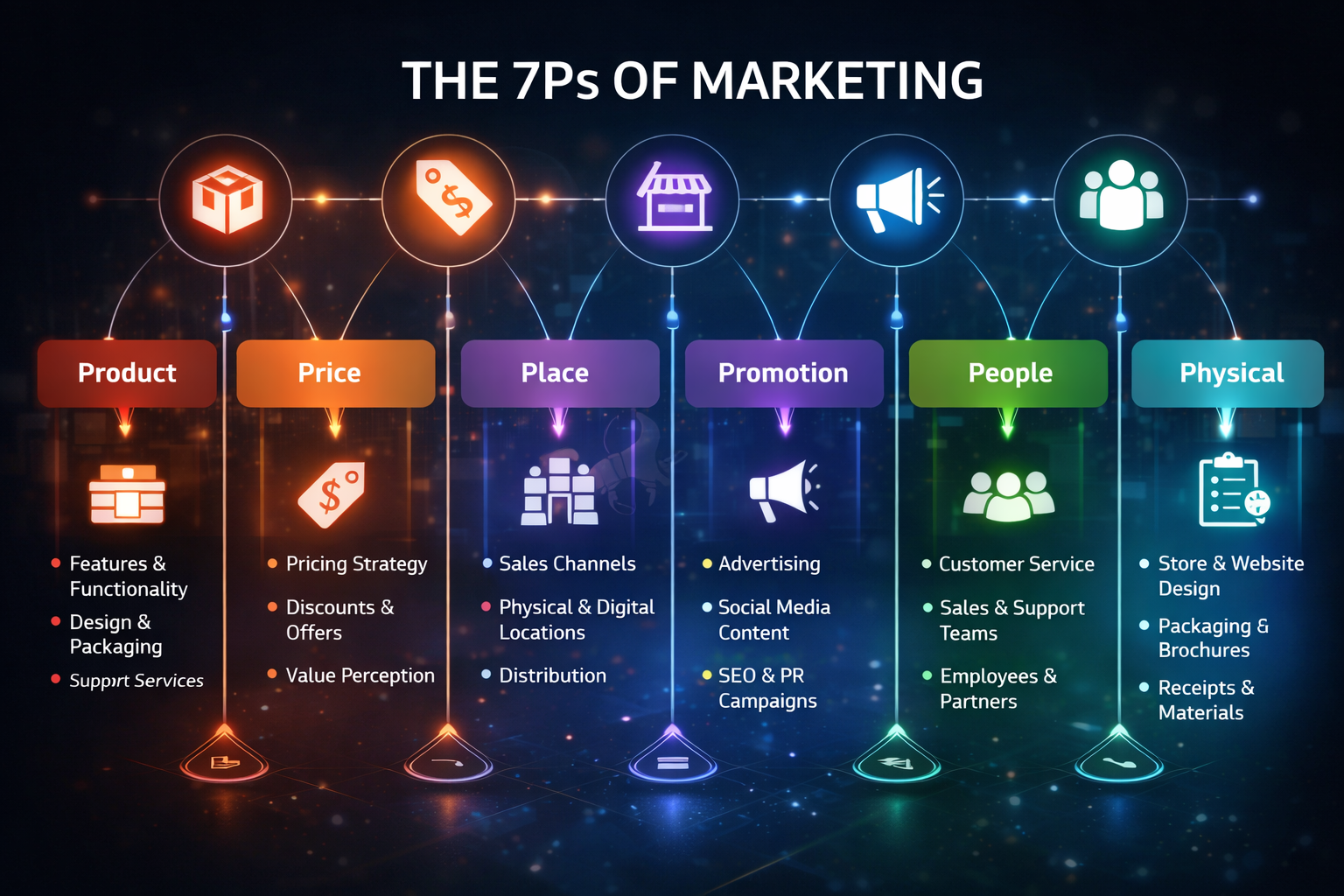
The classic 4Ps (Product, Price, Place, Promotion) have evolved into 7Ps to reflect modern service and experience‑driven businesses. Think of them as levers you can adjust to design a winning strategy.
The 7Ps are:
-
Product
-
Price
-
Place
-
Promotion
-
People
-
Process
-
Physical Evidence
Let’s walk through each one.
1. Product Strategy in Marketing Fundamentals
Your product isn’t just “what you sell.” It’s the full experience and outcome your customer gets.
Consider:
-
Features and functionality
-
Design, quality, and packaging
-
Onboarding, support, and after‑sales service
Ask yourself:
-
What problem does this solve?
-
Why is it better (or different) than alternatives?
-
How does it make the customer’s life easier, better, or more enjoyable?
If the product doesn’t deliver, no amount of marketing can save it in the long run.
2. Price: The Story Your Number Tells
Price is more than a figure on a tag—it signals value, positioning, and quality.
A smart pricing strategy:
-
Covers your costs and generates profit
-
Aligns with your brand (premium, mid‑range, budget, penetration, etc.)
-
Uses tactics like discounts, bundles, or limited offers thoughtfully—not desperately
Ask:
-
Does this price match the perceived value?
-
What does it say about the quality and target audience?
-
Are we using pricing as a lever (e.g., entry offers) or as a crutch?
Price should feel fair to customers and sustainable for the business.
3. Place: Where and How Customers Buy
“Place” is how your product reaches the customer—both physically and digitally.
This includes:
-
Retail stores, outlets, distributors
-
E‑commerce websites, marketplaces, social commerce
-
Warehouses and logistics setups that affect availability and delivery speed
Your goal is simple: make it as easy as possible for your ideal customer to access and purchase your offer, where they already are.
4. Promotion: How You Tell Your Story
Promotion covers every way you communicate with your audience:
-
Ads (online and offline)
-
Social media content
-
Email campaigns
-
PR, events, influencer partnerships
-
Content marketing and SEO
Done right, promotion should:
-
Grab the right people’s attention
-
Clearly explain your benefits
-
Nudge people toward taking a next step (sign up, buy, book, ask, follow)
The key is consistency—across channels, messages, and tone.
5. People: The Human Side of Your Brand
People are everyone who represents your brand and touches the customer experience:
-
Sales reps
-
Customer support teams
-
Store staff
-
Account managers
-
Brand ambassadors and even partners
Their behavior shapes how your brand feels.
Invest in:
-
Training (product knowledge, communication, empathy)
-
Culture (values that show up in daily interactions)
-
Motivation (so they care about more than just hitting targets)
In many industries, people are the main reason customers stay—or leave.
6. Process: How Everything Actually Works
Process is the “how” behind delivery:
-
How customers discover you
-
How they sign up, buy, or book
-
How you handle orders, support, returns, and follow‑ups
Smooth, well‑designed processes:
-
Reduce errors and frustration
-
Save time for both your team and your customers
-
Create a consistent experience that builds trust
Every friction point (slow site, confusing sign‑up, unclear emails) quietly kills conversions. Tight processes quietly boost them.
7. Physical Evidence: Tangible Proof You’re Legit
Physical evidence is everything the customer can see, touch, or experience that reinforces your brand:
-
Packaging, brochures, business cards
-
Store layout, signage, décor
-
Website design, UI/UX, app interface
-
Receipts, emails, documentation
Even for digital businesses, visuals and touchpoints matter. They help answer: “Does this feel professional? Can I trust them?”
Thoughtful design and consistent branding turn small details into confidence boosters.
Types of Marketing: Manual vs Digital
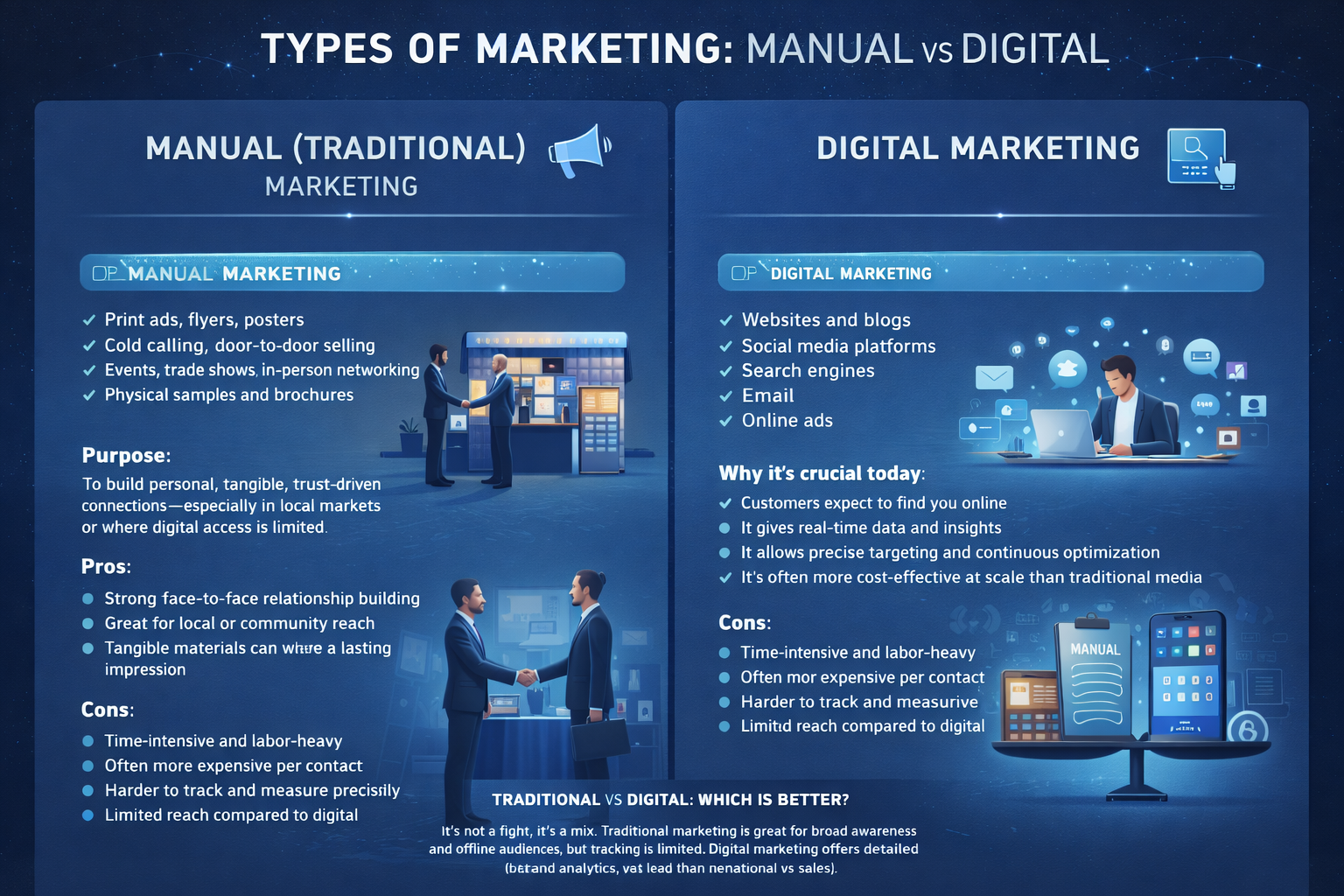
Marketing today lives in two main worlds: offline (manual) and online (digital). Both can play powerful roles if used intentionally.
Manual (Traditional) Marketing
Manual marketing includes:
-
Print ads, flyers, posters
-
Cold calling, door‑to‑door selling
-
Events, trade shows, in‑person networking
-
Physical samples and brochures
Purpose:
To build personal, tangible, trust‑driven connections—especially in local markets or where digital access is limited.
Pros:
-
Strong face‑to‑face relationship building
-
Great for local or community reach
-
Tangible materials can leave a lasting impression
Cons:
-
Time‑intensive and labor‑heavy
-
Often more expensive per contact
-
Harder to track and measure precisely
-
Limited reach compared to digital
Digital Marketing
Digital marketing promotes your brand through online channels:
-
Websites and blogs
-
Social media platforms
-
Search engines
-
Email
-
Online ads
Why it’s crucial today:
-
Customers expect to find you online
-
It gives real‑time data and insights
-
It allows precise targeting and continuous optimization
-
It’s often more cost‑effective at scale than traditional media
Digital isn’t just “another channel.” For many brands, it’s the backbone of their growth engine.
Traditional vs Digital: Which Is Better?
It’s not a fight, it’s a mix.
-
Traditional marketing is great for broad awareness and offline audiences, but tracking is limited.
-
Digital marketing offers detailed analytics, fast experimentation, and targeted reach.
The best strategies blend both based on:
-
Who your audience is
-
Where they spend their time
-
What you’re trying to achieve (brand awareness vs lead generation vs sales)
Core Components of Digital Marketing Fundamentals
Let’s break down the main pillars that form a strong digital Marketing Fundamentals strategy.
Search Engine Optimization (SEO)
SEO is about making your website easy for search engines to understand and rank—so your ideal customers find you when they search.
Benefits:
-
Increases organic (unpaid) traffic
-
Builds authority and trust over time
-
Delivers long‑term growth without constant ad spend
Best practices:
-
Do keyword research to know what your audience actually searches
-
Optimize meta titles, descriptions, headings, URLs, and internal links
-
Publish genuinely helpful content that matches user intent
-
Keep your site technically healthy (speed, mobile‑friendliness, clean structure)
Content Marketing Fundamentals
Content marketing means creating valuable content that attracts and nurtures your audience—articles, videos, guides, podcasts, infographics, etc.
Benefits:
-
Educates and warms up potential customers
-
Positions your brand as a helpful expert
-
Fuels SEO, social media, and email campaigns
Best practices:
-
Focus on solving real problems, not just selling
-
Maintain consistency in tone, format, and publishing frequency
-
Use analytics to see what resonates and double down on it
Social Media Marketing Fundamentals
This is how you show up where your audience scrolls every day.
Benefits:
-
Builds awareness and community
-
Lets you interact with customers in real time
-
Supports paid campaigns with organic content
Best practices:
-
Prioritize platforms your ideal customers actually use
-
Share a mix of value: education, entertainment, storytelling, offers
-
Reply, engage, and listen—not just broadcast
-
Track metrics like reach, saves, clicks, and conversions, not just likes
Email Marketing
Email is still one of the most powerful direct channels you own.
Benefits:
-
High ROI when done well
-
Great for nurturing relationships and driving repeat business
-
Highly personalizable based on user behavior
Best practices:
-
Segment your list (new leads, buyers, high‑value customers, etc.)
-
Use clear, honest subject lines and strong calls‑to‑action
-
Test send times, formats, and messaging regularly
-
Focus on value first; promotions second
Pay Per Click (PPC) Advertising
PPC is paid ads (like search ads) where you’re charged when someone clicks.
Benefits:
-
Immediate visibility and traffic
-
Laser targeting by keywords, demographics, interests, and behavior
-
Easy to measure performance and ROI
Best practices:
-
Do deep keyword and audience research
-
Write compelling ad copy that matches user intent
-
Design focused, relevant landing pages
-
Monitor and optimize bids, ads, and keywords continuously
Affiliate & Influencer Marketing
Here, you partner with others who already have your ideal audience’s attention.
Benefits:
-
Access to new, engaged communities
-
Uses trusted voices to recommend your brand
-
Often performance‑based (you pay for results, not just exposure)
Best practices:
-
Choose partners aligned with your brand values and audience
-
Track clicks, conversions, and revenue from each partner
-
Focus on long‑term relationships, not one‑off posts
Mobile Marketing
Mobile marketing targets users on their phones—apps, SMS, push notifications, mobile web.
Benefits:
-
Reaches people on the go
-
Enables personalization and location‑based messaging
-
Supports fast actions (tap to buy, tap to call, tap to download)
Best practices:
-
Make your site and emails fully mobile‑friendly
-
Design short, clear messages for small screens
-
Use push and SMS sparingly and thoughtfully to avoid being intrusive
Must-Read Books for Marketers
A few classic books can change the way you think about marketing:
-
Influence: The Psychology of Persuasion – Robert Cialdini
Explores why people say “yes” and how principles like social proof and authority shape decisions. -
Contagious: How to Build Word of Mouth in the Digital Age – Jonah Berger
Breaks down what makes ideas and products spread and how to design campaigns with built‑in virality. -
This Is Marketing – Seth Godin
Shifts your focus from shouting at everyone to serving a specific group deeply, using empathy and storytelling.
These aren’t just theory—they’re mental models you can apply across channels and trends.
Digital Marketing Strategy: Step by Step
A powerful strategy doesn’t appear out of nowhere. It’s built deliberately.
Key steps:
-
Set SMART goals
Specific, Measurable, Achievable, Relevant, Time‑bound.
Example: “Increase organic traffic by 20% in 6 months” or “Get 500 qualified leads in a quarter.” -
Define your target audience and buyer personas
Know who you’re talking to, what they care about, and how they make decisions. -
Analyze competitors and market trends
Understand what’s already working in your space—and where there’s room to stand out. -
Craft a strong value proposition and messaging
Clearly answer: “Why you?” and “Why now?” in language your audience actually uses. -
Choose your marketing channels
Double down on where your audience is and where you can execute well. -
Plan execution and responsibilities
Who does what, by when, with what resources? Put it on a calendar, not just in your head. -
Monitor, measure, and optimize
Track KPIs, test variations, and refine based on data.
When each step supports the next, your strategy becomes a roadmap instead of a random checklist.
Trends Shaping Digital Marketing Right Now
Fundamentals stay the same—but the tools and expectations evolve.
Key trends:
-
AI & Automation
Helps with content creation, ad optimization, chatbots, and predictive analytics. Used wisely, it boosts efficiency and personalization. -
Personalization
Users expect content, offers, and experiences tailored to their behavior and preferences, not one‑size‑fits‑all blasts. -
Video & Short‑Form Content
Short, snackable videos dominate attention on platforms like Reels, TikTok, Shorts. Brands use them for storytelling, education, and product demos. -
Voice Search & Conversational Marketing
More people search via voice and interact with chatbots, DMs, and live chat. Optimizing for natural language and quick responses is increasingly important.
Common Marketing Strategy Mistakes to Avoid
Even good intentions can go wrong if you ignore the basics.
Watch out for:
-
Skipping market research
Planning based on opinions instead of data leads to poor targeting and weak messaging. -
Ignoring customer feedback
Complaints, reviews, and suggestions are gold. Ignoring them means building in the dark. -
Chasing only short‑term wins
Discount‑heavy or “viral at any cost” tactics can damage long‑term brand value and loyalty. -
Fragmented efforts
Running random campaigns without a unifying strategy wastes budget and confuses your audience.
Creating Long-Term Growth From Fundamentals
When you respect the fundamentals—knowing your market, leveraging the 7Ps, and using digital tools strategically—you build a marketing system that compounds over time.
-
Your messaging gets sharper.
-
Your targeting becomes more precise.
-
Your processes become smoother.
-
Your brand trust grows with every interaction.
This is how you move from “trying campaigns” to running a machine that consistently generates leads, sales, and loyalty.
Conclusion
Marketing fundamentals are not “old school”—they’re the backbone of every smart, modern strategy. Understanding your audience, shaping a strong offer, and using the 7Ps of marketing thoughtfully gives you a clear structure to grow any brand. Digital channels, AI, and new trends are powerful amplifiers, but they can’t replace the basics. Brands that master Marketing Fundamentals consistently outperform those chasing short-term tactics.
When you blend timeless principles with modern tools, you don’t just chase attention—you build trust, authority, and long‑term momentum. That’s how campaigns turn into systems, and systems turn into sustainable growth. If you feel overwhelmed by tactics—new platforms, new formats, new hacks—step back and ask a few simple questions: Who am I serving? What value am I offering? Why should they choose me? How do I communicate that clearly and consistently?
Every time you get stuck, return to those questions. They’ll keep your strategy grounded, your experiments focused, and your efforts aligned with real business outcomes. Trends will keep changing, algorithms will keep shifting, but brands built on strong Marketing Fundamentals will always find a way to win.