

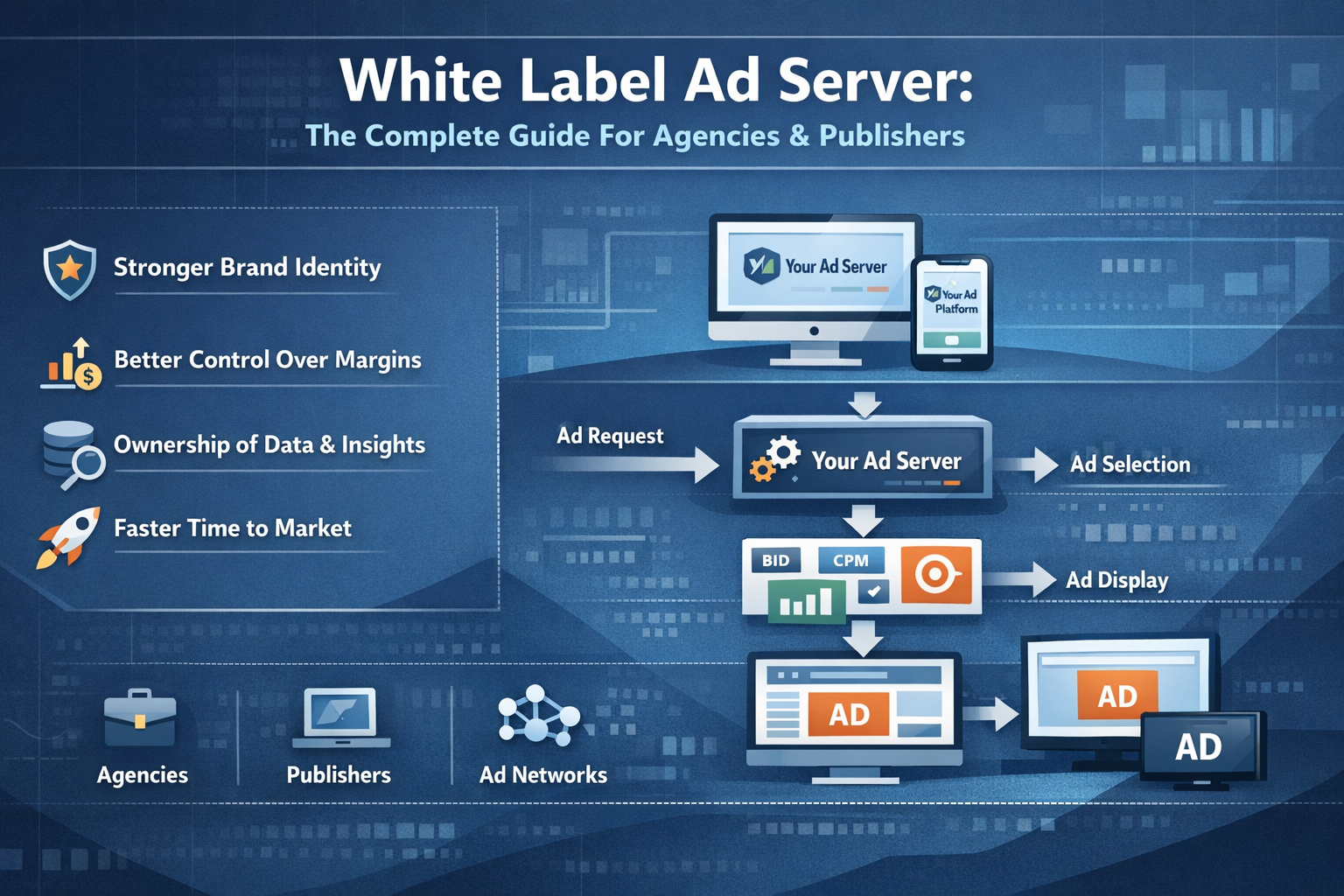
The digital ad world is noisy, competitive, and constantly shifting. New privacy rules, fresh formats, rising CPMs—if you work in this space, you know it can feel like trying to build a skyscraper on moving sand. In the middle of all that, one concept keeps coming up for agencies and publishers that want more control: the white label ad server.
Instead of sending your precious traffic through someone else’s platform and brand, a white label ad server lets you run your own ad technology under your own name. You control the look, the data, the setup, and a big piece of the revenue stack. Think of it as owning the engine room of your ad business rather than renting a seat on somebody else’s ship.
What Exactly Is A White Label Ad Server?
A white label ad server is a ready‑made ad‑serving platform that you can fully brand and operate as if you built it yourself. Under the hood, it is a proven, maintained piece of ad tech. On the surface, everything your clients and partners see—logos, colours, domains, dashboards—carries your brand, not the vendor’s.
In practice, this means:
-
Your teams and clients log in via your domain, with your brand identity.
-
You configure ad placements, targeting, pacing, and reporting from a central dashboard.
-
You can present the platform as “your own” solution when pitching to advertisers or publishers.
Imagine buying a high‑performance car chassis and drive train, then adding your own bodywork, interior, and branding. The engineering is solid, but the vehicle looks and feels uniquely yours.
Why Not Just Build Your Own Ad Server?
Building an ad server from scratch sounds glamorous—until you start doing the maths. You would need engineers who understand real‑time bidding, latency, caching, creative handling, fraud prevention, and more. Then there is maintenance, privacy compliance, and constant updates every time browsers or regulations change.
To build your own, you are taking on:
-
Long development cycles and high upfront cost.
-
Ongoing dev and DevOps just to stay functional and compliant.
-
The risk that, after all that time and money, the platform still lags behind competitors.
A white label ad server shortcuts this. You license a mature engine, then focus your energy where you add the most value: sales, strategy, relationships, and optimisation. You are not reinventing the wheel—you are putting your own brand rims on a wheel that already spins smoothly.
How A White Label Ad Server Works (In Plain English)
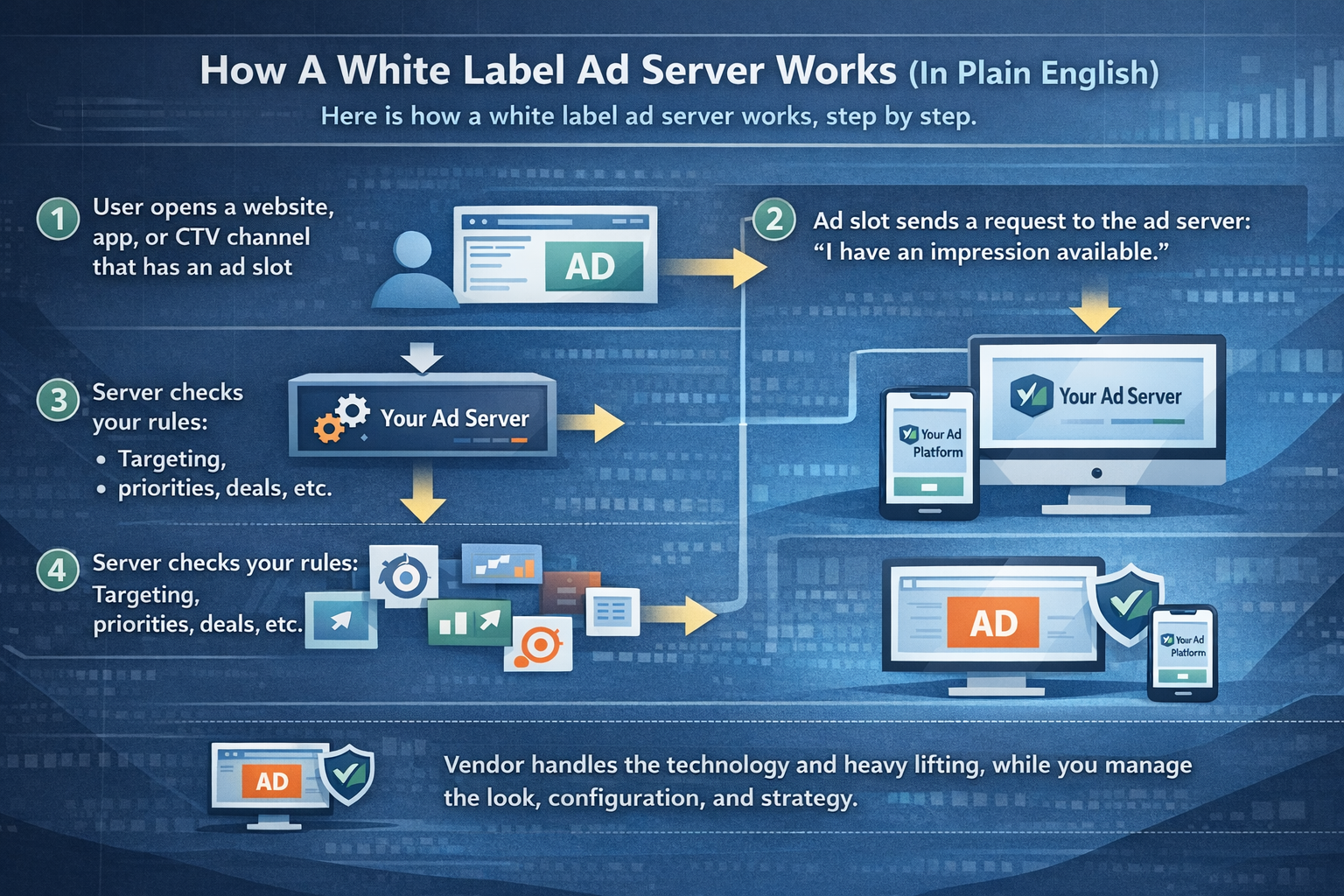
The technology can get complex fast, but the basic flow is easier than it looks. Here is how a white label ad server works, step by step.
-
A user opens a website, app, or CTV channel that has an ad slot.
-
That ad slot sends a request to the ad server: “I have an impression available.”
-
The server checks your rules: targeting, frequency caps, priorities, deals, and any connected demand sources.
-
It selects the best ad based on your logic—maybe highest CPM, maybe direct campaign priority, maybe specific audience criteria.
-
The creative is delivered to the user almost instantly, and the impression is tracked for reporting and billing.
From your client’s perspective, all of this happens on your platform. From your perspective, the vendor handles the heavy technical lifting while you handle configuration and strategy.
Who Typically Uses White Label Ad Servers?
White label ad servers are not just for giant networks; they are useful for a range of players in the ad ecosystem.
-
Digital marketing agencies
Agencies that manage campaigns for multiple clients can offer their own “platform” rather than just being a buyer using someone else’s tools. -
Publishers and media houses
Publishers with websites, apps, or streaming channels use white label ad servers to manage direct and programmatic demand in one place. -
Ad networks and SSP‑style businesses
Companies that aggregate inventory from many publishers can use a white label ad server as their core delivery and reporting engine. -
SaaS and MarTech platforms
Some marketing platforms embed white label ad serving so they can offer built‑in media buying capabilities under their own brand.
If your business depends on selling, managing, or optimising ad inventory, a white label ad server can become the central nervous system of your operation.
Key Features To Look For In A White Label Ad Server
Not all platforms are equal, and the features you choose will shape your daily workflow. When you evaluate options, pay close attention to these areas.
Full Branding Control
You should be able to use your own domain (e.g., ads.yourbrand.com), logo, colour scheme, and potentially even custom login pages. The more control you have over the UI and emails, the stronger your brand presence.
Flexible Targeting And Rules
Look for granular targeting: geo, device, OS, browser, time of day, frequency caps, and custom segments. You want to be able to define who sees what and when with precision.
Multi‑Format Support
A modern ad server should handle display, video (in‑stream, out‑stream), native, in‑app, and increasingly CTV/OTT formats. If you are expanding, DOOH or audio support may also matter.
Programmatic Connectivity
If part of your plan involves RTB, header bidding, or external SSPs and DSPs, check whether the white label solution supports OpenRTB, pre‑bid setups, or direct integrations.
Reporting And APIs
Detailed, near real‑time reporting is critical for optimisation and client transparency. RESTful APIs for data access and automation let you plug analytics into your own dashboards and BI tools.
User Management And Multi‑Tenant Architecture
If you serve multiple advertisers or publishers, you will need role‑based access control, separate accounts, and clean data segmentation so each partner sees only their own numbers.
Core Benefits Of A White Label Ad Server
So, what is the actual payoff? Why do agencies and publishers bother switching to a white label setup instead of continuing with off‑the‑shelf solutions?
- Stronger Brand Identity
When clients log into a platform covered in someone else’s branding, they see you as a user, not a provider. With a white label ad server, the opposite happens: your brand is front and centre, which strengthens trust and positions you as a serious tech‑enabled partner.
- Better Control Over Margins
Many third‑party platforms take a cut or lock you into rigid pricing. With a white label engine, you can set up your own fees, mark‑ups, and tiers, giving you direct control over how you price your services and grow your margins.
- Ownership Of Data And Insights
Instead of relying entirely on external reports, you get direct access to performance data and often more granular logs. That can help you refine your strategies and protect long‑term relationships, subject to privacy laws and contracts.
- Faster Time‑To‑Market
Launching a new ad product, network, or managed service can be done in weeks instead of the months or years required to build bespoke tech. That speed can be the difference between leading and playing catch‑up.
- Scalability Without Reinventing The Wheel
As you bring on more clients or publishers, you scale by configuration, not by hiring a new engineering squad. The vendor handles infrastructure, while you grow the business.
Common Use Cases: Real‑World Scenarios
To make it less abstract, consider a few typical scenarios where a white label ad server shines.
-
Performance‑Focused Agency
You run campaigns across multiple channels for dozens of clients. A white label ad server becomes the single platform where you manage creatives, targeting, and reporting, all under your brand. -
Niche Publisher Network
You own or manage several niche sites—sports, finance, lifestyle—and sell bundled inventory to advertisers. The ad server centralises delivery, frequency caps, and yield across your whole portfolio. -
Emerging Ad Network In A Specific Region
You aggregate local publishers and sell region‑specific packages. The white label engine powers your auctions, delivery, and stats while you focus on relationships and sales. -
MarTech Platform Adding Media Buying
You already offer analytics or CRM, and now want to add integrated media buying as a new revenue stream. White label ad serving lets you bolt that on quickly.
In each case, the ad server is not the product you market to end consumers; it is the infrastructure that lets you offer a polished, scalable service.
Challenges And Limitations You Should Expect
No solution is perfect. Before you sign anything, be aware of the challenges that come with adopting a white label ad server.
Learning Curve For Your Team
Your strategists and ops teams will need time to understand a new interface, new terminology, and new workflows. Training and documentation become essential.
Responsibility For Configuration
Even though you are not coding the platform, you are fully responsible for how it is configured: line items, priorities, floors, demand partners, tracking. A misconfigured setup can burn budget or leave revenue on the table.
Support Expectations From Clients
Once you present a platform as your own, clients see you as the first line of support. You need clear processes for handling issues, even if the underlying cause is vendor‑side.
Ongoing Optimisation
An ad server is not “set and forget.” Someone on your side must monitor fill rates, latency, CPMs, and campaign pacing to keep performance on track.
If you go in expecting a plug‑and‑play miracle, you will be disappointed. If you treat it as serious infrastructure that enables a stronger business model, the payoff can be substantial.
How To Choose The Right White Label Ad Server
Picking a white label partner is closer to choosing a long‑term strategic ally than buying a simple tool. Here is a practical way to approach the decision.
Clarify Your Model And Goals
Are you mainly an agency, a publisher, an ad network, or a SaaS platform? Do you care more about direct deals, programmatic, or a mix? Write this down before you even book demos.
Define Must‑Haves vs Nice‑To‑Haves
List the formats you need, the integrations you rely on, reporting depth, UI customisation, and data export requirements. Decide which are non‑negotiable.
Ask For Realistic Demos
Do not settle for generic presentations. Ask vendors to walk through scenarios based on your actual use cases: specific campaign types, inventory structures, or partner setups.
Check Support, SLAs, And Roadmaps
Good documentation, responsive support, clear uptime SLAs, and a transparent product roadmap are signs that you are dealing with a serious long‑term partner.
Think Two Years Ahead
Ask yourself, “If we double in size, will this still work?” Look for scalability in both technology and commercial terms so you are not forced to migrate again too soon.
Steps To Implement A White Label Ad Server Successfully
Once you choose a platform, treat rollout like a phased product launch, not a simple switch.
-
Audit Your Current Setup
Map all your current ad sources, placements, and reporting flows. Identify bottlenecks and pain points. -
Design Your New Architecture
Decide how advertisers, campaigns, placements, and publishers will be structured in the new platform. -
Start With A Pilot Group
Onboard a few internal projects or friendly clients first. Use this phase to refine workflows, documentation, and training. -
Train Your Internal Teams
Run sessions for ad ops, account managers, and sales so they understand how to use, explain, and sell the new platform. -
Roll Out Gradually
Once you are confident, migrate more campaigns and clients, keeping an eye on performance and feedback.
A careful rollout reduces risk and gives you time to adapt without putting your entire business at stake.
Conclusion
A white label ad server gives agencies, publishers, and ad networks a powerful way to own their ad tech stack without spending years building it from scratch. You get your brand on the front, a proven engine under the hood, and far more control over data, margins, and client experience. It is not a magic switch—you still need smart strategy, good creatives, and skilled people—but it can be the backbone of a more scalable, more profitable ad business.
So, what should you do now? Start by identifying the biggest pain point in your current setup—maybe scattered tracking, limited control over margins, or having to juggle multiple third‑party platforms. Then, talk with your team about what your “ideal” platform would look like. Use that list as your filter when you speak to white label vendors. The right ad server is not just the one with the most features; it is the one that makes your day‑to‑day work smoother, your results stronger, and your brand look like the one in control.


