

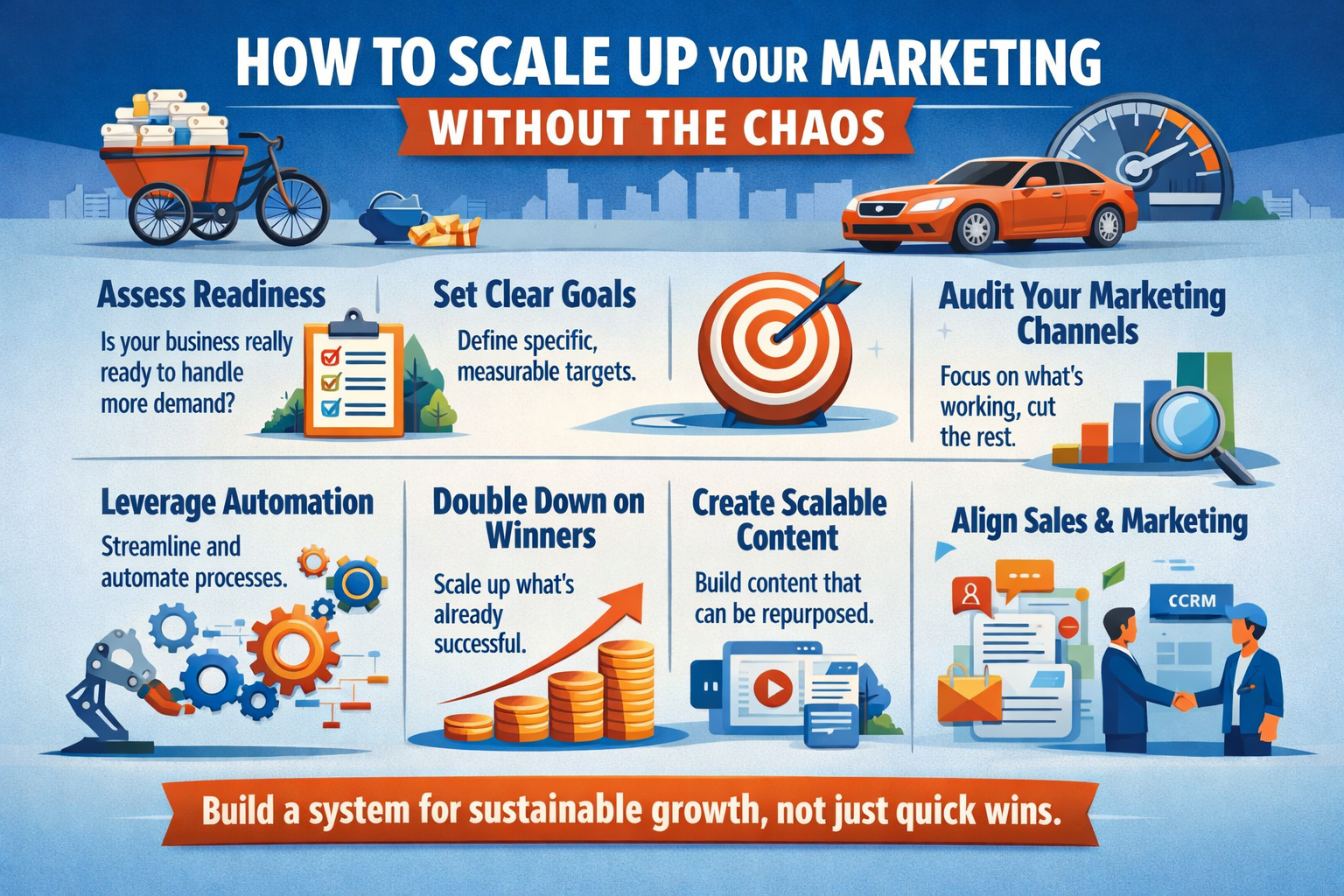
scale up marketing, When people say they want to “scale up marketing,” they usually mean one thing: more leads, more customers, and more revenue. But here’s the twist—if you only crank up volume without fixing your systems, you won’t scale, you’ll just create chaos. Think overflowing inboxes, stressed teams, annoyed customers, and money leaking out of every gap.
To truly scale up marketing, you don’t just “do more.” You build a machine that can handle more traffic, more leads, and more campaigns without falling apart. In this article, we’ll walk through how to grow your marketing in a controlled, profitable, and sustainable way—like upgrading from a scooter to a well‑tuned car, not just hitting the accelerator on a bicycle.
Understand If You’re Ready To Scale
Before you talk about scaling, you need to ask a hard question: are you actually ready for more demand?
Here’s a quick readiness check:
-
Do you already have an offer that sells consistently?
-
Do at least one or two channels already bring you leads or sales?
-
Can your operations actually handle more customers right now?
-
Do you know your basic numbers like conversion rate, customer acquisition cost (CAC), and lifetime value (LTV)?
If the honest answer is “no” to most of these, scaling up marketing is like pouring water into a bucket full of holes. You don’t need more water—you need to fix the bucket. That means tightening your offer, clarifying your positioning, and making sure your backend (delivery, support, fulfillment) won’t collapse if you double your customer base.
Set Clear Goals Before You Touch Your Budget
Scaling without goals is just expensive guessing. If you don’t know what “success” looks like, you’ll always feel like you’re not doing enough.
Ask yourself:
-
Do I want more leads or more qualified leads?
-
Is my primary goal revenue growth, profitability, or market share?
-
How fast do I actually need to grow—and can my team handle that pace?
Turn vague wishes into specific targets, like:
-
“Increase qualified leads by 40% in the next 90 days.”
-
“Maintain CAC at or below 30% of LTV while doubling ad spend.”
-
“Grow website traffic by 50% in 6 months from organic channels.”
These goals become your compass. Every time you consider a new campaign, tool, or channel, you can ask: does this move us toward these targets or just look impressive in a report?
Know Your Ideal Customer Better Than They Know Themselves
You can’t scale up marketing if you still don’t know exactly who you’re talking to. When your customer profile is fuzzy, everything else is a gamble—your messaging, your creatives, your offers, your channel choices.
Start by sharpening your ideal customer profile:
-
Who are they? (job title, industry, income, age, location)
-
What are they trying to achieve? (goals, desires, ambitions)
-
What’s keeping them stuck? (pain points, fears, frustrations)
-
Where do they spend their time? (social platforms, communities, events)
-
How do they make decisions? (quick impulse, slow research, committee buy)
Imagine you’re tuning a radio. If you’re off‑frequency by even a little, all your audience hears is static. But when you dial into their exact frequency, your ads, emails, and landing pages suddenly feel like they were written just for them—and that’s when scaling becomes much easier.
Audit Your Current Marketing Engine Before You Add Fuel
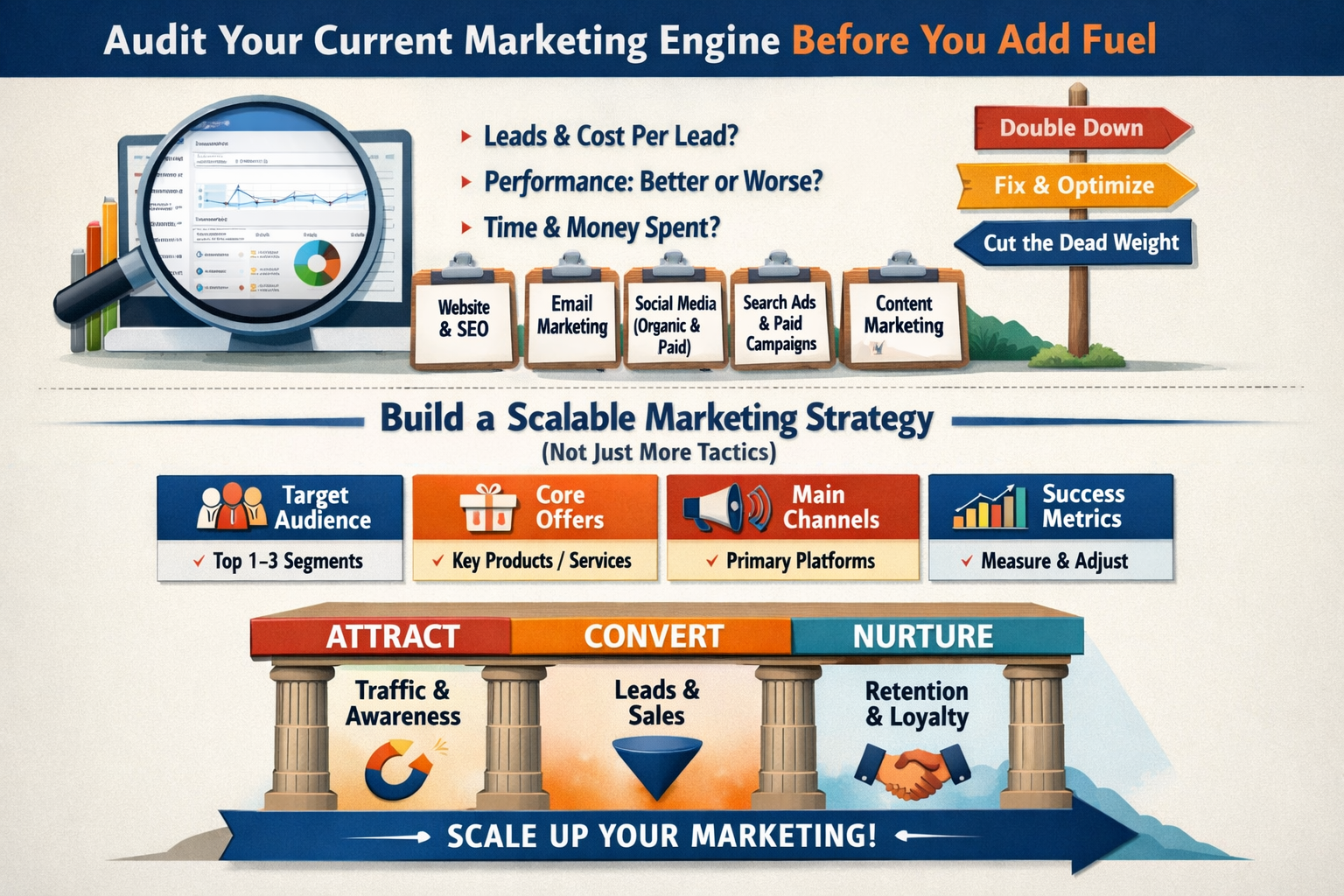
Scaling is not about starting from scratch; it’s about amplifying what already works. So, before you push more money and effort into marketing, you need an honest audit.
Look at every channel you’re using right now:
-
Website & SEO
-
Email marketing
-
Social media (organic and paid)
-
Search ads and other paid campaigns
-
Content marketing (blogs, videos, webinars, podcasts)
-
Referrals, affiliates, and partnerships
For each one, ask:
-
How many leads or sales does this channel generate?
-
What’s the cost per lead and cost per sale?
-
Is performance getting better, staying flat, or declining?
-
How much time and money does this channel consume?
Your goal isn’t to scale everything. It’s to identify the winners and double down on them, fix the “almost there” channels, and cut the dead weight. Scaling up is as much about focus as it is about growth.
Build A Scalable Marketing Strategy (Not Just More Tactics)
A lot of businesses confuse tactics with strategy. Posting more on social, launching another ad set, or sending more emails are tactics. A strategy is the big picture that connects all of them.
A scalable marketing strategy should clearly define:
-
Who you’re targeting (top 1–3 segments, not “everyone”)
-
What core offers you’re actively promoting
-
Which main channels will carry most of the load
-
What type of content and messages you’ll consistently use
-
How you’ll measure success and adjust over time
You can think of your marketing system as three pillars:
-
Attract – bring the right people into your world (traffic, awareness).
-
Convert – turn attention into leads and customers.
-
Nurture – deepen relationships so customers buy again, upgrade, and refer.
Scaling up means reinforcing all three pillars. If you only pump more traffic into a weak converting funnel, you’ll pay more and still feel stuck.
Double Down On What Already Works
The safest, fastest way to scale is boring but powerful: do more of what’s already working.
If your email list brings in sales every time you launch something, scaling might mean:
-
Growing your list faster with lead magnets and opt‑ins.
-
Sending more consistent and strategic campaigns.
paid ads are profitable at a small spend, scaling might look like:
-
Increasing your budget gradually while monitoring CAC.
-
Testing new creative angles, audiences, and offers.
If SEO is working, you might:
-
Publish more high-quality content targeting related keywords.
-
Improve internal linking and user experience to boost rankings.
Before you jump on the latest platform or trend, ask yourself: have I fully squeezed the juice out of the channels that are already working? Most of the time, the answer is no—and that’s your low‑risk scaling opportunity.
Create Content That Can Scale With You
Content isn’t just something you “do on the side.” If you want to scale up marketing, content becomes a core engine. The beauty of content is that it compounds: one strong piece can work for you for months or years.
Focus on content that:
-
Solves real problems your audience actually has.
-
Positions your brand as the expert or trusted guide.
-
Can be reused across multiple mediums and formats.
Think of a single in‑depth guide as a content tree:
-
The trunk is your long, detailed piece (a guide, whitepaper, or webinar).
-
The branches are blog posts, short videos, carousels, email sequences, and social clips that come out of it.
This way, instead of constantly starting from zero, you’re building on strong foundations. That’s what makes content scalable instead of exhausting.
Use Automation So Your Team Doesn’t Melt Down
You cannot scale if everything in your marketing is manual. At some point, your team will hit a wall—and when they do, quality drops, customers feel it, and growth stalls.
Automation doesn’t mean replacing humans; it means letting software handle repetition so humans can focus on strategy, creativity, and relationships.
You can automate:
-
Email sequences (welcome series, nurture flows, post‑purchase follow‑ups).
-
Lead scoring (identifying which leads are hot and sending them to sales).
-
Lead routing and notifications (who should contact whom, and when).
-
Basic chat, FAQs, and simple support queries.
Good automation feels like a smooth conveyor belt behind the scenes: leads come in, get nurtured, and are moved forward without constant manual pushing.
Align Sales And Marketing So Scaling Doesn’t Backfire
One of the biggest mistakes companies make when scaling up marketing is forgetting about the sales team. If marketing generates more leads but sales can’t handle them—or thinks they’re low quality—you just create frustration.
To avoid that, sales and marketing need to act like a single team, not rivals.
Make sure you:
-
Define what a qualified lead actually is and get everyone to agree.
-
Share feedback: what kind of leads close easily, and which are a waste of time.
-
Align your messaging so prospects don’t hear one story from marketing and another from sales.
-
Use a shared CRM so both teams see the same information.
When sales and marketing are aligned, scaling up doesn’t just mean “more leads.” It means more closed deals, better fit customers, and smoother experiences.
Track The Right Metrics (And Ignore The Vanity Ones)
As you scale up marketing, numbers start flying everywhere: impressions, likes, shares, followers, open rates, click‑throughs. Some of these matter; some just look pretty in screenshots.
The metrics that truly matter for scaling are:
-
CAC (Customer Acquisition Cost) – how much you spend to acquire a customer.
-
LTV (Lifetime Value) – how much a customer brings in over the relationship.
-
CAC:LTV ratio – the balance between what you spend and what you earn.
-
Conversion rates at key steps (visitor to lead, lead to customer).
-
Churn and retention – how long customers stay and how often they buy.
If a channel gives you cheap clicks but almost no customers, it’s not a great scaling channel. On the other hand, even if a channel looks “expensive” at first glance, it might be perfect if those customers stick around and buy repeatedly.
Test, Learn, And Iterate As You Grow
scale up marketing isn’t a straight highway; it’s more like a staircase. You test an idea, stabilize at a new level, then climb again.
To do this well, you need a culture of experimentation:
-
A/B test headlines, images, offers, and landing page layouts.
-
Try different value propositions, pricing packages, and bonuses.
-
Explore new audiences or retargeting strategies on your best platforms.
The key is to run controlled tests, not random experiments. Change one core element at a time so you know what caused the result. Over months, these small optimizations stack up into big gains.
Avoid Common Pitfalls When Scaling Up Marketing
Scaling sounds exciting, but it comes with traps that catch a lot of brands:
-
Scaling a broken funnel – driving more traffic to pages that don’t convert.
-
Overcomplicating everything – adding tools, platforms, and processes faster than your team can learn them.
-
Chasing every new trend – jumping from channel to channel before you master any.
-
Ignoring the customer experience – slower support, delayed delivery, and weak onboarding as volume increases.
-
Refusing to hire or delegate – expecting a small team to handle big‑brand volume.
Healthy scaling should feel like controlled acceleration, not a car shaking at high speed. Whenever growth feels out of control, that’s a signal to improve systems instead of pushing harder.
Build A Team That Can Support Scaled Marketing
At a certain level, you simply can’t scale alone. You need people who can own and grow pieces of the marketing machine.
Some roles you might need as you scale:
-
A marketing lead or strategist to connect the dots.
-
Performance marketers to manage paid campaigns.
-
Content creators and copywriters to fuel your channels.
-
A marketing ops or automation specialist to keep the tech running smoothly.
-
Designers and video editors to keep your brand looking sharp.
You don’t have to hire everyone at once. You can start with freelancers or agencies, then build in‑house as you grow. The important part is that tasks don’t stay permanently stuck on one overwhelmed founder or manager.
Conclusion
Scaling up marketing is not about shouting louder, posting more, or spending wildly. It’s about building a system that can handle increased attention and demand without breaking. You clarify your goals, understand your audience deeply, double down on proven channels, create reusable content, and support the engine with automation, data, and the right people.
Done right, scaling doesn’t feel like chaos—it feels like momentum. Campaigns become easier to repeat, numbers become more predictable, and marketing turns from a gamble into a reliable growth lever for your business.

