
Video marketing has changed dramatically in recent years. Artificial intelligence can now generate scripts, voiceovers, avatars, animations, captions, and even complete videos within minutes. At the same time, human-created videos continue to dominate areas where authenticity, personality, storytelling, and emotional connection matter.
This raises an important question for creators and marketers: AI vs human video—which performs better in 2026?
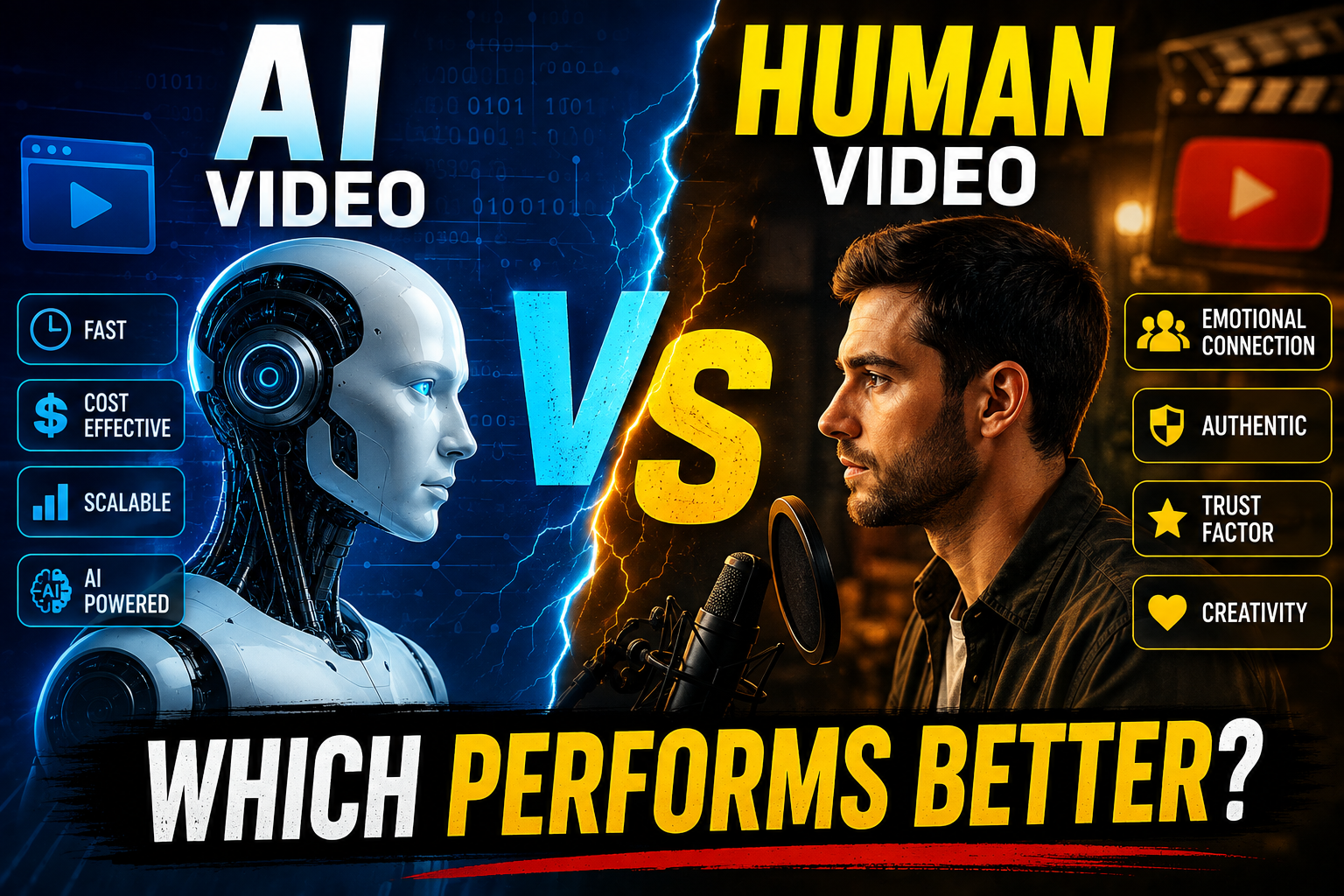
The answer is not as simple as choosing one over the other. AI videos are excellent for speed, scalability, automation, and production efficiency, while human videos often perform better when trust, personality, and emotional storytelling are the priority.
The best strategy in 2026 is increasingly a combination of AI efficiency and human creativity.
What Is AI Video?
AI video refers to content created or assisted by artificial intelligence tools. These tools can generate scripts, images, video clips, voiceovers, subtitles, animations, avatars, and complete video sequences.
For example, a marketer can provide an AI tool with a topic such as “Best Video Marketing Strategies for 2026,” and the software can help create a script, select visuals, generate narration, and produce a finished video.
AI video is particularly useful for:
- YouTube Shorts
- Instagram Reels
- TikTok-style videos
- Product demonstrations
- Educational content
- Explainer videos
- Social media advertisements
- Faceless YouTube channels
- Marketing presentations
The biggest advantage is speed. A process that might take hours or days manually can often be completed much faster with AI assistance.
What Is Human-Created Video?
Human-created video is produced primarily by people, including creators, presenters, videographers, editors, writers, and marketers.
This could include a YouTuber explaining a topic on camera, a brand founder telling their story, a customer testimonial, a product review, or a professionally filmed advertisement.
Human videos have a major advantage: authenticity.
Viewers can see a person’s expressions, body language, personality, and emotions. These elements can make content feel more relatable and trustworthy.
Human-created videos are especially powerful for:
- Personal brands
- Influencer marketing
- Customer testimonials
- Interviews
- Product reviews
- Storytelling
- Brand-building campaigns
- Educational content requiring personal expertise
AI vs Human Video: Which Gets More Views?
Views depend on much more than whether a video was created by AI or a person.
The topic, thumbnail, title, hook, audience, retention, editing, platform, and distribution strategy all influence performance.
AI can help creators produce more content and test different hooks quickly. This creates more opportunities to discover content that performs well.
However, simply generating more AI videos does not guarantee more views. Low-quality, repetitive, generic, or poorly edited AI content can struggle to capture attention.
Human videos can also go viral because viewers connect with personalities, opinions, reactions, humor, and real experiences.
Winner for scalability: AI
Winner for personality-driven content: Human
Which Gets Better Engagement?
Engagement includes likes, comments, shares, saves, watch time, and other viewer interactions.
Human videos often have an advantage when the goal is to create a strong emotional response. A genuine reaction, personal story, or expert explanation can encourage viewers to comment and participate.
AI videos can perform extremely well for short educational or informational content, especially when the information is presented clearly and quickly.
The key factor is not simply whether AI or humans created the video. Viewer value matters most.
A useful AI-generated tutorial can outperform a boring human-made video, while an engaging human story can outperform dozens of generic AI videos.
Which Builds More Trust?
When trust is important, human video usually has the advantage.
Imagine two videos reviewing a new smartphone. One uses a generic AI avatar and voiceover. The other features a real technology creator who has personally tested the phone and explains the advantages and disadvantages.
Many viewers will find the second video more credible because it demonstrates personal experience.
This is particularly important for industries such as:
- Finance
- Education
- Technology reviews
- Healthcare information
- Professional services
- Business consulting
- Personal development
For trust-focused marketing, human expertise combined with AI production assistance can be a powerful approach.
Which Is Better for SEO?
AI and human videos can both support SEO when the content is genuinely useful and properly optimized.
Video SEO involves several elements, including:
- Search-focused topics
- Relevant titles
- Strong descriptions
- Keywords
- Captions
- Audience retention
- Engagement
- Helpful content
- Effective thumbnails
AI can make SEO workflows faster. It can help generate keyword ideas, video outlines, descriptions, captions, and content variations.
However, AI-generated content still needs human review. Keyword stuffing, repetitive scripts, misleading titles, and low-value content can damage the overall user experience.
A strong strategy is to use AI for research and optimization, while allowing humans to provide originality, expertise, examples, and opinions.
AI Video vs Human Video for Marketing
For businesses, the choice depends on the marketing objective.
AI is highly useful when a company needs to create large amounts of content. A business could create multiple product videos, localized advertisements, social media clips, and educational videos without producing every asset from scratch.
Human video is more valuable for campaigns where the brand needs to establish emotional connections.
For example, a founder explaining why they created a company can be far more persuasive than an AI-generated avatar reading the same story.
Therefore, marketers should consider the purpose of the video before choosing the production method.
Cost and Production Time
AI has a significant advantage when it comes to production efficiency.
Traditional video production may require:
- Cameras
- Lighting
- Microphones
- Locations
- Actors
- Editors
- Designers
- Multiple production stages
AI can reduce the need for some of these resources.
Creators can generate scripts, voiceovers, graphics, subtitles, and rough edits using AI tools. This can make video production more accessible to small businesses and individual creators.
However, high-quality AI video may still require human editing, fact-checking, creative direction, and quality control.
So the real advantage is not necessarily “AI replaces humans.” It is AI reduces repetitive production work so humans can focus on creative decisions.
The Best Strategy: AI + Human Creativity
Instead of asking whether AI or human video is better, marketers should ask:
Which parts of video production should AI handle, and which parts should humans handle?
A highly effective workflow could look like this:
Step 1: Human Chooses the Idea
Start with audience research and identify a problem, question, trend, or opportunity.
Step 2: AI Helps With Research
Use AI to generate topic variations, outlines, keyword ideas, hooks, and content angles.
Step 3: Human Creates the Core Message
Add personal experience, expertise, opinions, examples, humor, and storytelling.
Step 4: AI Speeds Up Production
AI can assist with captions, voice cleanup, graphics, translations, editing, and content repurposing.
Step 5: Human Reviews Everything
Check facts, tone, visuals, narration, brand consistency, and originality.
Step 6: Test and Improve
Publish the content and monitor retention, engagement, clicks, and conversions. Then use the results to improve future videos.
This hybrid approach combines the strengths of both sides.
AI vs Human Video: Final Verdict
So, AI vs human video—which performs better?
There is no universal winner.
AI videos are better for speed, scalability, automation, experimentation, and cost-efficient production. Human videos are better for authenticity, trust, personality, emotional storytelling, and personal branding.
For creators and businesses in 2026, the strongest strategy is not to choose between AI and humans. It is to use AI as a production assistant while keeping human creativity and judgment at the center.
Think of AI as the engine and humans as the driver.
AI can help you create more videos, faster. But humans determine what is worth creating, why the audience should care, and how the story should be told.
Ultimately, the video that performs best is not necessarily the one made entirely by AI or entirely by humans. It is the one that captures attention, provides genuine value, earns trust, and gives viewers a reason to keep watching.
Conclusion
The future of video marketing is likely to be hybrid. AI will continue making video production faster and more accessible, while human creativity will remain essential for differentiation and connection.
If you want better results in 2026, use AI to eliminate repetitive tasks—but keep your unique voice, experience, creativity, and storytelling at the heart of your videos.
AI can help you make videos faster. Humans make those videos worth watching.