
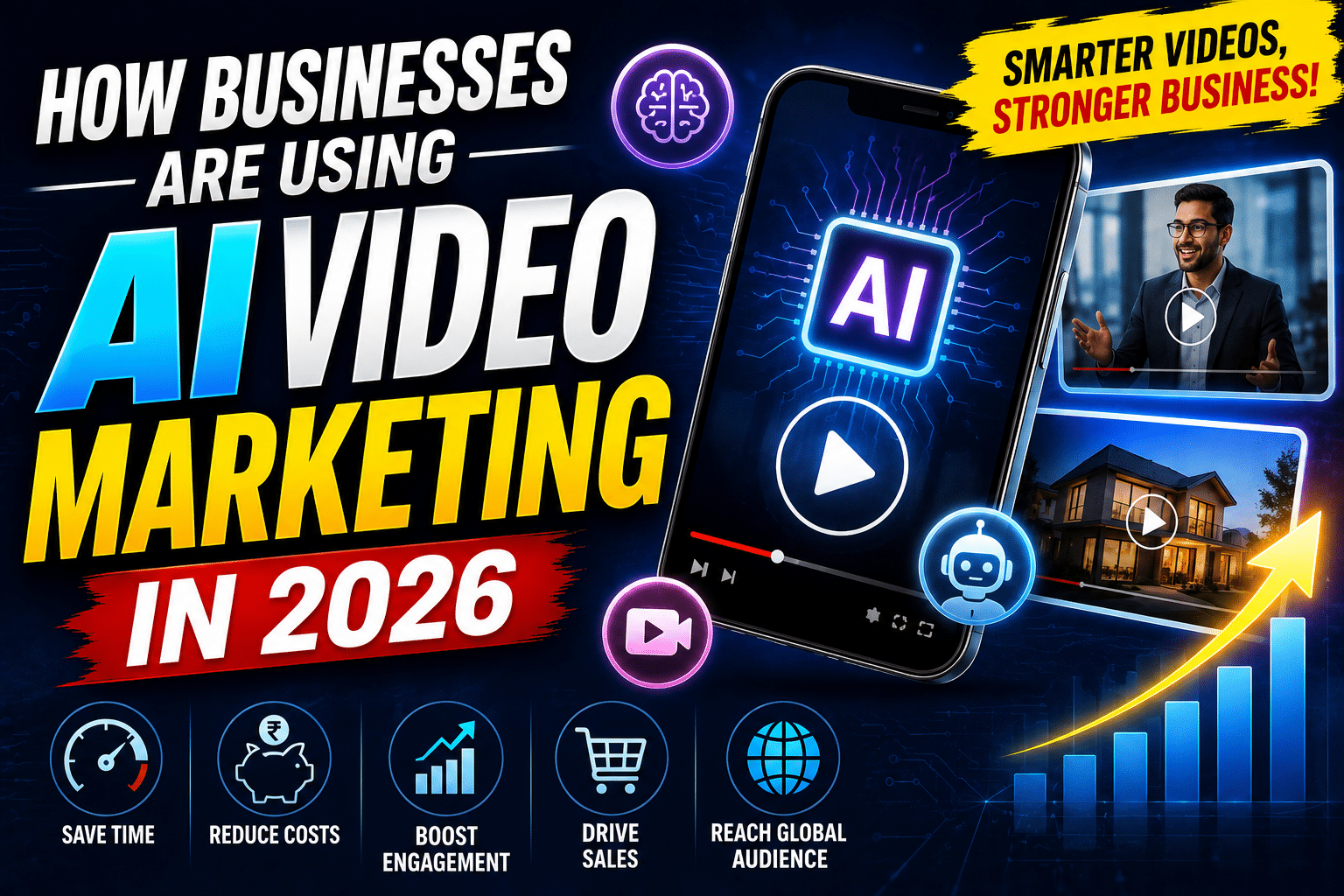
Artificial intelligence is transforming the way businesses create, distribute, and optimize video content. In 2026, companies are no longer using AI only for experiments. Businesses are increasingly integrating AI into everyday marketing workflows, from creating short-form videos and advertisements to translating content and personalizing customer experiences.
The rise of AI video marketing is especially important because consumers continue to spend significant time watching short-form and long-form video. Platforms such as YouTube, Instagram, and Facebook are also introducing more AI-powered creation and advertising features, giving businesses new ways to produce content at scale.
Meta, for example, says its video-generation tools had reached a combined revenue run-rate of $10 billion in Q4 2025, while AI-generated and translated video content is increasingly integrated into its advertising ecosystem.
So, how are businesses using AI video marketing in 2026? Let’s explore the biggest use cases and strategies.
What Is AI Video Marketing?
AI video marketing is the use of artificial intelligence to create, edit, personalize, distribute, or optimize video content for marketing purposes.
Instead of producing every video manually, businesses can use AI to assist with tasks such as:
- Script generation
- Video editing
- AI voiceovers
- Subtitles and captions
- Product demonstrations
- AI avatars
- Video translations
- Social media clips
- Personalized advertisements
- Background generation
- Content repurposing
- Video performance analysis
The important change in 2026 is that AI is becoming part of the complete marketing workflow rather than being used as an isolated video-generation tool.
1. Businesses Are Creating More Short-Form Videos
Short-form video remains one of the most important formats for digital marketing.
Businesses use AI to transform a single piece of content into multiple short videos for YouTube Shorts, Instagram Reels, Facebook, and other platforms.
For example, a company could record a 10-minute product presentation and use AI-assisted editing to identify important sections, create several short clips, add captions, and prepare different versions for social platforms.
This allows marketing teams to produce more content without dramatically increasing production time.
YouTube is also expanding AI-powered creation tools. In 2026, the platform introduced additional AI features for remixing and creating Shorts, showing how AI is becoming increasingly integrated into video creation.
2. AI Is Making Video Advertising Faster
Traditional advertising production can involve scripts, actors, filming, editing, voiceovers, graphics, and multiple approval stages.
AI can shorten several of these steps.
Businesses can generate different creative concepts, test multiple headlines, create variations of video advertisements, and adapt content for different audiences.
This is particularly useful for e-commerce companies that need to promote many products.
Instead of creating one advertisement for an entire campaign, marketers can create multiple versions based on different products, customer groups, or promotional messages.
Meta is expanding AI capabilities for advertisers, including tools that can help businesses create video ads, translate content, and produce UGC-style creative using avatars and voiceovers.
3. Businesses Are Using AI for Product Videos
Product videos are another major application of AI video marketing.
An online store may have hundreds or thousands of products, making traditional video production difficult and expensive.
AI can help businesses turn product information, images, specifications, and existing footage into short promotional videos.
For example, an electronics retailer could create videos explaining:
- Key smartphone features
- Laptop specifications
- Battery performance
- Camera capabilities
- Product comparisons
- Best-use scenarios
These videos can then be distributed across product pages, social media, YouTube, and advertising campaigns.
The result is a larger video library without requiring a complete production shoot for every product.
4. AI Is Helping Businesses Personalize Videos
Personalization is becoming one of the most powerful applications of AI in marketing.
Instead of showing exactly the same video to everyone, businesses can create variations for different audiences.
For example, a travel company might promote the same destination differently to:
- Families
- Solo travelers
- Couples
- Students
- Business travelers
The core video concept remains similar, but the message, visuals, voiceover, or offer can be adapted to the target audience.
This makes video marketing more relevant while allowing businesses to scale personalization.
5. AI Video Translation Is Expanding Global Marketing
Language has traditionally been a major barrier for businesses trying to reach international audiences.
AI-powered dubbing, translation, and voice technologies are changing this.
Businesses can take an existing video and create versions in multiple languages without recording every version from scratch.
YouTube reported that more than 6 million daily viewers watched at least 10 minutes of autodubbed content on average in December 2025, illustrating the growing role of AI-powered language accessibility.
For businesses, this can open opportunities in international markets while reducing localization costs.
For Indian businesses, multilingual video can be particularly valuable because brands can create content for audiences speaking English, Hindi, and other regional languages.
6. Businesses Are Creating AI-Powered Training Videos
AI video marketing isn’t limited to advertisements.
Companies are also using AI video technology for internal communication and employee training.
Businesses can create videos explaining:
- Company policies
- Software tutorials
- Employee onboarding
- Product training
- Safety procedures
- Sales techniques
- Customer service processes
AI avatars and voice generation can help companies update these videos more quickly when information changes.
Instead of organizing a new recording session every time a process changes, businesses may be able to update portions of the video digitally.
7. AI Is Helping Small Businesses Compete With Larger Brands
One of the biggest advantages of AI video marketing is accessibility.
A small business may not have the budget for a professional video production team, studio, actors, and editors.
AI tools can lower the barrier to entry.
A local business can use AI-assisted tools to create:
- Promotional videos
- Product explainers
- Social media content
- Customer education videos
- Video advertisements
- Seasonal campaigns
This allows smaller companies to maintain a more consistent video presence.
For example, a local restaurant could turn menu photographs into short promotional videos, while a small technology company could create educational videos explaining its products.
8. Businesses Are Repurposing Existing Content
Creating new content constantly can be exhausting for marketing teams.
AI makes content repurposing much easier.
A company can take a webinar, podcast, blog post, interview, or presentation and turn it into multiple pieces of video content.
One webinar could become:
- A full YouTube video
- Five Shorts
- Several Reels
- Quote-based videos
- Educational clips
- Customer-focused advertisements
This strategy increases the return on existing content investments.
9. AI Is Improving Video Accessibility
AI can also make marketing videos easier to understand and access.
Businesses can automatically generate captions, subtitles, translated versions, and voiceovers.
This helps people who watch videos without sound, speak different languages, or have accessibility requirements.
YouTube has also introduced AI-assisted creation tools in India, including features that can transform raw footage into a first draft with elements such as music, transitions, and voiceover.
10. Businesses Are Using AI to Test Creative Ideas
Another major advantage of AI video marketing is experimentation.
Instead of investing heavily in one video concept, marketers can create several variations and compare their performance.
They might test different:
- Hooks
- Headlines
- Thumbnails
- Voiceovers
- Offers
- Calls to action
- Video lengths
- Visual styles
Performance data can then help marketers identify which creative direction resonates with their audience.
This turns video marketing into a continuous testing process rather than a one-time production project.
AI Video Marketing and Authenticity
Despite all these advantages, businesses need to be careful about overusing AI.
Consumers can become frustrated with repetitive, generic, or obviously automated content.
Authenticity is particularly important when businesses are building trust.
Human creativity should therefore remain part of the process.
AI can generate the first draft, but people should review the message, facts, visuals, brand voice, and overall quality.
YouTube has also increased transparency requirements around realistic AI-generated or altered content. In 2026, the platform introduced more prominent AI disclosure labels and automatic detection signals for certain photorealistic AI content.
This means businesses should consider transparency when using realistic synthetic media.
The Best AI Video Marketing Strategy for 2026
The most effective strategy is not to replace human marketers with AI.
Instead, businesses should combine AI efficiency with human creativity.
A practical workflow looks like this:
Research → Strategy → AI Production → Human Editing → Testing → Optimization
AI can handle repetitive production tasks, while marketers focus on strategy, storytelling, positioning, and customer psychology.
This approach also helps prevent what YouTube describes as low-quality or repetitive “AI slop,” which the platform says it is working to reduce through existing systems designed to combat spam and clickbait.
Benefits of AI Video Marketing for Businesses
When implemented correctly, AI video marketing can provide several advantages:
Faster Production
Businesses can produce video content much faster than traditional workflows allow.
Lower Production Costs
AI can reduce the need for some repetitive production tasks and resources.
Greater Content Volume
Marketing teams can create more variations for different platforms and audiences.
Better Personalization
AI allows businesses to adapt messages to different customer segments.
Easier Global Expansion
Translation and dubbing make it easier to reach international audiences.
Faster Experimentation
Marketers can test creative concepts before investing heavily in production.
Challenges Businesses Need to Consider
AI video marketing also comes with challenges.
Businesses need to monitor:
- Accuracy
- Brand consistency
- Copyright
- AI disclosure
- Privacy
- Voice and likeness rights
- Customer trust
- Content quality
AI should not be treated as a completely autonomous creative department.
Human review remains essential, particularly for advertisements, claims, product information, and content involving real people.
Conclusion: The Future of AI Video Marketing
AI video marketing is becoming an important part of modern business strategy in 2026.
Companies are using AI to create short-form videos, produce advertisements, personalize content, translate campaigns, promote products, train employees, repurpose existing material, and test creative ideas faster.
The biggest opportunity isn’t simply creating videos with AI. It is using AI to build a smarter and more scalable video marketing system.
Businesses that combine automation with human creativity can produce more content while maintaining quality and authenticity.
The future of video marketing will not necessarily be completely AI-generated. Instead, the strongest brands are likely to use AI as a powerful production partner while humans remain responsible for strategy, storytelling, creativity, and trust.
In 2026, the competitive advantage isn’t just creating more videos—it is creating better videos, faster, for the right audience, on the right platform, with a clear business goal.