
Introduction
A good product video does more than show what a product looks like. It helps potential customers understand why they should care about it.
That is why high-converting product videos have become an important part of ecommerce and digital marketing in 2026.
Consumers want quick answers. They want to know how a product works, whether it solves their problem, what it looks like in real life and whether other people trust it.
Video can answer many of those questions in seconds.
However, simply recording a product and uploading the footage is not enough. A successful product video needs a clear message, strong opening, useful visuals and a logical call to action.
What Makes a Product Video Convert?
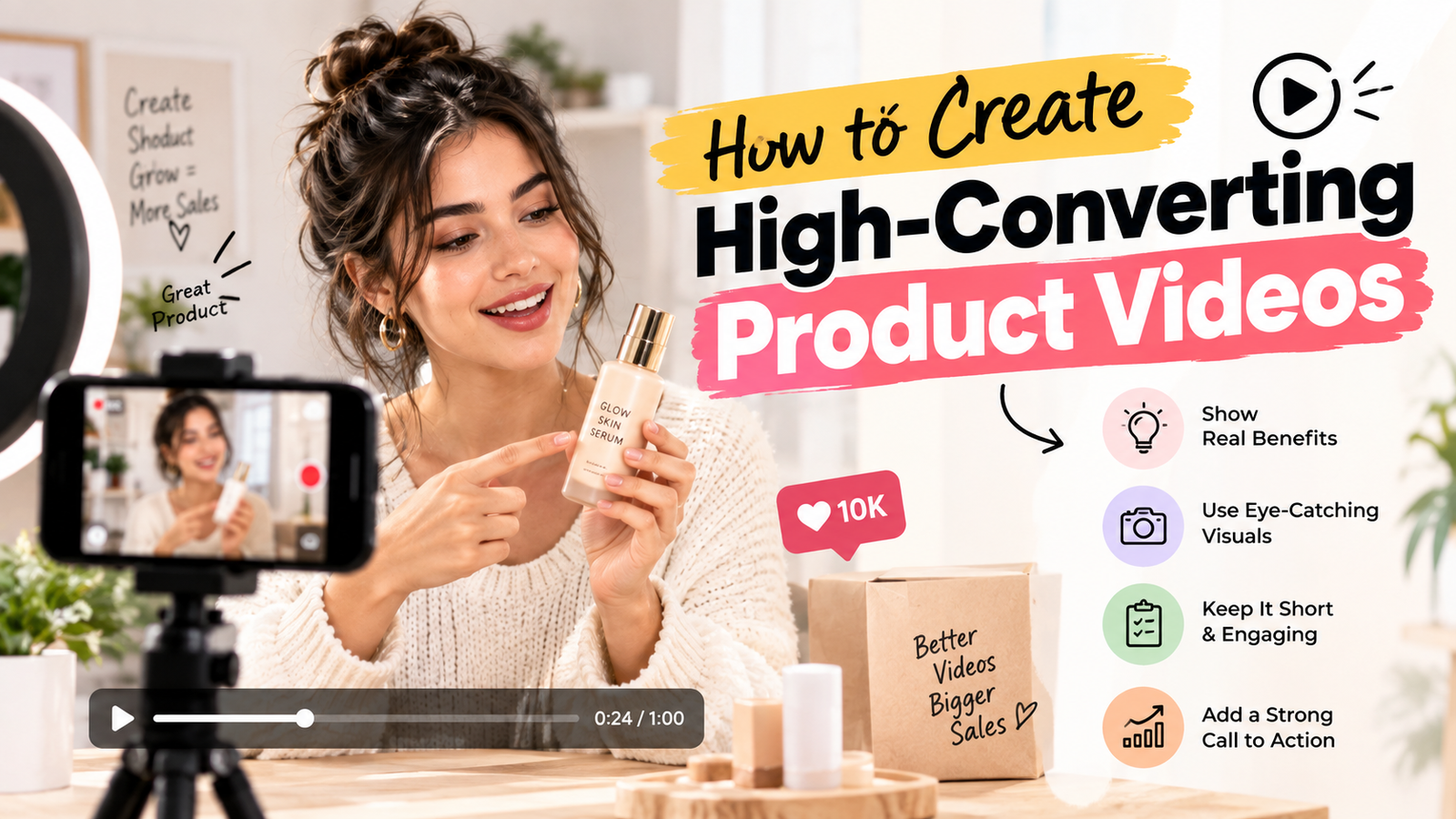
A high-converting product video usually combines five elements:
- A strong hook
- A clear customer problem
- A visual product demonstration
- Evidence or trust
- A clear next step
Think about the video from the customer’s perspective.
Instead of asking, “What features should I show?”
Ask:
“What does my customer need to understand before buying?”
That small change can improve the entire video strategy.
Start With the Customer Problem
Do not begin with a long company introduction.
Begin with the problem.
For example:
“Struggling to keep your phone battery alive during a busy day?”
That opening immediately speaks to a specific customer.
Then introduce the product as the solution.
This structure is stronger than starting with:
“Welcome to our brand. We have been making accessories since 2015.”
The customer is interested in the solution first.
Create a Strong Hook
The first few seconds matter because social media users can scroll away instantly.
Useful hooks include:
- A question
- A surprising result
- A common problem
- A quick demonstration
- A before-and-after
- A mistake
- A bold but accurate statement
For example:
“Three reasons your current power bank may be charging slowly.”
Then demonstrate the solution.
Show, Don’t Just Tell
Product videos work best when viewers can see the product solving a problem.
If you are marketing headphones, show:
- The design
- Pairing process
- Controls
- Comfort
- Microphone
- Noise cancellation demonstration where appropriate
If you are marketing skincare, show:
- Texture
- Application
- Amount used
- Routine placement
- Product packaging
Visual evidence makes the explanation easier to understand.
Focus on Benefits
Features describe what a product has.
Benefits explain why customers should care.
For example:
Feature: 5,000 mAh battery.
Benefit: More power for your phone when you are away from a charger.
A good product video should translate technical features into everyday benefits.
Keep One Main Message
Trying to explain every feature in one video can make the content confusing.
Instead, choose one main message.
For example:
“This laptop is designed for students who need long battery life.”
Then build the video around that promise.
You can create additional videos for performance, display quality, design and other features.
Use a Simple Video Structure
A useful product video structure is:
Hook → Problem → Product → Demonstration → Benefit → Proof → CTA
For example:
Hook: “Still carrying two chargers?”
Problem: “Most people need separate charging solutions for their devices.”
Product: Introduce the product.
Demonstration: Show how it works.
Benefit: Explain the convenience.
Proof: Show reviews, testing or relevant evidence.
CTA: Tell viewers where to learn more.
This structure is simple enough for short-form content but can also work for longer videos.
Use Realistic Demonstrations
Customers want to imagine using the product themselves.
Therefore, show products in realistic situations.
A smartphone accessory can be shown in a college bag.
A coffee machine can appear in a kitchen.
A fitness tracker can be demonstrated during a workout.
Context helps viewers visualize ownership.
Use Customer Reviews
Reviews can add credibility.
Consider using:
- Customer testimonials
- UGC
- Ratings
- Demonstration clips
- Expert explanations
- Frequently asked questions
However, avoid fake testimonials or exaggerated claims.
Trust is particularly important when video is being used to influence purchasing decisions.
Optimize Product Videos for Mobile
For social media, design for the screen where your customers watch.
Use vertical video where appropriate.
Make sure:
- Product details are visible
- Text is large enough
- Captions are readable
- The main subject stays centered
- Important information does not sit behind interface elements
The viewer should understand the product even without sound.
Add Captions
Captions make videos easier to understand in silent viewing environments.
They also improve accessibility.
Instead of placing an entire paragraph on screen, break information into short phrases.
For example:
“Long battery life.”
Then:
“Fast charging.”
Then:
“Lightweight design.”
This creates a visual rhythm without overwhelming viewers.
Create Different Versions
Do not assume one product video will work everywhere.
A 15-second social video and a two-minute product-page video have different purposes.
You can create:
- 15-second teaser
- 30-second social ad
- 60-second product demonstration
- Long-form product explanation
- Customer testimonial
- FAQ video
The same product footage can often support several pieces of content.
Use A/B Testing
Testing helps brands discover which creative elements perform better.
You can test:
- Different hooks
- Different thumbnails
- Video lengths
- CTAs
- Product angles
- Voiceovers
- Captions
- Offers
For example, one version might begin with a question while another begins with a product demonstration.
Compare meaningful business metrics rather than relying only on views.
Track the Right Metrics
Important product-video metrics can include:
- Watch time
- Completion rate
- Click-through rate
- Product-page visits
- Add-to-cart rate
- Conversion rate
- Revenue
- Cost per acquisition
Views tell you whether people watched.
Conversions help tell you whether the video contributed to business results.
Product Videos for Ecommerce
Ecommerce stores can place videos throughout the customer journey.
Consider adding video to:
- Product pages
- Category pages
- Homepage
- Social media
- Email campaigns
- Retargeting campaigns
A product video on a product page can answer questions that static photographs cannot.
Use AI Carefully
AI can speed up product-video production.
It can help generate:
- Video scripts
- Hook ideas
- Captions
- Translations
- Content variations
- Shot lists
However, marketers should verify product claims before publishing.
AI-generated content should not invent specifications, results or customer experiences.
Common Product Video Mistakes
Avoid these mistakes:
Too Much Brand Introduction
Customers want to understand the product quickly.
Feature Overload
Too many features reduce clarity.
Weak Opening
A slow introduction can lose viewers.
Poor Lighting
Product details become difficult to see.
No CTA
Viewers may not know what to do next.
Overpromising
Unrealistic claims can damage trust.
No Testing
A single video is rarely enough to understand what works.
A Simple Product Video Checklist
Before publishing, ask:
- Does the first few seconds create interest?
- Is the customer problem clear?
- Can viewers see the product properly?
- Are benefits easy to understand?
- Is the information accurate?
- Does the video work without sound?
- Is the CTA obvious?
- Can performance be measured?
If the answer is yes, the video has a stronger foundation.
Final Thoughts
Creating high-converting product videos is not about making the most expensive production. It is about making the product easy to understand and the buying decision easier to navigate.
Start with the customer problem. Show the solution. Demonstrate the product. Build trust. Finish with a clear next step.
When brands combine useful storytelling with strong visuals and measurable calls to action, product video becomes much more than advertising. It becomes part of the customer experience.