
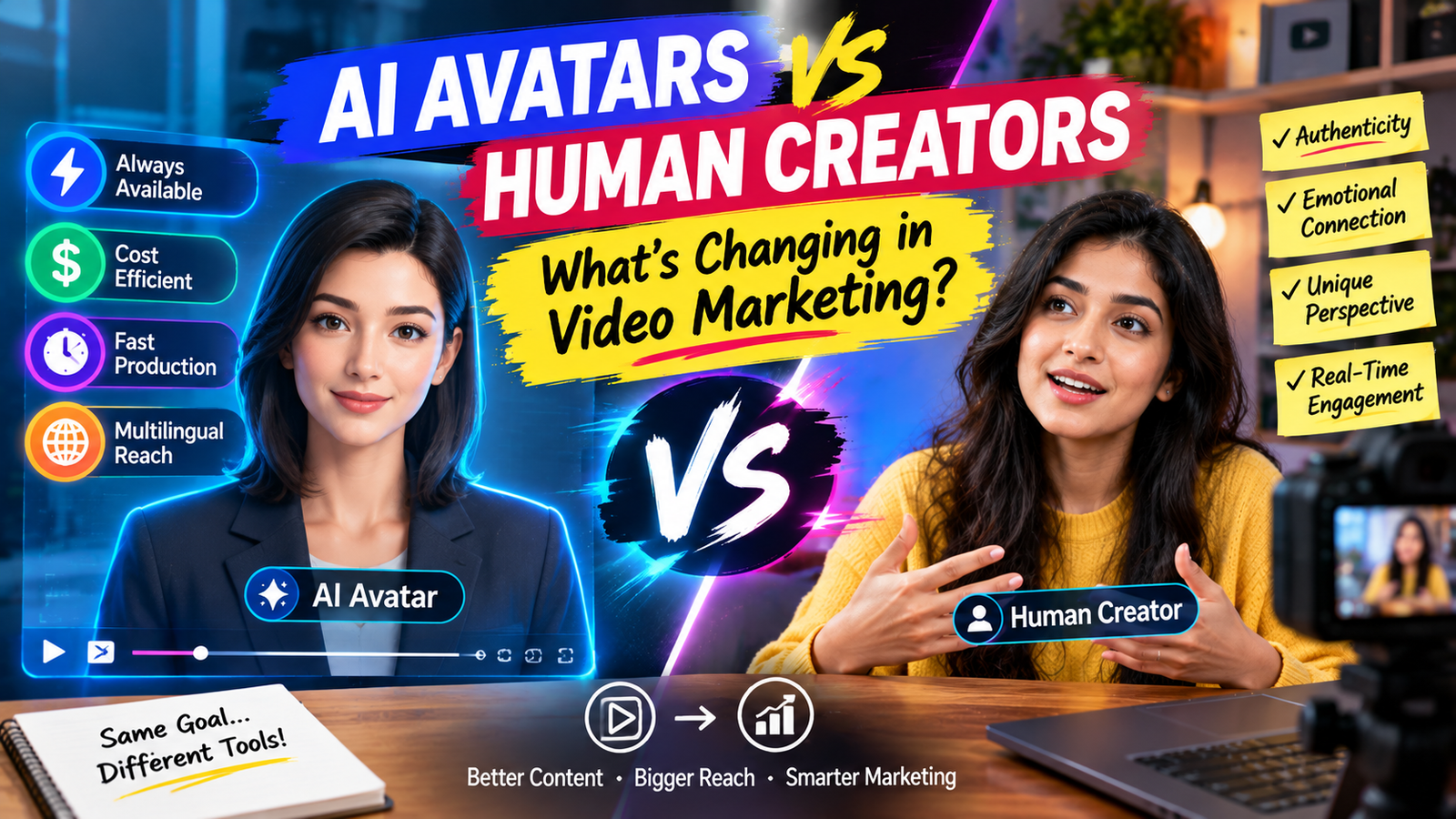
AI avatars vs human creators has become one of the biggest conversations in video marketing in 2026. Brands now have more choices than ever when producing marketing videos. They can work with real creators, use AI-generated presenters, or combine both approaches.
AI avatars can produce videos quickly, support multiple languages, and reduce the need for repeated recording sessions. Human creators, meanwhile, bring personality, personal experience, natural reactions, and audience relationships that technology cannot automatically reproduce.
The shift is not simply about replacing creators with AI. Instead, brands are deciding which type of content is better suited to an AI avatar, a real creator, or a combination of both.
What Are AI Avatars in Video Marketing?
AI avatars are digital characters or virtual presenters that can deliver spoken content using artificial intelligence.
A marketer can provide a script, select an avatar and voice, and create a presenter-style video without arranging a traditional filming session.
Modern avatar platforms can also support multilingual content and different presentation styles. This makes them useful for brands that need to produce many versions of similar videos.
A 2026 study from HeyGen involving more than 1,000 small-business owners and solopreneurs found that 71.1% of avatar users said the technology saved them time, while 55.3% said they posted more often. The same study reported that 64.8% of its Indian respondents used AI video avatar technology.
These figures show why AI avatars are becoming part of everyday marketing workflows.
Why Human Creators Still Matter
Human creators offer something different: a real person with a recognizable personality and individual experience.
A creator can demonstrate a skincare product, test a smartphone, share a personal opinion, tell a story, or respond naturally to audience comments.
That human element can be particularly valuable for influencer marketing and user-generated content.
For example, imagine someone reviewing a new pair of headphones. A real creator can explain how the headphones feel during everyday use, demonstrate them in different situations, and share personal observations.
An AI avatar can deliver information about the headphones, but it does not actually use the product in the same human sense.
This difference becomes important when the marketing message depends on personal experience or trust.
AI Avatars vs Human Creators: The Biggest Differences
The easiest way to understand the change is to look at what each approach does well.
| Factor | AI Avatars | Human Creators |
|---|---|---|
| Production speed | Very fast | Usually slower |
| Scalability | High | Limited by creator availability |
| Personal experience | Limited | Strong |
| Multilingual content | Easier to scale | Requires additional production |
| Brand personality | Controlled | Naturally expressive |
| Repeated videos | Efficient | Requires new recordings |
| Audience relationship | Depends on format | Often stronger |
| Content variations | Easy to create | More time-consuming |
Neither approach works perfectly for every campaign.
The right choice depends on the marketing goal.
1. AI Avatars Are Changing Production Speed
One of the biggest advantages of AI avatars is speed.
Traditional presenter videos can involve scheduling, cameras, lighting, recording, editing, retakes, and post-production.
An AI avatar can reduce many of these steps.
That matters when a company needs to produce large amounts of content.
For example, an online education company could create hundreds of short instructional videos using consistent virtual presenters. A software company could produce product-update videos without asking an executive to record every announcement.
Research from Pictory, based on more than 1.5 million videos created during the first half of 2026, found that AI-powered video workflows were increasingly being used by professional teams to repurpose existing assets and scale production.
2. Human Creators Bring Authenticity
Human creators remain important because audiences often connect with people rather than polished advertisements.
A creator can make a video feel spontaneous.
They can laugh, make a mistake, change their opinion, react to a product, or answer a comment. Those small imperfections can become part of the content’s personality.
This is especially relevant for lifestyle, beauty, fashion, food, travel, and product-review campaigns.
A brand selling skincare products, for instance, may benefit from a real creator showing how a product fits into an actual morning routine.
The creator’s identity and relationship with followers become part of the marketing value.
3. AI Avatars Are Useful for Multilingual Marketing
Language is another area where AI avatars can change video production.
A brand operating across India may want content in Hindi, English, Gujarati, Tamil, Telugu, Bengali, or Marathi.
Creating separate recordings for every language can be expensive and time-consuming.
AI-powered video tools can help companies create localized versions faster.
HeyGen’s 2026 research found that 36.6% of avatar users surveyed already published content in a language other than their own.
This could make AI avatars particularly useful for companies trying to reach audiences across multiple regions.
However, brands should still review translated scripts carefully. Literal translations may miss cultural context, humor, or local expressions.
4. AI Avatars Are Strong for Repetitive Content
Some video formats don’t require a unique human personality.
Consider:
- Product tutorials
- Software instructions
- Internal training
- FAQ videos
- Product updates
- Educational explainers
- Basic customer-support content
These videos often communicate straightforward information.
An AI avatar can deliver the same type of message repeatedly without requiring a new recording session.
That makes avatars useful as part of a scalable content system.
5. Human Creators Are Strong for Storytelling
Storytelling remains one of the areas where human creators can provide a distinctive advantage.
A creator can talk about personal experiences and connect those experiences with a brand.
For example, a fitness creator might document their journey using a fitness tracker. A beauty creator might show how a product fits into their routine. A technology creator might explain how a laptop performs during their actual workday.
The audience isn’t simply receiving information. They are following someone’s experience.
That creates a different type of content from a scripted AI presenter.
6. The Rise of the Hybrid Model
The biggest change may be that brands don’t have to choose only one option.
A hybrid strategy can combine AI avatars and human creators.
For example:
Human creator: Creates the original product story.
AI tools: Generate captions, translations, clips, and alternative versions.
AI avatar: Handles repetitive educational content.
Human creator: Appears in major campaigns and community-focused videos.
This approach allows brands to use AI for scale while keeping humans involved where personality and trust matter most.
7. Digital Twins Are Creating a New Middle Ground
Another emerging model is the digital twin.
A digital twin is an AI-generated version of a real person that can deliver content without requiring the person to record every video.
This creates an interesting middle ground between traditional creators and fully synthetic avatars.
A creator could record once and potentially use an approved digital version for certain marketing tasks, such as multilingual content or routine educational videos.
However, consent, licensing, disclosure, and control over the creator’s likeness are extremely important.
A creator’s face and voice are personal assets, so brands should establish clear agreements before using digital replicas.
8. The Biggest Challenge: Trust
AI avatars can look increasingly realistic, but realism does not automatically equal trust.
Some audiences may appreciate AI-generated presenters because they make content faster and easier to access. Others may prefer real people because they want authentic experiences and opinions.
A 2026 report from Presenc AI found strong resistance among surveyed marketers to using AI creator clones as substitutes for human influencers. Because the report comes from an industry participant, its figures should be treated as one survey’s findings rather than a universal measure of consumer opinion.
The lesson for brands is simple: transparency matters.
If an avatar is being used, businesses should consider whether audiences need to know and follow the disclosure requirements of the platforms and markets where the content appears.
9. What Brands Should Use AI Avatars For
AI avatars can be particularly useful for:
- Product explainers
- Training videos
- Tutorials
- Frequently asked questions
- Internal communications
- Multilingual videos
- Personalized sales messages
- Repetitive educational content
- High-volume social content
These formats often benefit from consistency and scalability.
10. What Brands Should Use Human Creators For
Human creators can be especially useful for:
- Product reviews
- Testimonials
- Lifestyle campaigns
- Influencer marketing
- Personal stories
- Behind-the-scenes content
- Community engagement
- Live videos
- Experiential campaigns
- Authentic user-generated content
Here, personality and real-world experience are central to the message.
What This Means for Video Marketing in 2026
The debate around AI avatars vs human creators is moving beyond the question of which one is better.
Instead, marketers are asking a more practical question:
What type of content should be created by AI, and what type should be created by people?
That is an important shift.
AI can help brands produce more content, test more variations, localize campaigns, and reduce repetitive production work.
Human creators can provide personality, experience, community, and storytelling.
Together, these capabilities can create a more flexible video marketing strategy.
Final Thoughts
AI avatars vs human creators is not necessarily a battle where one side replaces the other.
AI avatars are changing how quickly brands can produce and scale video content. Human creators continue to offer personality, lived experience, and audience relationships that are difficult to reproduce synthetically.
For many businesses, the most practical strategy in 2026 may be a combination of both.
Use AI when speed, consistency, localization, and volume matter. Use human creators when authenticity, storytelling, personal experience, and community matter.
The future of video marketing may therefore be less about choosing between humans and AI and more about giving each one the right job.