

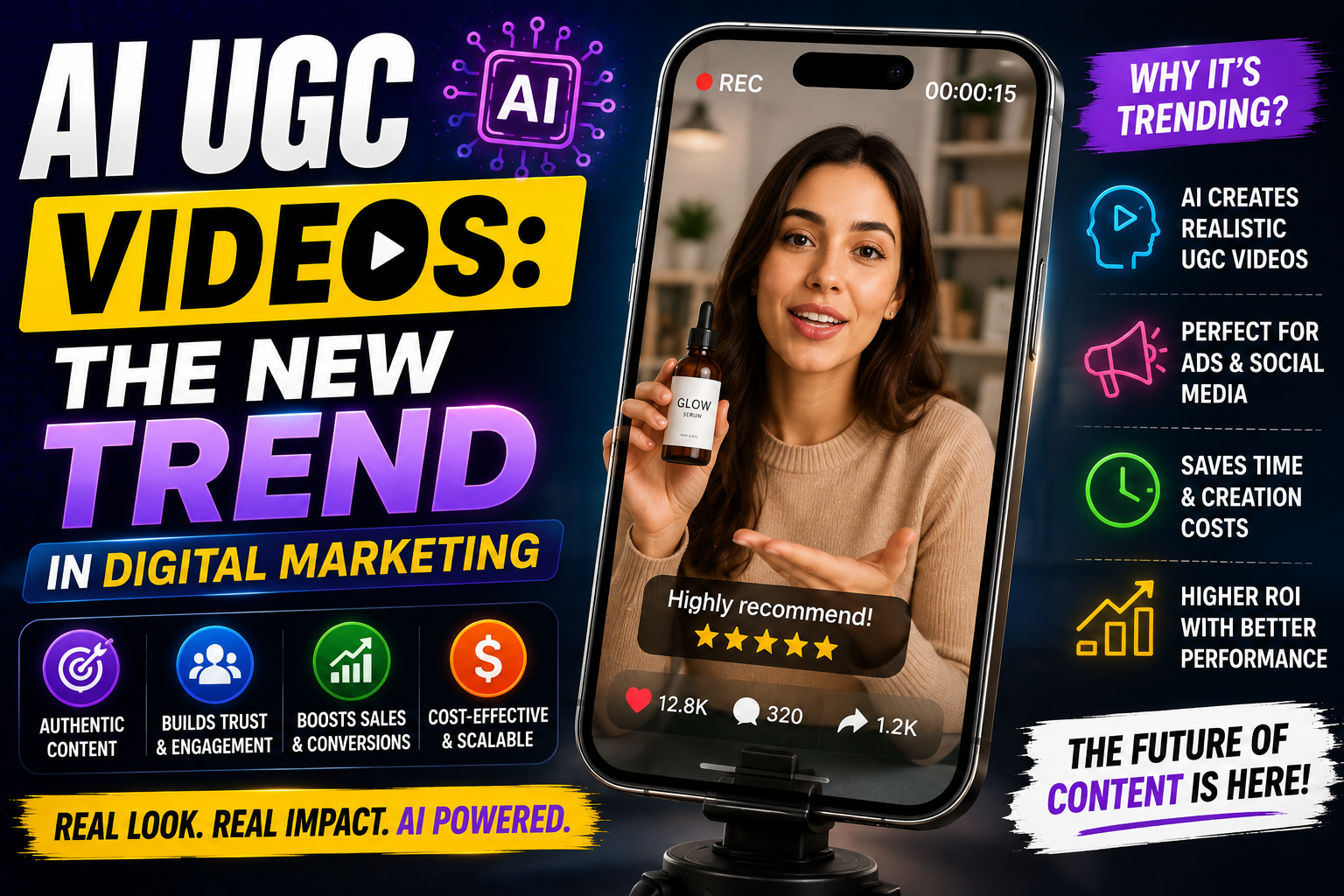
AI UGC Videos: The New Trend in Digital Marketing
What if a brand could create dozens of product-style videos without arranging a traditional photoshoot, hiring a large production team or waiting weeks for new creative assets?
That’s the promise behind AI UGC videos.
User-generated content, commonly called UGC, has become a powerful format for brands because it can feel more personal and relatable than traditional advertising. Now, artificial intelligence is changing how that content is produced.
Instead of relying entirely on real creators to record every video, brands can use AI tools to generate scripts, avatars, voiceovers, product demonstrations and video variations.
As a result, AI UGC videos are becoming an important trend in digital marketing in 2026.
However, there is an important distinction. AI-generated content can reproduce the style of creator-led advertising, but it isn’t necessarily genuine user-generated content. That difference matters when brands think about trust, disclosure and authenticity.
So, what exactly is AI UGC, and should marketers use it?
Let’s explore.
What Are AI UGC Videos?
AI UGC videos are marketing videos created partly or entirely with artificial intelligence while using the familiar style of user-generated content.
Traditional UGC might involve a customer recording a smartphone video saying:
“I tried this product for a week, and here’s what I noticed.”
AI-powered production can recreate parts of that workflow using synthetic presenters, AI voices, generated scripts and automated editing.
A typical AI UGC video may include:
- An AI-generated or digital presenter
- AI-written scripts
- Synthetic voiceovers
- Product images or video
- AI-assisted editing
- Captions and text overlays
- Different versions for different audiences
The goal is usually to create content that looks natural and social-media-friendly rather than like a polished television commercial.
Why Are AI UGC Videos Trending in 2026?
Short-form video continues to dominate platforms such as Instagram, TikTok and YouTube Shorts.
That creates a problem for marketers.
Brands need more video content than ever.
Producing every video traditionally can become expensive and time-consuming. A campaign might require a creator, scriptwriter, videographer, editor and several rounds of revisions.
AI can reduce some of that workload.
For example, a marketer can create multiple scripts and variations, test different hooks and adapt the same product message for different audiences.
Consequently, AI UGC can help brands produce creative content at greater speed.
AI UGC vs Traditional UGC
The two formats may look similar, but their production process is different.
| Feature | Traditional UGC | AI UGC |
|---|---|---|
| Presenter | Real person | AI/synthetic or AI-assisted creator |
| Script | Human-written | Human or AI-generated |
| Recording | Real camera | AI-generated or AI-assisted |
| Production speed | Moderate | Potentially much faster |
| Cost | Varies | Can be lower at scale |
| Authenticity | Usually high | Depends on execution |
| Variations | More expensive | Easier to create |
| Human connection | Strong | Can vary |
Traditional UGC has a major advantage: real human experience.
AI UGC, meanwhile, has an advantage in speed and scalability.
Therefore, marketers should not automatically treat one as a replacement for the other.
1. Faster Video Production
One of the biggest benefits of AI UGC is speed.
A traditional video may take days or weeks to plan, record and edit.
AI-assisted workflows can shorten some parts of that process.
A marketing team can generate several script concepts, select the strongest ideas and quickly create multiple versions.
This is especially useful for brands running frequent social campaigns.
Instead of waiting for one perfect video, marketers can test multiple concepts and learn which ones attract attention.
2. Lower Production Costs
Video production can become expensive.
Creator fees, studio costs, equipment, travel and editing can all add to the final budget.
AI doesn’t eliminate every cost, but it can reduce expenses for certain types of content.
For example, a brand may use AI for:
- Script development
- Voiceovers
- Captions
- Editing
- Background generation
- Presenter creation
- Creative variations
However, lower production cost shouldn’t become an excuse to publish low-quality content.
A cheap video that nobody watches isn’t a successful marketing campaign.
3. Create Multiple Video Variations
This is where AI UGC can become particularly powerful.
Imagine a skincare brand selling one product.
Instead of producing one advertisement, marketers can create different versions focused on:
- Dry skin
- Oily skin
- Beginners
- Busy professionals
- Students
- Night routines
- Morning routines
Each version can use a different hook and message.
This makes personalised video marketing easier to test.
4. AI UGC Works Well for Short-Form Content
Short-form platforms require constant creative experimentation.
A video may receive thousands of views, while another version of the same concept may perform poorly.
Therefore, marketers need to test:
- Hooks
- Captions
- Video length
- Presenters
- Music
- Offers
- Calls to action
- Opening scenes
AI can help create those variations more efficiently.
This makes AI UGC particularly relevant to Instagram Reels, TikTok and YouTube Shorts marketing.
5. AI Can Help Generate Better Hooks
The first few seconds of a short-form video are critical.
Instead of beginning with:
“Today we’re going to talk about our product…”
a marketer might test stronger openings such as:
“I wish I knew this before buying skincare products.”
or:
“Three mistakes people make when choosing a face serum.”
AI can help brainstorm dozens of hooks quickly.
However, marketers should still evaluate them carefully.
A hook should attract attention without making false or exaggerated claims.
How Brands Can Use AI UGC Videos
AI UGC can be used across many industries.
Beauty and Skincare
Brands can create product explainers, routines and educational videos.
Fashion
AI presenters can showcase styling ideas and product combinations.
Technology
Brands can create demonstrations, tutorials and feature explainers.
Food and Beverage
AI-assisted videos can promote recipes, products and lifestyle content.
E-Commerce
Product-focused videos can explain features, benefits and use cases.
SaaS
Software companies can create quick tutorials and product walkthroughs.
The key is to match the format to the audience.
AI UGC for E-Commerce
E-commerce may be one of the most interesting applications.
Online shoppers cannot physically touch a product before purchasing.
Video can help bridge that gap.
A creator-style video can demonstrate:
- How the product works
- How it looks
- How to use it
- What problem it addresses
- Who might benefit from it
AI can make it easier to create multiple versions of these demonstrations.
However, brands should ensure that generated visuals accurately represent the actual product.
A beautiful AI-generated product that looks completely different from what customers receive can damage trust.
Does AI UGC Feel Authentic?
Here’s the biggest challenge.
Authenticity is the reason UGC works in the first place.
People often respond well to content that feels like a recommendation from another person rather than a traditional advertisement.
If an AI-generated presenter looks unnatural, speaks mechanically or makes unrealistic claims, viewers may immediately recognise it as synthetic.
Therefore, successful AI UGC shouldn’t simply try to trick people into believing an AI character is a real customer.
Instead, brands should focus on useful, transparent and engaging content.
Authenticity comes from the message and honesty—not just from making an AI avatar look human.
Should Brands Disclose AI-Generated Content?
Transparency is becoming increasingly important.
Rules and platform policies around AI-generated content can vary by country, platform and type of content. In addition, advertising standards may apply when synthetic people, endorsements or testimonials are involved.
Brands should therefore review the applicable advertising and platform requirements before publishing AI-generated promotional content.
Most importantly, brands shouldn’t fabricate a customer testimonial and present it as a genuine experience.
For example, generating an AI person saying:
“I personally used this product for six months and it changed my life”
would be misleading if no such person actually had that experience.
Instead, the content should clearly represent what it is.
AI UGC and Influencer Marketing
AI UGC doesn’t necessarily replace influencers.
In fact, the two can work together.
A brand might use real influencers for major campaigns while using AI-assisted content for everyday advertising variations.
Real creators can provide genuine experiences and credibility.
AI can then help marketers adapt ideas into different formats.
This creates a hybrid video marketing strategy.
Human creativity provides authenticity, while AI provides efficiency.
Common Problems With AI UGC Videos
Despite its advantages, AI UGC has limitations.
Lack of Authenticity
Viewers may recognise artificial presenters quickly.
Repetitive Content
Generating hundreds of similar videos can make social feeds feel generic.
Unrealistic Visuals
AI-generated products or people may sometimes contain errors.
Incorrect Claims
AI-generated scripts can produce inaccurate information.
Brand Safety Issues
Synthetic voices, faces and imagery can create legal or reputational risks.
Audience Distrust
If viewers feel manipulated, the campaign can backfire.
Therefore, human review should remain part of the workflow.
How to Create Better AI UGC Videos
Want your AI-generated videos to perform better?
Follow these principles.
Start With a Strong Idea
Technology cannot rescue a weak marketing concept.
Write for Humans
Keep the script conversational and easy to understand.
Keep Videos Focused
One video should usually communicate one main idea.
Use Real Product Information
Don’t allow AI to invent specifications or benefits.
Add Captions
Many social users watch videos without sound.
Test Different Hooks
Create multiple openings and compare performance.
Maintain Brand Consistency
Use consistent messaging, visual identity and tone.
Keep Human Oversight
Review every important claim before publishing.
AI UGC Video Metrics to Track
Views are useful, but they don’t tell the whole story.
Marketers should monitor:
- Watch time
- Completion rate
- Engagement rate
- Click-through rate
- Conversion rate
- Cost per acquisition
- Saves
- Shares
- Comments
- Return on ad spend
A video with 100,000 views isn’t necessarily better than one with 10,000 views.
If the smaller video generates more qualified customers, it may be the stronger campaign.
The Future of AI UGC Marketing
AI UGC is likely to become more sophisticated as AI video generation improves.
We can expect marketers to experiment with:
- Personalised video ads
- AI-generated presenters
- Multilingual videos
- Automated dubbing
- Real-time creative variations
- AI-assisted product demonstrations
- Automated social media content
- Creator-AI collaborations
However, technology alone won’t determine success.
The brands that stand out will probably be those that combine AI efficiency with human creativity, transparency and strong storytelling.
AI UGC Video Strategy for Small Businesses
Small businesses can also experiment without building a huge production operation.
Start with one product and create three or four different concepts.
For example:
Video 1: Problem → Solution
Video 2: Three product benefits
Video 3: How-to demonstration
Video 4: Common mistakes
Publish and compare the results.
Once you understand which format works, create additional variations.
This approach is more effective than producing dozens of random AI videos without measuring performance.
Final Thoughts
AI UGC videos are becoming one of the most interesting developments in digital marketing in 2026.
They can help brands produce video content faster, experiment with more creative variations and potentially reduce production costs.
Yet AI UGC shouldn’t be viewed as a magic replacement for real creators.
The biggest strength of traditional UGC is its human experience and credibility. AI, meanwhile, brings speed, scalability and flexibility.
The smartest approach may therefore be a combination of both.
Use AI to brainstorm ideas, write drafts, create variations, edit content and scale campaigns. At the same time, keep humans involved in strategy, fact-checking, creative direction and ethical review.
Most importantly, don’t sacrifice trust for convenience.
The future of AI UGC marketing isn’t simply about making more videos. It’s about making better, more relevant and more transparent videos that people actually want to watch.
As short-form video continues to dominate digital marketing, brands that learn how to balance AI technology with human creativity could have a significant advantage in the increasingly competitive content landscape.