
Introduction
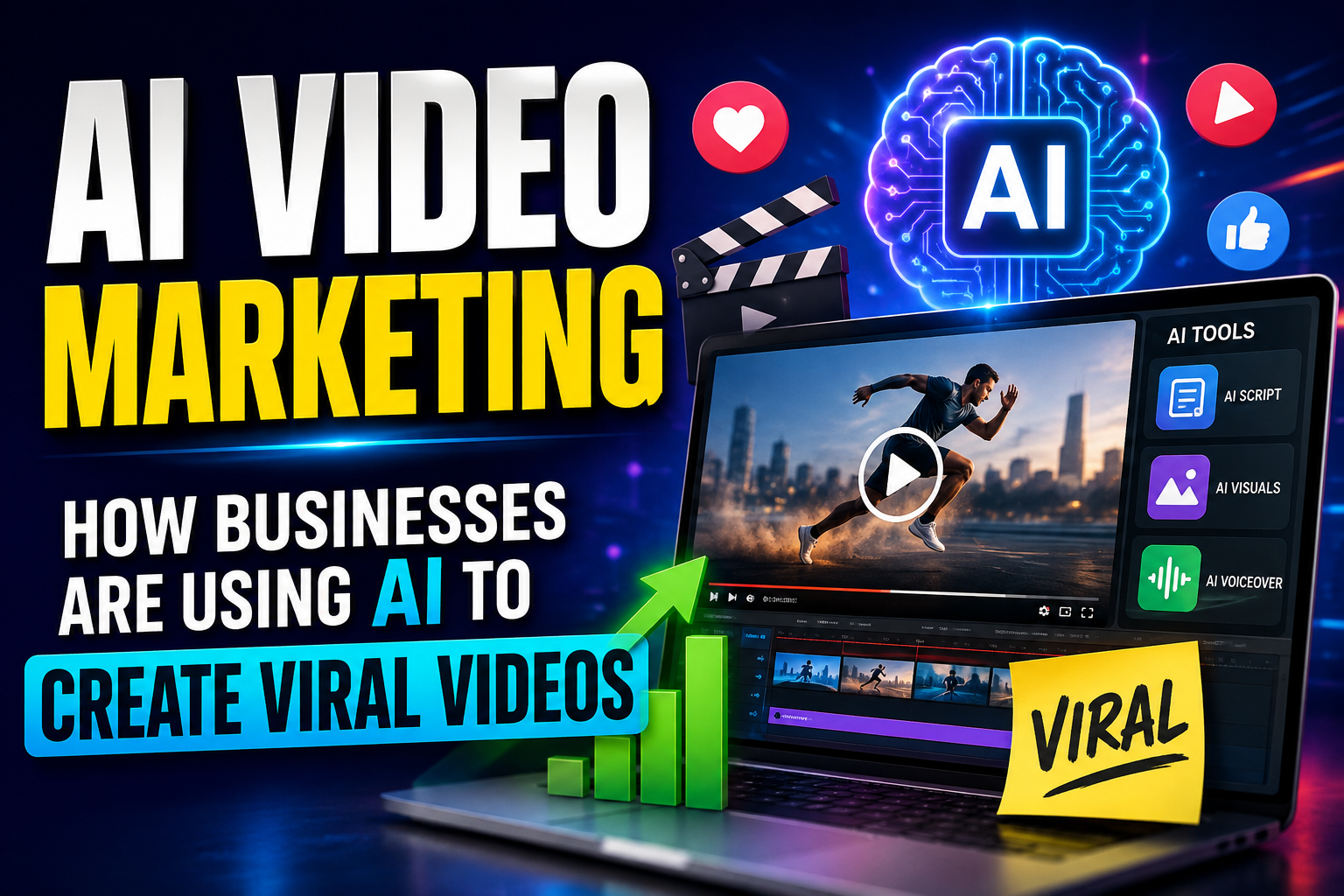
Video has become one of the most powerful ways for businesses to attract attention online. From Instagram Reels and YouTube Shorts to product demonstrations and social media advertisements, brands are constantly searching for better ways to create engaging content. In 2026, AI video marketing is changing how businesses plan, produce, edit, and distribute videos.
Artificial intelligence can help transform a simple idea into a polished video within minutes. Businesses can use AI to generate scripts, create visuals, produce voiceovers, add captions, edit footage, and develop multiple versions of the same campaign.
But can AI really help a business create viral videos? The answer is yes—but AI is a tool, not a magic button. The most successful campaigns combine AI’s speed and efficiency with human creativity, storytelling, and an understanding of the audience.
What Is AI Video Marketing?
AI video marketing refers to using artificial intelligence tools and technologies to create, optimize, personalize, and distribute marketing videos.
Instead of manually completing every stage of production, marketers can use AI to automate repetitive tasks. For example, a business can provide a product description and use AI to generate a video concept, script, voiceover, captions, and visual structure.
AI can also analyze audience behavior and marketing data to help businesses understand what types of videos are more likely to generate views, clicks, comments, or conversions.
This makes AI particularly valuable for small businesses and creators that may not have large video-production teams.
Why Businesses Are Turning to AI Video Creation
Traditional video production can require cameras, lighting, editing software, actors, voice artists, and considerable time. AI doesn’t completely replace these resources, but it can reduce the workload involved in many production stages.
One major advantage is speed. Marketers can create several video concepts quickly instead of spending days producing one piece of content.
Another advantage is cost efficiency. Businesses can reduce spending on certain repetitive production tasks, especially when creating short-form social media content.
AI also makes experimentation easier. A brand can create different hooks, scripts, captions, thumbnails, and video formats and compare their performance.
In other words, AI gives marketers more opportunities to test what works.
How AI Helps Create Viral Videos
Going viral is never guaranteed. However, AI can support several factors that contribute to highly shareable content.
1. AI Generates Video Ideas
Coming up with fresh ideas every day can be challenging. AI can analyze trends, audience interests, keywords, and previous content to suggest new topics.
For example, a skincare company could generate ideas such as:
- “5 skincare mistakes people make every morning”
- “What happens when you stop using harsh skincare products?”
- “3 ingredients your skin may love”
- “Morning skincare routine in 30 seconds”
The marketer can then select the strongest concept and turn it into a short video.
2. AI Helps Write Stronger Scripts
The first few seconds of a video are extremely important, particularly for short-form content.
AI can help marketers develop different hooks and script variations. Instead of beginning with a generic introduction, a video might open with a question, surprising fact, problem, or bold statement.
For example:
Weak hook: “Today we are discussing skincare.”
Stronger hook: “Are you making this common skincare mistake every morning?”
The second approach creates curiosity and encourages viewers to continue watching.
3. AI Creates Visual Content
AI-powered video tools can generate or assist with visual content based on text prompts. Businesses can use these capabilities for promotional videos, explainer content, product concepts, educational clips, and social media posts.
For businesses without professional filming equipment, this can make visual storytelling more accessible.
However, brands should ensure that generated visuals accurately represent their products. Misleading or unrealistic product demonstrations can damage consumer trust.
4. AI Voiceovers Make Production Easier
Professional voiceovers can be expensive and time-consuming. AI voice technology allows businesses to create narration in different voices, languages, and tones.
This is particularly useful for brands targeting multilingual audiences.
For example, an Indian business could potentially create versions of the same marketing video in English, Hindi, Gujarati, Tamil, Bengali, or other languages.
Localization can help brands reach different audiences without completely recreating the campaign from scratch.
5. AI Automates Video Editing
Editing is one of the most time-consuming parts of video production. AI can help automatically remove unnecessary sections, generate subtitles, identify important moments, improve audio, resize videos, and format content for different platforms.
A long interview, podcast, webinar, or product presentation can potentially be transformed into several short clips.
This approach is especially useful for businesses following a short-form video marketing strategy.
AI and Short-Form Video Marketing
Short-form videos have become an important part of digital marketing. Platforms such as YouTube Shorts, Instagram Reels, and other short-video formats allow brands to reach audiences quickly.
AI helps businesses produce short-form content consistently.
For example, one 20-minute webinar could become:
- 5 educational Shorts
- 3 Instagram Reels
- 2 promotional clips
- Several quote graphics
- Multiple social media posts
This is known as content repurposing, and AI can significantly speed up the process.
How Businesses Use AI Video Marketing for Products
E-commerce brands can use AI to create product-focused content without producing a completely new video for every campaign.
A clothing brand, for example, could create videos showcasing different product features, styling ideas, seasonal collections, or customer questions.
Similarly, a technology company could create short videos explaining product features, comparisons, tutorials, and troubleshooting tips.
The key is to focus on the customer’s problem rather than simply showing the product.
A video saying “Our phone has a 5,000mAh battery” may be informative.
A video saying “Here’s how long this phone can realistically last during a busy day” creates a stronger customer-focused story.
AI Personalization in Video Marketing
Personalization is another major opportunity.
AI can help businesses create different versions of marketing content for different audiences. A campaign might have separate versions based on location, language, interests, customer stage, or previous interactions.
For example, an online retailer could create one video for first-time visitors and another for returning customers.
Personalized video content can make marketing messages feel more relevant instead of generic.
How AI Helps With Video SEO
Creating a video is only half the job. People need to discover it.
AI can help marketers identify relevant keywords and create optimized titles, descriptions, captions, hashtags, and transcripts.
For YouTube, marketers can research search-friendly topics and create titles that clearly communicate the video’s value.
For short-form platforms, AI can help identify relevant keywords and content themes.
However, keyword stuffing should be avoided. The content should remain natural and useful to viewers.
AI Video Marketing Mistakes to Avoid
AI makes video production easier, but businesses should not rely on automation for everything.
One common mistake is creating videos that feel robotic. If every brand uses identical AI voices, scripts, visuals, and editing patterns, audiences may quickly lose interest.
Another mistake is publishing AI-generated content without fact-checking. AI can produce inaccurate information, so marketers should review claims before publishing.
Businesses should also avoid copying competitors or creating misleading content simply because a particular format is trending.
Authenticity still matters.
How to Create a Viral Video With AI
A practical AI-powered workflow can look like this:
Step 1: Identify your target audience.
Step 2: Research popular questions, trends, and problems.
Step 3: Generate several video ideas with AI.
Step 4: Select a strong concept and create a compelling hook.
Step 5: Develop the script.
Step 6: Create or collect appropriate visuals.
Step 7: Add voiceover, music, captions, and transitions.
Step 8: Optimize the title, description, and keywords.
Step 9: Publish the video on the right platform.
Step 10: Analyze watch time, retention, engagement, and conversions.
The final step is crucial. Instead of guessing what audiences want, businesses can use performance data to improve future videos.
Future of AI Video Marketing in 2026 and Beyond
AI video marketing is likely to become increasingly integrated into everyday content production.
Businesses will have more opportunities to generate personalized videos, automate editing, localize campaigns, analyze viewer behavior, and produce content at scale.
However, the human element will remain important.
AI can generate a script, but it doesn’t automatically understand a brand’s personality. It can create visuals, but it doesn’t replace genuine customer experiences. It can analyze data, but marketers still need to decide what story is worth telling.
The brands that succeed will likely be those that use AI as a creative assistant rather than treating it as a complete replacement for human marketing.
Conclusion
AI video marketing is changing the way businesses create and distribute digital content. From generating ideas and scripts to editing footage, producing voiceovers, creating captions, and optimizing videos, AI can make the entire process faster and more scalable.
The biggest opportunity isn’t simply producing more videos. It’s producing better, more relevant, and more engaging videos.
Businesses that combine AI technology with strong storytelling, authentic brand messaging, audience research, and continuous testing can build a powerful video marketing strategy in 2026.
Going viral may never be guaranteed, but with the right combination of AI, creativity, consistency, and data, businesses have more tools than ever to capture attention and turn viewers into customers.