
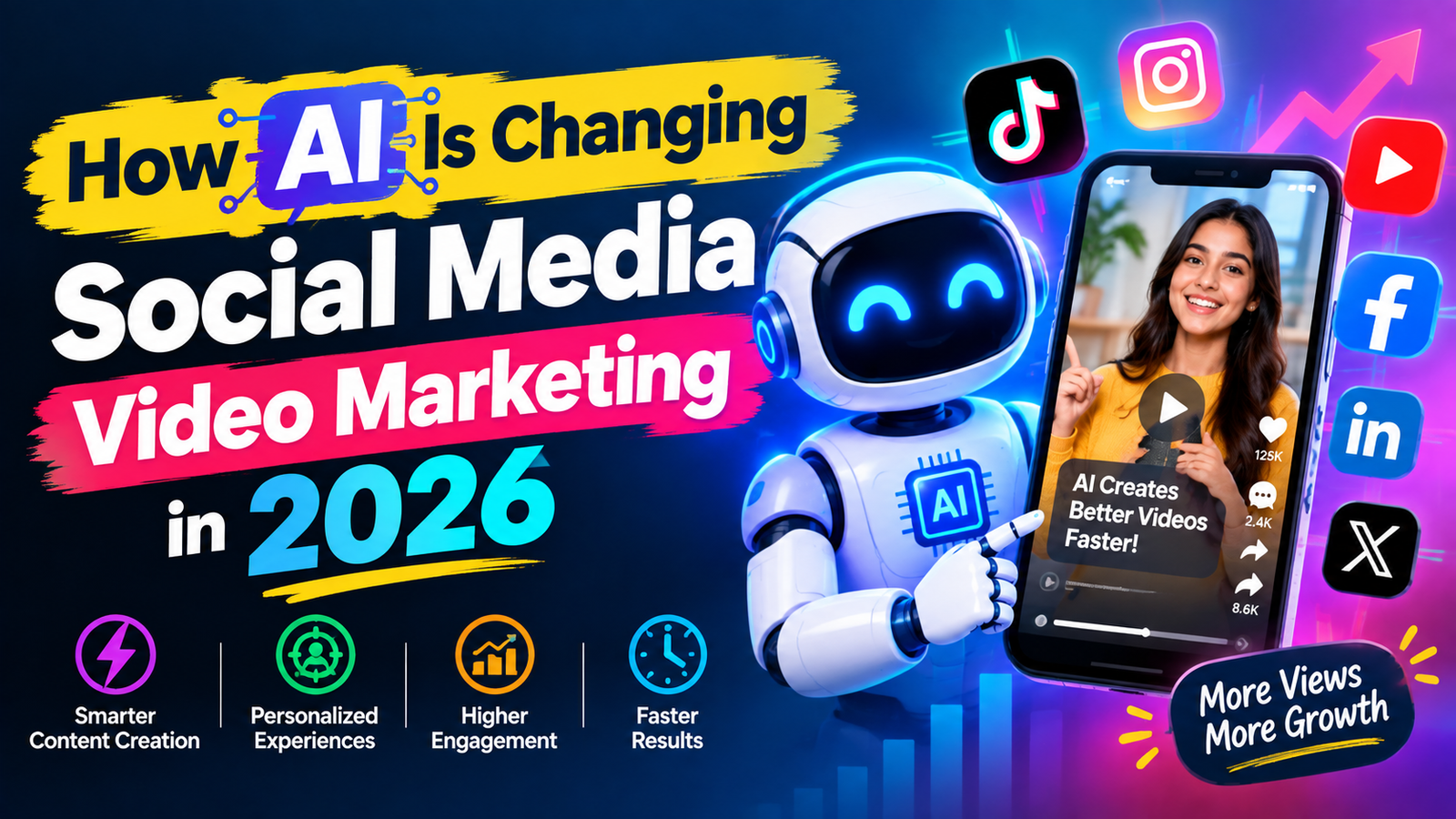
Social media video marketing is changing faster than ever. Platforms such as YouTube, Instagram, TikTok, Facebook, and LinkedIn are increasingly built around video content, while brands are under constant pressure to create more engaging videos. In 2026, artificial intelligence is becoming one of the biggest technologies transforming this process.
From generating video ideas and writing scripts to creating voiceovers, editing footage, adding captions, analyzing audiences, and personalizing campaigns, AI can now support almost every stage of video marketing. For marketers and creators, this means less time spent on repetitive tasks and more opportunities to focus on creativity and strategy.
So, how is AI changing social media video marketing? Let’s explore the biggest changes and the ways businesses can use AI to create better content.
What Is AI-Powered Social Media Video Marketing?
AI-powered social media video marketing refers to using artificial intelligence tools to create, edit, optimize, distribute, and analyze video content for social platforms.
Traditional video marketing often requires separate tools and teams for research, scripting, filming, editing, design, captions, voiceovers, and analytics. AI can bring many of these tasks into a faster workflow.
For example, a marketer can start with a product idea and use AI to generate several video concepts. The same technology can help create a script, suggest a hook, produce narration, generate captions, and recommend different versions for different audiences.
AI doesn’t eliminate the need for human creativity. Instead, it can act as a powerful assistant throughout the content production process.
1. AI Is Making Video Ideas Easier to Generate
Coming up with fresh content ideas every day can be challenging.
AI tools can analyze topics, audience interests, previous content, and marketing goals to help generate new video concepts. Instead of spending hours brainstorming, marketers can quickly create a list of possible ideas.
For example, a skincare brand could ask AI for:
- Instagram Reel ideas
- Product demonstration concepts
- Educational video topics
- Seasonal campaign ideas
- Frequently asked question videos
- User-generated content concepts
Marketers can then select the strongest ideas and develop them further.
This makes AI particularly useful for brands that need to maintain a consistent publishing schedule.
2. AI Is Transforming Video Script Writing
Writing a strong video script is one of the most important parts of content creation.
AI script writing tools can create introductions, hooks, talking points, transitions, storytelling structures, and calls to action.
For short-form videos, AI can also help shorten a long explanation into a concise script.
A marketer might start with a 1,500-word blog post and turn it into several short videos. One could explain the main idea, another could highlight three important tips, while another could answer a common customer question.
However, AI-generated scripts should not simply be copied and published. Human editing is essential for adding personality, accuracy, brand voice, and originality.
3. AI Is Improving Video Editing
Video editing can take hours, particularly when creating frequent short-form content.
AI-powered editing features can automate several repetitive tasks. Depending on the software, these may include removing unwanted sections, generating captions, improving audio, detecting scenes, resizing videos, and identifying important moments.
AI can also help creators turn long-form videos into shorter clips.
This is particularly valuable for marketers who want to distribute one piece of content across multiple platforms.
Instead of creating completely separate videos for YouTube, Instagram, and TikTok, marketers can start with a longer piece and adapt it into platform-specific formats.
4. AI Is Creating More Personalized Videos
Personalization has become an important part of digital marketing.
AI can help brands create different versions of a video based on audience characteristics, interests, behavior, or location.
For example, an online retailer could create different promotional messages for new customers and existing customers.
A travel company could also promote different destinations based on a viewer’s interests.
The goal is simple: show people content that feels more relevant to them.
However, personalization needs to be used responsibly. Brands should respect privacy and follow applicable data protection requirements when using customer information.
5. AI Voiceovers Are Making Narration Easier
Professional voiceovers can improve marketing videos, but traditional recording can require time, equipment, and additional production costs.
AI voice generators allow marketers to transform written scripts into spoken narration.
Modern AI voice tools can offer different languages, accents, speaking styles, and tones. This can help brands produce promotional videos, tutorials, explainer content, and social media clips more efficiently.
AI voiceovers can also make revisions easier. If one sentence changes, marketers can regenerate the affected section rather than arranging an entirely new recording.
For commercial campaigns, businesses should always check the tool’s voice licensing and usage terms.
6. AI Is Making Multilingual Video Marketing Easier
Social media allows brands to reach audiences around the world.
However, language barriers can make international marketing challenging.
AI translation and dubbing technologies can help marketers adapt video content for different languages. A single campaign can potentially be transformed into several language versions.
This can make localization faster and more scalable.
Still, automated translation should be reviewed by fluent speakers whenever possible. Direct translations may miss cultural references, humor, slang, or subtle differences in meaning.
7. AI Is Improving Social Media Captions
Many people watch social media videos without sound.
Captions therefore play an important role in accessibility and engagement.
AI can automatically generate subtitles and captions from video audio. It can also help format text for short-form videos.
Some AI editing platforms can identify important phrases and create visually emphasized captions.
Creators should still review automatically generated captions because names, technical terms, numbers, and accents can sometimes be transcribed incorrectly.
8. AI Is Helping Brands Create Better Video Ads
AI is changing how businesses approach social media advertising.
Instead of creating one advertisement and hoping it performs well, marketers can produce multiple versions with different hooks, visuals, messages, and calls to action.
These variations can then be tested to understand which creative approach works best.
For example, one version might focus on price, another on convenience, and another on a specific product benefit.
AI-powered analytics can help identify patterns in campaign performance, allowing marketers to make more informed creative decisions.
9. AI Is Improving Video SEO and Discoverability
Creating a great video is only half the challenge. People also need to find it.
AI can help marketers identify relevant topics, keywords, titles, descriptions, and content angles.
For YouTube, this may include suggestions for searchable titles and descriptions. For Instagram and other platforms, AI can help identify relevant topics and phrases that make content easier to understand and categorize.
However, keyword stuffing is not a good strategy.
The primary goal should always be creating useful content that satisfies the audience.
10. AI Is Helping Predict Content Performance
One of the most interesting developments in AI-powered video marketing is predictive analysis.
AI can examine historical performance data and identify patterns related to views, watch time, engagement, audience retention, and conversions.
Marketers can use these insights to make better decisions about:
- Video length
- Topics
- Posting schedules
- Hooks
- Formats
- Calls to action
- Audience segments
AI predictions are not guarantees. Social media trends can change quickly, so marketers should combine AI recommendations with real-world testing.
11. AI Is Making Content Repurposing Faster
Content repurposing is one of the biggest opportunities for marketers.
A single long-form video can become multiple pieces of content.
For example, a 15-minute YouTube video could be transformed into:
- Five Instagram Reels
- Several YouTube Shorts
- TikTok clips
- Quote graphics
- Social media captions
- Blog content
- Email content
AI can identify potentially valuable sections and help transform them into different formats.
This approach allows brands to get more value from every piece of content they produce.
12. AI Is Changing Influencer and UGC Marketing
User-generated content and influencer marketing continue to be important for social media brands.
AI can help marketers analyze creator content, generate campaign briefs, write scripts, identify content themes, and organize large volumes of video assets.
AI-generated UGC-style content is also becoming more common.
However, transparency matters. Brands should avoid misleading audiences into believing that synthetic content is genuine user-generated content when that distinction is important.
Authenticity remains one of the biggest advantages of creator marketing.
Benefits of AI for Social Media Video Marketing
The growing use of AI offers several advantages:
Faster Production
AI can automate repetitive tasks and reduce production time.
Lower Costs
Businesses may be able to reduce some expenses associated with editing, transcription, narration, and content development.
More Content
Faster workflows make it easier to produce content consistently.
Better Personalization
AI can help create content variations for different audience groups.
Improved Analysis
AI can process large amounts of performance data and identify useful patterns.
Easier Repurposing
Long-form content can be transformed into multiple short-form assets.
Challenges of AI in Video Marketing
Despite its benefits, AI also creates challenges.
One concern is content quality. AI-generated videos can sometimes feel repetitive, generic, or overly polished.
Another issue is originality. If many brands use similar AI tools and prompts, their content can begin to look and sound alike.
There are also concerns around misinformation, deepfakes, copyright, voice cloning, privacy, and disclosure.
For these reasons, human oversight remains essential.
How Marketers Can Use AI Without Losing Authenticity
The best strategy is not to let AI take over the entire creative process.
Instead, use AI for repetitive and time-consuming tasks while keeping humans responsible for important creative decisions.
For example:
AI: Generate ideas.
Human: Select the best concept.
AI: Create a first-draft script.
Human: Add personal stories and brand expertise.
AI: Generate captions.
Human: Check accuracy and tone.
AI: Analyze performance data.
Human: Decide what to create next.
This combination can create a faster workflow without sacrificing authenticity.
The Future of AI in Social Media Video Marketing
AI will likely become even more integrated into video marketing workflows.
Future tools may make it easier to generate highly personalized videos, automatically adapt content for different platforms, create multilingual versions, and analyze audience reactions.
However, technology alone will not guarantee success.
People still respond to stories, emotions, humor, useful information, and authentic experiences. Brands that use AI while maintaining a strong human voice will have a better opportunity to stand out.
Final Thoughts
AI is changing social media video marketing by making content creation faster, more scalable, and increasingly personalized. From AI script writing and voiceovers to automated editing, captions, analytics, and content repurposing, artificial intelligence can support almost every stage of a modern video strategy.
The biggest opportunity isn’t simply creating more videos. It is creating better and more relevant videos with less wasted effort.
Brands and creators should therefore treat AI as a creative partner rather than a complete replacement for human input. Use technology to handle repetitive tasks, but keep storytelling, originality, judgment, and authenticity at the center of your strategy.
In 2026, the brands that combine AI-powered efficiency with human creativity may be the ones best positioned to capture attention in an increasingly crowded social media landscape.