
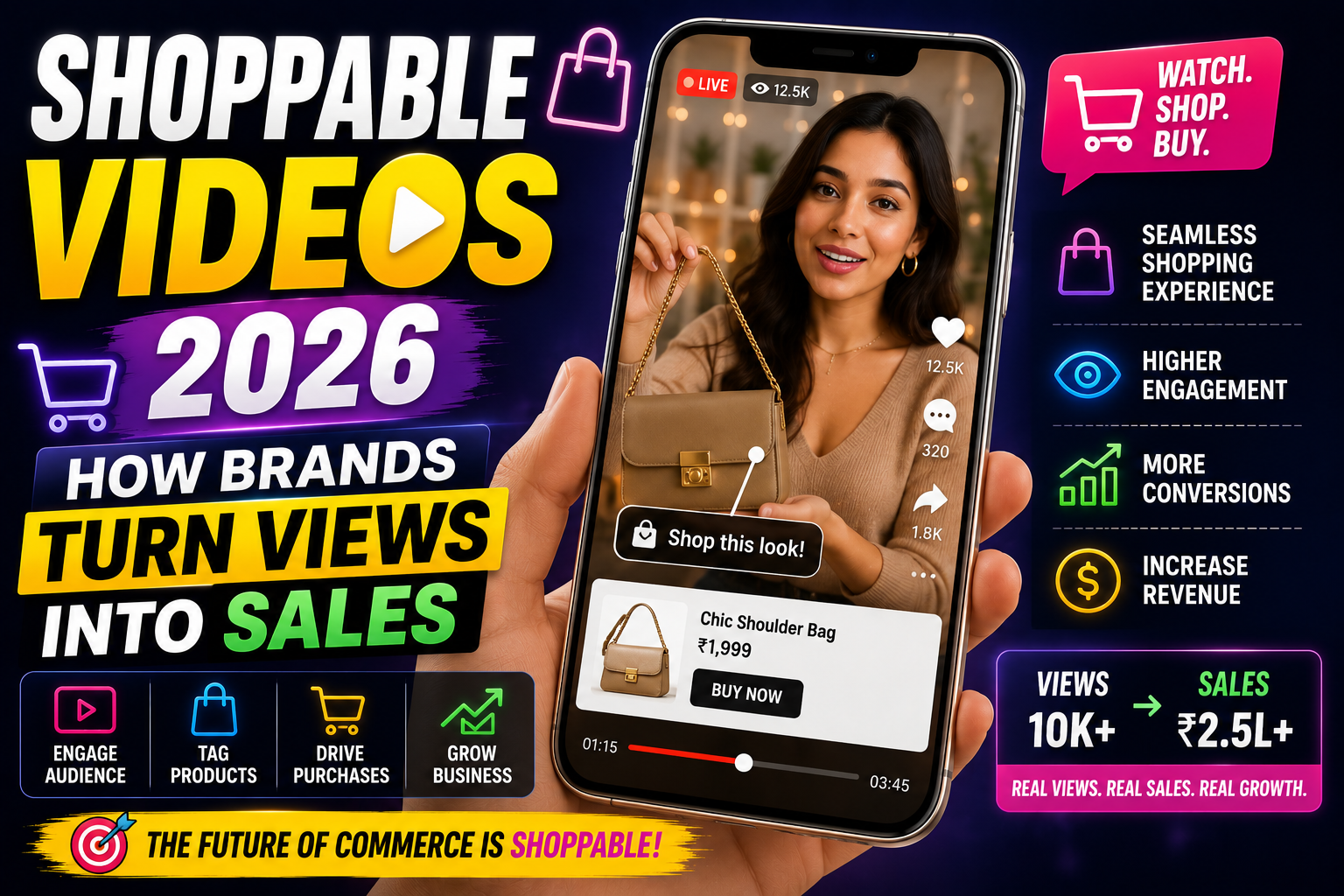
Shoppable Videos 2026: How Brands Turn Views Into Sales
Imagine watching a short video about a stylish outfit. You like the jacket, want to know its price and decide to buy it. Instead of leaving the video, opening a browser and searching for the product, you simply tap the item on the screen and head directly to checkout.
That is the basic idea behind shoppable videos.
Video has already become one of the most powerful formats for digital marketing. Now, brands are taking it a step further by connecting entertainment, product discovery and shopping in the same experience.
As a result, shoppable videos in 2026 are becoming an important strategy for e-commerce brands, retailers, creators and small businesses.
But how exactly do they work? Why are brands investing in them? And can a video really turn views into sales?
Let’s take a closer look.
What Are Shoppable Videos?
Shoppable videos are videos that allow viewers to interact with products and move closer to purchasing them.
Depending on the platform, viewers may be able to:
- Tap a product
- View product details
- Check prices
- Explore different products
- Visit a product page
- Add an item to a shopping cart
- Complete a purchase
Traditional video marketing mainly focuses on awareness and engagement.
Shoppable video marketing adds a commerce layer to that experience.
Instead of asking viewers to remember a product and search for it later, brands can make the buying journey much shorter.
Why Are Shoppable Videos Trending in 2026?
Consumers increasingly discover products through social media, creators, short-form videos and recommendations.
People aren’t always searching for a product by typing its name into a search engine.
Sometimes, they discover it while scrolling.
A beauty creator demonstrates a skincare routine. A fashion creator styles a new outfit. A technology creator demonstrates a gadget.
Suddenly, the viewer becomes a potential customer.
That’s where shoppable videos become powerful.
Discovery and purchasing can happen much closer together.
Instead of separating entertainment from shopping, brands can combine the two.
How Do Shoppable Videos Work?
The process is relatively simple.
Step 1: Create the Video
A brand or creator produces engaging video content around a product.
Step 2: Add Product Information
Relevant products are connected to the video through shopping tags, links or interactive elements, depending on the platform.
Step 3: Viewer Watches
The audience watches the video naturally.
Step 4: Viewer Interacts
Interested viewers tap the product or shopping feature.
Step 5: Product Page Opens
The viewer sees additional information such as price, specifications, sizes or variations.
Step 6: Purchase
The customer completes the purchase through the available shopping experience.
The fewer unnecessary steps between watching and buying, the easier it can be for interested viewers to convert.
Shoppable Videos vs Traditional Product Videos
A traditional product video may show an item and tell viewers where to buy it.
For example:
“Visit our website to shop this product.”
A shoppable video can make the next step more direct.
| Feature | Traditional Product Video | Shoppable Video |
|---|---|---|
| Product demonstration | Yes | Yes |
| Product discovery | Yes | Yes |
| Direct shopping interaction | Limited | Yes |
| Product links | Sometimes | Usually |
| Purchase journey | Longer | Potentially shorter |
| Engagement | Video-based | Video + shopping |
| Conversion focus | Moderate | High |
This doesn’t mean traditional product videos are outdated.
Instead, shoppable videos add another layer to the customer journey.
1. Shoppable Videos Reduce Friction
Online shoppers can lose interest when the purchasing process becomes complicated.
Imagine discovering a product on social media and then having to:
- Remember the brand name
- Search for the website
- Find the product
- Select the correct version
- Add it to the cart
- Complete checkout
That’s a lot of steps.
A shoppable video can reduce some of that friction.
When the product is directly connected to the content, the viewer can move from interest to product discovery much more easily.
2. Short-Form Video Makes Products More Discoverable
Instagram Reels, YouTube Shorts and TikTok-style content have changed how people consume online video.
Short-form content is fast, visual and highly shareable.
That makes it a natural environment for product discovery.
A brand doesn’t necessarily need to create a traditional advertisement.
Instead, it can create useful or entertaining content around the product.
For example:
“3 ways to style white sneakers.”
The sneakers become part of the content rather than feeling like an interruption.
That distinction can make product promotion feel more natural.
3. Influencers Can Drive Shoppable Commerce
Creators have built strong relationships with niche audiences.
A fashion creator might influence clothing purchases.
A beauty creator can introduce skincare products.
A technology creator can demonstrate gadgets.
Consequently, influencer marketing and shoppable videos can work particularly well together.
Instead of simply mentioning a product, creators can demonstrate how it fits into their content.
Viewers who are interested can then explore the product directly.
4. Live Shopping Is Expanding the Concept
Shoppable videos don’t have to be pre-recorded.
Live shopping combines livestreaming with real-time product discovery.
During a live session, creators or brand representatives can:
- Demonstrate products
- Answer questions
- Compare products
- Explain features
- Offer promotions
- Interact with viewers
- Direct viewers toward products
This format creates a more interactive shopping experience.
It can also help brands answer questions that customers might normally ask before purchasing.
5. Shoppable Videos Are Powerful for Beauty and Fashion
Some industries are naturally visual.
Beauty and fashion are perfect examples.
A beauty brand can create a video showing:
Cleanser → Serum → Moisturiser → Sunscreen
Viewers can then explore individual products.
Similarly, a fashion creator could show an entire outfit:
Top → Jeans → Shoes → Bag → Accessories
Each item can potentially become part of the shopping experience.
This creates an opportunity for brands to increase product discovery without making every video feel like a conventional advertisement.
6. Brands Can Use Shoppable Videos for Product Demonstrations
Some products are difficult to understand from photographs alone.
Video can demonstrate how they work.
For example:
- Kitchen appliances
- Fitness equipment
- Smartphones
- Beauty tools
- Home gadgets
- Cleaning products
- Furniture
Instead of simply describing a product feature, marketers can show it in action.
That visual demonstration can help customers understand the product more quickly.
How to Create a High-Converting Shoppable Video
Creating a shoppable video doesn’t mean simply attaching a product link to any random video.
The content itself needs to be engaging.
Here are some useful strategies.
Start With a Strong Hook
The first few seconds need to give viewers a reason to continue watching.
Try starting with:
“Here’s why this product is everywhere right now.”
or:
“Three things I wish I knew before buying this.”
The hook should match the actual content and avoid misleading claims.
Show the Product Early
Don’t make viewers wait until the final seconds to understand what you’re promoting.
Introduce the product naturally near the beginning.
Show how it looks, works or solves a problem.
Demonstrate Instead of Just Describing
A demonstration is often more powerful than a list of features.
Instead of saying:
“This blender is powerful.”
show it blending different ingredients.
Instead of saying:
“This jacket is versatile.”
show three ways to style it.
Use Realistic Calls to Action
Your call to action should tell viewers what to do next.
Examples include:
- Shop the product
- Explore the collection
- See available colours
- Check today’s offer
- Discover the full range
Avoid using aggressive sales language in every video.
The CTA should feel like the natural next step.
Keep the Shopping Experience Mobile-Friendly
Most social video consumption happens on mobile devices.
Therefore, product pages should load quickly and display important information clearly.
Make sure customers can easily find:
- Product price
- Product images
- Sizes or variants
- Key features
- Delivery information
- Reviews
- Return information
- Checkout options
A great video can still fail if the product page creates unnecessary friction.
Use UGC for Shoppable Videos
User-generated content can make product videos feel more relatable.
For example, instead of creating a highly polished commercial, a brand can use creator-style content showing someone genuinely demonstrating a product.
However, brands should distinguish between real customer experiences and AI-generated or scripted promotional content.
If a testimonial isn’t based on an actual customer experience, it shouldn’t be presented as one.
Trust matters.
AI and Shoppable Videos in 2026
Artificial intelligence is also changing video commerce.
AI can help marketers with:
- Video scripts
- Product descriptions
- Captions
- Editing
- Translation
- Voiceovers
- Creative variations
- Personalisation
- Audience targeting
For example, one product video could be adapted into different versions for different audiences.
However, human review remains important.
AI-generated content can contain errors, inaccurate product details or unrealistic visuals.
Always verify important product information before publishing.
How to Measure Shoppable Video Performance
Views are only one part of the story.
A strong shoppable video marketing strategy should track the entire customer journey.
Important metrics include:
Video Views
How many people watched the content?
Watch Time
How long did viewers stay?
Engagement Rate
Did people like, comment, save or share it?
Product Clicks
How many viewers interacted with the shopping element?
Add-to-Cart Rate
How many visitors added the product to their cart?
Conversion Rate
How many completed purchases?
Revenue
How much sales revenue did the video generate?
Return on Ad Spend
If you’re running paid campaigns, how much revenue did you generate compared with advertising costs?
These metrics help marketers understand whether videos are generating attention and business results.
Common Shoppable Video Mistakes
Even a great concept can fail if executed poorly.
Making Every Video a Hard Sell
People don’t open social apps only to see advertisements.
Create useful and entertaining content too.
Weak Product Demonstrations
Simply holding a product in front of the camera isn’t always enough.
Show what makes it useful.
Too Many Products
Promoting dozens of products in one short video can overwhelm viewers.
Focus on a clear theme.
Misleading Claims
Don’t exaggerate product results or features.
Ignoring Mobile Experience
Your shopping page needs to work smoothly on smartphones.
Focusing Only on Views
A million views don’t automatically equal a million sales.
Shoppable Video Ideas for Brands
Need inspiration?
Try these formats:
- Product unboxing videos
- How-to tutorials
- Before-and-after demonstrations
- Top 5 product lists
- Creator reviews
- Styling videos
- Product comparisons
- Frequently asked questions
- Behind-the-scenes content
- Live product demonstrations
- Gift guides
- Seasonal shopping videos
The best format depends on your product and audience.
The Future of Shoppable Videos
The future of video commerce is likely to become increasingly interactive.
Instead of simply watching advertisements, consumers may discover products through personalised feeds, creator recommendations, AI-powered suggestions and interactive videos.
Brands may also use more personalised creative variations.
For example, a customer interested in skincare could see a video focused on skincare routines, while another interested in fitness might see the same product positioned differently.
As technology improves, the boundary between content and commerce could become even smaller.
Final Thoughts
Shoppable videos are changing the way brands turn attention into action in 2026.
Instead of separating video marketing from e-commerce, brands can connect product discovery and shopping within the same digital experience.
The biggest opportunity isn’t simply adding a shopping button to a video.
It’s creating content that people genuinely want to watch and then making it easy for interested viewers to explore the product.
Short-form videos, creator content, product demonstrations, live shopping and AI-assisted production are all helping brands experiment with this approach.
However, successful video commerce still depends on the basics: strong storytelling, accurate product information, authentic communication and a smooth mobile shopping experience.
Ultimately, views are valuable—but conversions are what turn video marketing into a business strategy.
In 2026, the brands that combine entertainment, usefulness and easy shopping could have the strongest opportunity to turn the endless social-media scroll into meaningful sales.