
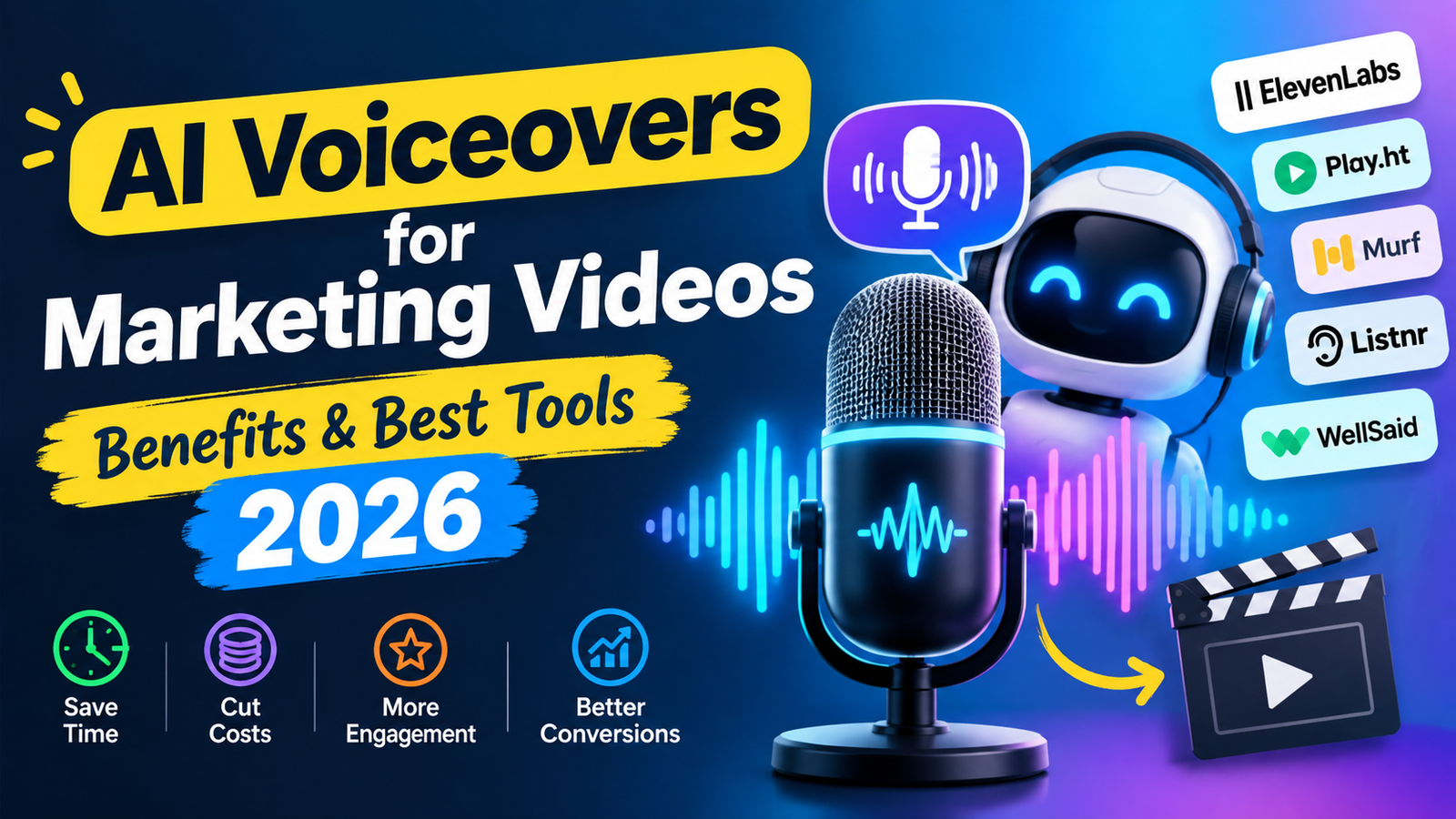
Video marketing has become one of the most powerful ways for brands to reach customers, but producing professional videos can take considerable time and money. From writing scripts and recording narration to editing audio and syncing it with visuals, the process involves several steps. AI voiceovers for marketing videos are changing that workflow by allowing businesses and creators to turn written scripts into natural-sounding narration in minutes.
AI voice generators can create voices for advertisements, product demonstrations, explainer videos, social media content, tutorials, presentations, and promotional campaigns. They can also help brands create multiple versions of a video for different audiences and languages.
However, AI voice technology isn’t simply about pressing a button and generating speech. Choosing the right voice, controlling pronunciation, matching the tone to your brand, and reviewing the final audio are all important. Let’s explore the benefits of AI voiceovers and some of the best tools to consider in 2026.
What Are AI Voiceovers?
AI voiceovers use artificial intelligence and text-to-speech technology to transform written text into spoken audio.
Instead of hiring a voice actor and recording every sentence in a studio, marketers can enter a script into an AI voice generator, choose a suitable voice, and create narration digitally.
Modern AI voices can offer different accents, languages, speaking styles, pacing, and emotional tones. Some platforms also provide voice cloning or customization features.
This makes AI voiceovers useful for brands that need to produce a large amount of video content quickly.
Why Are AI Voiceovers Popular for Marketing?
Marketing teams constantly need fresh content. A company might create YouTube videos, Instagram Reels, product ads, educational videos, website tutorials, and social media campaigns at the same time.
Traditional voice recording can become expensive and time-consuming, especially when a campaign requires multiple revisions.
AI voiceovers can simplify this process.
A script can be updated and regenerated without scheduling another recording session. Marketers can also experiment with different voices and delivery styles before choosing the final version.
For example, an energetic voice may work well for a short social media advertisement, while a calm and professional voice may be more suitable for a software tutorial.
Benefits of AI Voiceovers for Marketing Videos
1. Faster Content Production
One of the biggest advantages of AI voiceovers is speed.
Once the script is ready, marketers can generate narration quickly instead of arranging recording sessions. This can be particularly useful for businesses producing frequent social media content.
A faster workflow means teams can spend more time on creative ideas, visuals, distribution, and performance analysis.
2. Lower Production Costs
Hiring professional voice talent for every video can increase production expenses.
AI voice generators can reduce some of those costs, particularly for businesses producing large volumes of short-form content.
However, brands should always review the licensing terms of the specific AI tool and voice they use, especially for paid advertising and commercial campaigns.
3. Consistent Brand Voice
Consistency matters in marketing.
Using a consistent AI voice across videos can help audiences become familiar with a brand’s audio identity. Some platforms also offer voice customization or cloning features that can support a more recognizable style.
A consistent voice can be particularly useful for product tutorials, training content, and recurring social media series.
4. Easy Editing and Revisions
Marketing videos often change after approval.
A product price might change. A promotion may end. A product feature could be updated.
With traditional voice recording, even one changed sentence may require another recording session.
With AI voiceovers, marketers can modify the script and regenerate the affected section.
5. Multilingual Marketing
Global brands often need to adapt campaigns for different markets.
AI voice platforms can support multiple languages and accents, making localization more accessible.
For example, one marketing concept can be adapted into different language versions rather than relying entirely on a single English-language video.
However, native-language review remains valuable because pronunciation, cultural context, and wording can vary considerably.
6. Better Accessibility
Voice narration can make visual content easier to understand for people who prefer or require audio-based information.
When combined with captions and accessible design, AI voiceovers can help marketers create more inclusive content.
Best AI Voiceover Tools for Marketing Videos in 2026
Several platforms stand out for different marketing workflows. The best choice depends on whether you prioritize realism, editing, branding, multilingual content, or an all-in-one production workflow.
1. ElevenLabs
ElevenLabs is one of the prominent AI voice platforms for creators and marketing teams.
Its current platform offers expressive text-to-speech, voice customization, voice cloning, and multilingual capabilities. ElevenLabs says its technology supports more than 70 languages, while its video-focused tools can add AI voiceovers to tutorials, advertisements, vlogs, and social content.
Best for:
- Marketing advertisements
- Social media videos
- Product narration
- Multilingual campaigns
- Expressive voiceovers
For brands where natural and expressive narration is a priority, ElevenLabs is worth considering.
2. Murf AI
Murf AI is designed specifically around AI voice generation and content production.
Murf says its platform provides more than 300 AI voices across more than 33 languages, along with controls for pitch, speed, pronunciation, emphasis, and emotional tone.
It also provides tools for combining narration with visuals and background music. Its Canva integration allows users to generate and add voiceovers directly within Canva projects.
Best for:
- Marketing videos
- Explainer videos
- Presentations
- Product demonstrations
- Corporate content
- Canva-based workflows
Murf can be particularly useful for marketers who want more control over how narration matches their visuals.
3. Descript
Descript combines AI voiceovers with video and audio editing.
Its AI Voice Over tool lets users enter or paste a script, choose an AI voice, and synchronize narration with the video. Descript also supports voice cloning and text-based video editing.
The platform also provides a broader marketing-video workflow that combines scripts, voiceovers, captions, visuals, and editing.
Best for:
- YouTube marketing
- Social media videos
- Tutorials
- Product videos
- Video editing and voiceover in one workflow
If you want to edit your video and voiceover together, Descript can be a practical choice.
4. Canva AI Voice Generator
Canva is another convenient option for marketers who already create graphics and videos on the platform.
Canva’s AI voice generator allows users to enter text, choose a voice, generate narration, and continue editing the video within Canva. The platform supports multiple languages and accents and positions the feature for ads, promotional videos, YouTube clips, and other content.
Best for:
- Social media marketers
- Small businesses
- Promotional videos
- Instagram Reels
- Simple video projects
Its biggest advantage is convenience for users who already use Canva for visual content.
How to Choose the Best AI Voice Generator
Don’t choose a platform simply because its voice sounds realistic.
Consider your complete marketing workflow.
Voice Quality
Listen to samples before selecting a voice. Pay attention to pronunciation, pauses, emotion, and natural rhythm.
Language Support
If your business serves international audiences, check whether the tool supports the languages and accents you actually need.
Commercial Rights
Always read the licensing terms before using AI-generated voices in advertisements or other commercial campaigns.
Customization
Look for controls over speed, pitch, emphasis, pronunciation, and emotional delivery if your content requires a specific style.
Editing Features
An integrated editor can save time if you want to synchronize narration with video, captions, music, and visual elements.
How to Create an AI Voiceover for a Marketing Video
The process is relatively simple.
Step 1: Write the Script
Start with a clear marketing message. Keep the audience and objective in mind.
Step 2: Choose the Voice
Select a voice that matches your brand personality.
A technology company might prefer a confident and modern voice, while a wellness brand could benefit from a calm and friendly tone.
Step 3: Adjust the Delivery
Fine-tune pronunciation, speed, pauses, emphasis, and tone where the platform allows it.
Step 4: Generate and Review
Listen carefully before publishing. Check names, numbers, product terms, and technical words.
Step 5: Sync With Visuals
Match narration with product shots, animations, captions, demonstrations, or other visuals.
Step 6: Add Captions and Music
Captions can improve accessibility and help viewers understand the message when watching without sound. Background music should support the narration rather than overpower it.
How to Make AI Voiceovers Sound More Natural
Even high-quality AI voices can sound unnatural if the script is poorly written.
Write conversational sentences rather than complicated paragraphs. Use punctuation to create natural pauses.
You can also break long sentences into shorter sections and add pronunciation guidance when necessary.
Most importantly, listen to the entire recording before publishing.
A sentence that looks perfectly fine on a screen may sound awkward when spoken aloud.
Limitations of AI Voiceovers
AI voiceovers offer significant advantages, but they aren’t perfect.
Some voices may still struggle with unusual names, technical terminology, sarcasm, humor, or highly emotional performances.
There are also ethical and legal considerations surrounding voice cloning. Businesses should obtain appropriate permission before cloning or reproducing someone’s voice.
AI-generated audio should also be reviewed for accuracy, pronunciation, and brand suitability.
Final Thoughts
AI voiceovers for marketing videos are becoming an important part of modern content production. They can help businesses create narration faster, reduce some production costs, maintain consistency, support multilingual campaigns, and simplify revisions.
Tools such as ElevenLabs, Murf AI, Descript, and Canva offer different approaches to AI voice generation and video production. The right option depends on your budget, content volume, desired voice style, editing workflow, and commercial requirements.
Still, technology should support creativity rather than replace it. A great AI voice cannot rescue a weak marketing message.
Start with a strong script, choose a voice that fits your audience, review the generated narration carefully, and combine it with compelling visuals. Done well, AI voiceovers can make your video marketing workflow faster while helping your brand produce more content consistent