
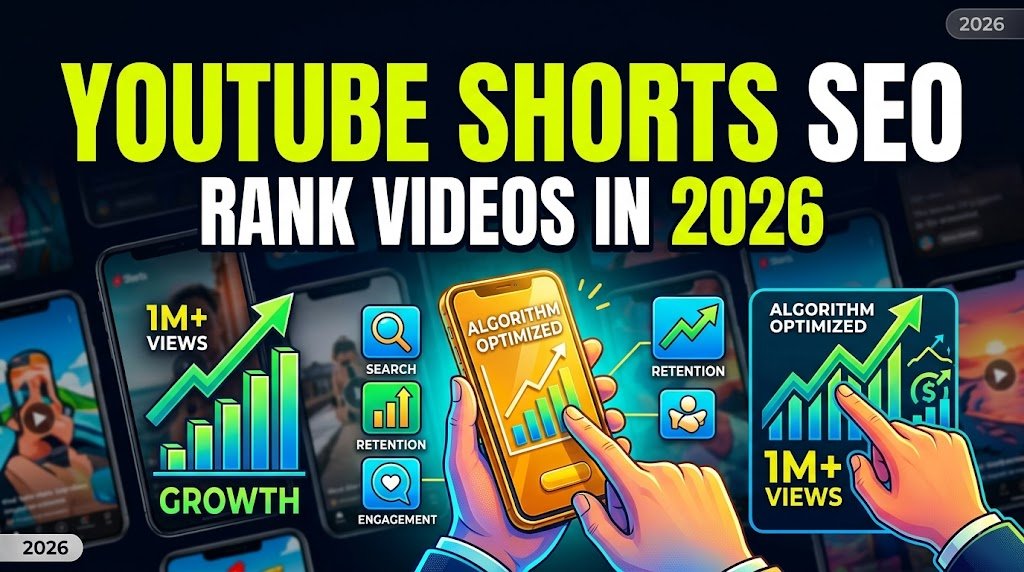
YouTube Shorts SEO has become increasingly important for creators who want their short-form videos to reach a larger audience in 2026. With viewers discovering content through the Shorts feed, YouTube Search, recommendations and the home page, simply uploading a video is no longer enough.
A successful Shorts strategy combines keyword optimization, strong hooks, audience retention, engaging titles, relevant descriptions, captions and consistent publishing. The goal isn’t to stuff keywords everywhere. Instead, creators should help YouTube understand what their video is about while creating content viewers genuinely want to watch.
Whether you’re a beginner, influencer, small business owner or established creator, understanding how to rank YouTube Shorts in 2026 can help you attract new viewers and build a stronger channel.
What Is YouTube Shorts SEO?
YouTube Shorts SEO refers to the process of optimizing short-form videos so they can be better understood and discovered by YouTube’s search and recommendation systems.
Unlike traditional SEO, Shorts SEO isn’t just about keywords.
YouTube also considers how viewers interact with your content. Factors such as watching behavior, engagement and viewer satisfaction can influence how widely a Short is recommended.
That’s why a perfectly optimized title won’t rescue a boring video.
Think of SEO as the map, while your content is the vehicle. You need both to reach your destination.
1. Choose the Right Keyword
Keyword research is the foundation of YouTube Shorts SEO.
Start by identifying what your target audience is searching for.
For example, a beauty creator could target:
- Easy makeup routine
- Makeup tips for beginners
- Best skincare routine
- How to apply concealer
- Summer skincare tips
A fitness creator might target:
- 5-minute workout
- Home workout
- Beginner workout
- Exercises for stronger legs
- Daily stretching routine
Choose keywords that accurately describe your video.
Avoid targeting a highly popular keyword if your video doesn’t actually answer the searcher’s question.
2. Put the Main Keyword in Your Title
Your title should clearly communicate what viewers will get from the video.
For example:
Weak:
“Try This 😍🔥”
Better:
“5-Minute Morning Workout for Beginners”
The second title immediately explains the subject.
You don’t have to make every title robotic or keyword-heavy. A good title should sound natural while clearly communicating the video’s topic.
3. Write SEO-Friendly Descriptions
Descriptions give YouTube additional context.
For Shorts, you don’t need an enormous description. A few useful sentences can be enough.
For example:
“Try this simple 5-minute morning workout for beginners. These easy exercises can help you build a consistent home fitness routine without equipment.”
The main keyword appears naturally without unnecessary repetition.
You can also include related phrases and relevant information.
4. Use Relevant Hashtags
Hashtags can help categorize your content, but don’t treat them as a magic formula for viral reach.
Use a small number of relevant hashtags.
For example, a fitness Short might use:
#Shorts #HomeWorkout #FitnessTips
A beauty video could use:
#Shorts #MakeupTips #BeautyTips
Avoid adding dozens of unrelated hashtags.
Relevance is more useful than quantity.
5. Create a Strong Hook
SEO can help people discover your Short, but your opening determines whether they stay.
The first few seconds need to create curiosity.
Try openings such as:
- “Stop doing this if you want clearer skin.”
- “Here’s the easiest way to style wide-leg jeans.”
- “Try these three exercises before your next workout.”
- “Most beginners make this makeup mistake.”
- “Here’s what nobody tells you about YouTube Shorts.”
The hook should match the actual content.
Don’t promise something dramatic and then deliver something unrelated.
6. Improve Audience Retention
Retention is one of the most important areas to focus on when creating Shorts.
If viewers consistently swipe away quickly, your video may struggle to reach a wider audience.
Keep your video moving.
You can improve retention by:
- Removing unnecessary introductions
- Using quick visual changes
- Adding captions
- Showing the result early
- Creating curiosity
- Using storytelling
- Avoiding repetitive sections
Every second should have a purpose.
7. Keep Your Shorts Focused
One Short should generally communicate one main idea.
Suppose your topic is skincare.
Instead of creating one video containing:
“10 skincare tips, 5 makeup tricks, 3 hairstyles and 4 fashion trends,”
split the information into separate Shorts.
You could create:
Short 1: 3 skincare mistakes
Short 2: How to repair your skin barrier
Short 3: Morning skincare routine
Short 4: Night skincare routine
This gives you multiple pieces of content from one topic.
8. Use Keywords in Spoken Content
YouTube can understand more than your title.
Your spoken words can also provide useful context.
If your Short is about YouTube Shorts SEO, naturally say something like:
“Here are three YouTube Shorts SEO tips that can help beginners optimize their videos.”
Don’t repeat the keyword unnaturally.
Speak normally.
The purpose is to clearly communicate the topic rather than manipulate the system.
9. Add Captions and On-Screen Text
Captions can make Shorts easier to follow, especially for viewers watching without sound.
Use short phrases rather than large blocks of text.
For example:
“3 YouTube Shorts SEO Tips”
Then introduce each tip:
“1. Use a clear keyword”
“2. Improve your hook”
“3. Study retention”
Make your text readable on mobile screens and avoid placing important information where interface elements may cover it.
10. Create Search-Friendly Content
Some Shorts are naturally more searchable than others.
Tutorials, how-to videos, answers and quick explanations can perform well in search because viewers have a specific question.
Examples include:
- How to edit YouTube Shorts
- How to add captions to Shorts
- How to grow on YouTube
- How to use YouTube Studio
- How to make thumbnails
- How to improve video quality
Think about the questions your audience types into YouTube.
Then create Shorts that provide quick answers.
11. Use Trending Topics Without Losing Your Niche
Trends can provide an opportunity to attract new viewers.
However, jumping onto every trend can confuse your audience.
Instead, connect trends to your niche.
A fashion creator could discuss a trending celebrity outfit.
A technology creator could explain a new smartphone trend.
A fitness creator could analyze a popular workout trend.
The formula is:
Trending topic + your expertise = relevant content
12. Study YouTube Analytics
Don’t rely entirely on views.
YouTube Studio can provide valuable information about how your Shorts perform.
Look at metrics such as:
- Views
- Watch time
- Audience retention
- Likes
- Comments
- Shares
- Subscribers gained
- Traffic sources
Compare your best-performing Shorts with videos that received fewer views.
Ask yourself:
Did the successful video have a stronger hook?
Was the topic more searchable?
Was it shorter?
Did viewers watch more of it?
Your analytics can reveal patterns that are difficult to see from the outside.
13. Make Content People Want to Share
A Short can reach new audiences when viewers share it with friends or communities.
Create content that is:
- Useful
- Entertaining
- Relatable
- Surprising
- Educational
- Inspirational
For example, a Short titled “5 YouTube mistakes beginners make” could be highly relevant to new creators.
People are more likely to share information when they believe someone else will find it useful.
14. Post Consistently
Consistency gives you more opportunities to learn.
That doesn’t mean you need to upload several Shorts every day.
Instead, create a schedule you can realistically maintain.
For example:
Monday: Educational Short
Wednesday: Trend-related Short
Friday: Tutorial
Sunday: Q&A or relatable content
Quality should remain more important than simply increasing upload volume.
15. Build Topic Authority
If you repeatedly publish useful content around a specific subject, viewers may begin to associate your channel with that topic.
For example, a channel focused on:
YouTube growth → YouTube SEO → Shorts tips → YouTube analytics
has a clearer identity than a channel that randomly posts cooking, gaming, fashion and finance videos.
A focused content strategy can make it easier to attract the right audience.
YouTube Shorts SEO Mistakes to Avoid
While optimizing your Shorts, avoid these common mistakes:
Keyword Stuffing
Repeating the same keyword multiple times doesn’t make your video better.
Clickbait
A misleading title might generate clicks, but disappointed viewers won’t necessarily become loyal followers.
Irrelevant Hashtags
Using unrelated trending hashtags can make your content less relevant.
Copied Content
Reusing someone else’s content without adding meaningful original value can create problems for your channel and may reduce the opportunity for recommendation.
Weak Introductions
Long greetings waste valuable attention.
Ignoring Analytics
If you never study your performance data, you’re essentially guessing.
How Long Should YouTube Shorts Be in 2026?
YouTube expanded Shorts to support videos up to three minutes, giving creators more flexibility for storytelling and educational content.
However, longer doesn’t automatically mean better.
A 20-second video may be ideal for a quick tip.
A 60-second video may work better for a tutorial.
A longer Short can make sense when the topic genuinely requires more explanation.
The key is to use only as much time as the idea needs.
Best YouTube Shorts SEO Strategy for 2026
A practical workflow can look like this:
Step 1: Find a topic your audience cares about.
Step 2: Identify the primary keyword.
Step 3: Create a strong hook.
Step 4: Explain one clear idea.
Step 5: Add relevant captions.
Step 6: Write a natural SEO-friendly title.
Step 7: Add a concise description.
Step 8: Use relevant hashtags.
Step 9: Publish consistently.
Step 10: Study the analytics and improve your next video.
This creates a cycle of research → creation → publishing → analysis → improvement.
Can YouTube Shorts SEO Make a Video Go Viral?
SEO can improve discoverability, but there is no guaranteed formula for virality.
A Short can have excellent keywords and still receive limited views.
Another video with a simple title can suddenly attract millions of viewers because the content connects strongly with an audience.
That’s why you shouldn’t focus exclusively on rankings.
Focus on making something people want to watch until the end, share with others and watch again.
Final Thoughts
YouTube Shorts SEO in 2026 is about much more than adding keywords and hashtags. Successful creators need to combine search optimization with strong storytelling, audience retention, original content and consistent experimentation.
Start with a clear keyword and topic. Build a compelling opening. Keep the video focused. Add useful captions and a natural description. Then study your analytics to understand what your audience actually enjoys.
Most importantly, don’t chase algorithms at the expense of viewers.
Create for people first, optimize for discovery second, and use analytics to improve continuously.
That’s the approach that can help your YouTube Shorts channel grow sustainably in 2026.