

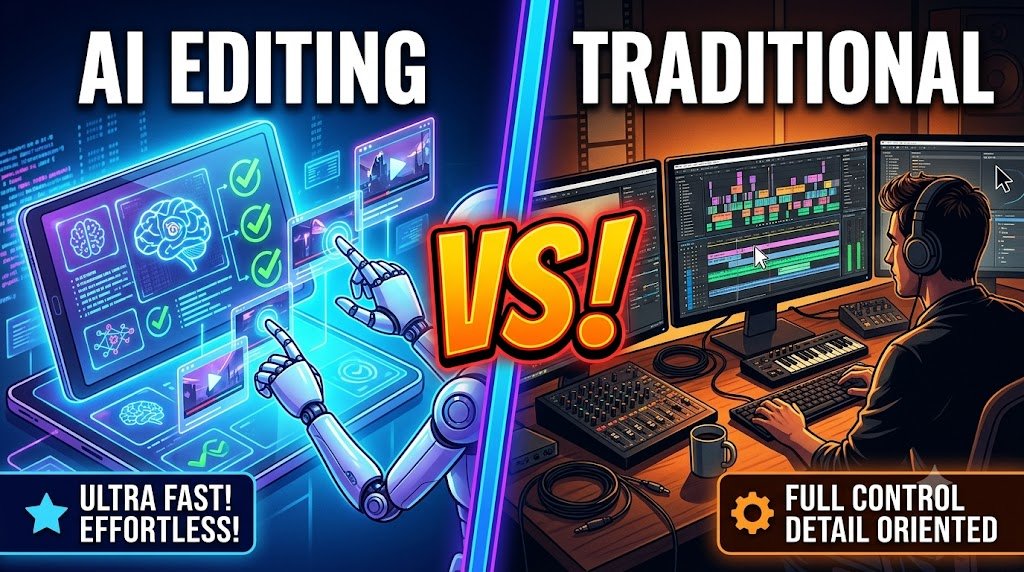
AI Video Editing vs Traditional Video Editing has become one of the biggest discussions among YouTubers, marketers, filmmakers and content creators in 2026. Artificial intelligence has changed the way videos are produced, offering automated editing, captions, scene detection, background removal, audio enhancement and even AI-generated footage.
Traditional video editing, however, is far from obsolete. Professional editors still rely on tools such as Adobe Premiere Pro, Apple Final Cut Pro and Blackmagic Design DaVinci Resolve when projects require detailed creative control.
So, is AI video editing better than traditional video editing?
The short answer is: neither is automatically better. AI is excellent at speeding up repetitive tasks, while traditional editing gives creators greater control over storytelling, timing and creative decisions. In many cases, the strongest workflow in 2026 combines both.
Let’s compare AI and traditional video editing, their advantages and disadvantages, costs, speed, quality and the situations where each approach makes the most sense.
What Is AI Video Editing?
AI video editing uses artificial intelligence and machine-learning technology to automate or assist with different parts of the editing process.
Instead of manually reviewing every clip, an AI-powered editor can analyze footage and identify useful scenes, speech, objects and audio.
Depending on the software, AI features may include:
- Automatic video trimming
- Speech-to-text transcription
- Automatic subtitles
- Background removal
- Noise reduction
- Audio enhancement
- Scene detection
- Silence removal
- Automatic reframing
- Object tracking
- Color correction
- Generative video features
- AI voiceovers
- Text-based video editing
The biggest advantage is simple:
AI can reduce the amount of repetitive manual work required to produce a video.
What Is Traditional Video Editing?
Traditional video editing relies primarily on human decisions.
An editor imports footage, organizes clips, creates a timeline, cuts scenes, adjusts audio, adds transitions, performs color correction and builds the final story.
Professional editing software can provide extremely detailed control over:
- Video cuts
- Timing
- Color
- Audio
- Visual effects
- Motion graphics
- Transitions
- Camera angles
- Text
- Animation
- Layering
Traditional editing can be slower, but it gives the editor control over practically every creative decision.
AI Video Editing vs Traditional Video Editing: Key Difference
The biggest difference is automation versus manual creative control.
AI asks:
“How can I complete this editing task faster?”
Traditional editing asks:
“Exactly how do I want this moment to look and feel?”
AI can analyze thousands of frames in a short period.
A human editor can understand context, emotion, humor, cultural references and storytelling in a way automated systems may not consistently reproduce.
That difference becomes particularly important for professional productions.
AI Video Editing: Major Advantages
1. Faster Editing
Speed is probably AI video editing’s biggest advantage.
Imagine recording a 45-minute interview.
Traditionally, an editor might need to watch the entire recording, identify important sections and create clips manually.
AI can help with transcription, silence detection, clip identification and caption generation.
That doesn’t necessarily eliminate the editor, but it can dramatically reduce repetitive work.
2. Automatic Captions
AI can automatically transcribe spoken content and create subtitles.
This is particularly useful for:
- YouTube videos
- Instagram Reels
- YouTube Shorts
- TikTok videos
- Interviews
- Educational content
Captions can also make videos more accessible to viewers who are deaf or hard of hearing.
3. Easy Background Removal
AI-powered background removal can separate subjects from their surroundings without requiring traditional green-screen workflows in many situations.
This can be useful for:
- Product videos
- Social-media content
- Tutorials
- Presentations
- Short-form videos
4. Audio Enhancement
AI tools can reduce background noise, improve speech clarity and help balance audio.
For creators recording in imperfect environments, this can be extremely useful.
5. Automatic Reframing
A horizontal video may need to become a vertical Short.
AI can automatically identify the main subject and reposition the frame.
This makes it easier to repurpose long-form content for mobile platforms.
6. Lower Barrier to Entry
Traditional professional editing can have a steep learning curve.
AI-powered editors can simplify certain tasks for beginners.
Someone who has never edited a video may be able to create a basic social-media video much faster with AI assistance.
Traditional Video Editing: Major Advantages
1. Complete Creative Control
Traditional editing gives you precise control over every frame.
You decide:
- When a cut happens
- Which reaction shot appears
- How long a pause lasts
- When music begins
- How colors change
- How the story develops
For professional storytelling, that control can be invaluable.
2. Better Creative Decision-Making
AI can recognize patterns, but storytelling isn’t simply pattern recognition.
A human editor can understand why a three-second pause might make an emotional scene more powerful.
They can intentionally break conventional editing rules.
They can decide that an unexpected cut is better than a technically “optimal” transition.
3. Complex Projects
Large productions often involve complicated timelines, multiple cameras, visual effects, audio tracks and detailed color workflows.
Traditional professional software remains extremely powerful for this type of work.
4. Consistency and Brand Identity
Brands often need highly specific visual styles.
A professional editor can maintain:
- Brand colors
- Typography
- Animation styles
- Transitions
- Music choices
- Visual pacing
AI can assist with these tasks, but human oversight is often necessary for consistent results.
AI Video Editing vs Traditional Editing: Speed
When it comes to speed, AI generally has the advantage.
For repetitive tasks such as:
Transcription → Captions → Silence removal → Basic trimming → Formatting
AI can dramatically accelerate production.
Traditional editing takes longer because the editor manually makes decisions.
However, speed isn’t everything.
A 30-minute AI workflow that produces a poor video isn’t better than a two-hour workflow that produces an excellent one.
The goal should be efficient quality, not speed alone.
Which Is More Affordable?
The answer depends on the software and project.
AI editing platforms often use:
- Free tiers
- Monthly subscriptions
- Credit systems
- Usage-based pricing
Traditional professional editing software can also involve subscriptions or one-time purchases, depending on the application.
But software cost isn’t the only expense.
Traditional editing may require:
- Powerful hardware
- Storage
- Plugins
- Templates
- Professional editing skills
AI can reduce some of these barriers.
For beginners and small creators, AI may therefore provide a more accessible entry point.
AI vs Traditional Editing: Which Produces Better Quality?
This question is more complicated.
AI can produce impressive results, especially for routine editing.
But quality depends heavily on the project.
For a simple talking-head YouTube video, AI may be capable of handling much of the basic editing.
For a dramatic short film, advertisement or documentary, human creative control becomes much more important.
The strongest approach is often:
AI handles repetitive tasks → Human handles creative decisions.
AI Video Editing for YouTube Creators
YouTube creators can benefit significantly from AI-assisted editing.
For example, one long video can become:
- Full YouTube video
- Three YouTube Shorts
- Instagram Reels
- TikTok clips
- Captioned social posts
- Highlight clips
AI can help identify interesting sections and automatically resize content for different platforms.
This allows creators to turn one recording session into multiple pieces of content.
Traditional Editing for Professional Creators
Traditional editing remains valuable for:
- Films
- Commercials
- Music videos
- Documentaries
- High-end YouTube productions
- Corporate films
- Television
- Narrative storytelling
These projects often require creative judgment that cannot simply be automated.
An experienced editor can shape a story emotionally.
That’s something software alone cannot guarantee.
AI Video Editing vs Traditional Video Editing: Pros and Cons
| Feature | AI Video Editing | Traditional Editing |
|---|---|---|
| Speed | Very fast for repetitive tasks | Usually slower |
| Ease of use | Beginner-friendly | Steeper learning curve |
| Automation | Excellent | Limited |
| Creative control | Moderate to high | Extremely high |
| Captions | Excellent automation | Usually manual or assisted |
| Audio cleanup | Strong AI assistance | Detailed manual control |
| Complex storytelling | Limited by AI workflow | Excellent |
| Learning curve | Lower | Higher |
| Customization | Increasing rapidly | Extremely extensive |
| Best use | Fast content production | Professional creative work |
Will AI Replace Video Editors?
This is one of the biggest questions in the industry.
The more realistic answer is that AI is more likely to change the role of video editors than completely eliminate them.
Editors who only perform repetitive tasks may face greater automation.
But editors who understand:
- Storytelling
- Pacing
- Branding
- Cinematography
- Sound design
- Visual language
- Creative direction
can use AI as a productivity tool.
Think about photography.
Digital cameras didn’t eliminate photographers.
They changed photography.
AI is doing something similar to video editing.
How Human Editors Can Use AI
Instead of seeing AI as competition, editors can treat it as an assistant.
For example:
AI: Transcribes interview.
Editor: Chooses the strongest statements.
AI: Removes obvious silences.
Editor: Refines pacing.
AI: Creates captions.
Editor: Corrects errors and styles them.
AI: Suggests clips.
Editor: Chooses the clips that actually tell the story.
This workflow combines automation with human judgment.
Best AI Video Editing Tools in 2026
The AI video-editing market includes tools with different strengths.
Popular categories include:
AI-Powered Professional Editors
Professional editing platforms increasingly include AI features for transcription, masking, audio enhancement and creative workflows.
Text-Based Video Editors
These allow users to edit video by editing a transcript.
They’re especially useful for interviews and talking-head videos.
AI Social Video Editors
These focus on quickly producing Shorts, Reels and social-media clips.
Generative Video Tools
These can create or modify video content using text or image prompts, expanding the possibilities beyond traditional editing.
Who Should Use AI Video Editing?
AI editing is particularly useful for:
- Beginners
- YouTubers
- Social-media creators
- Small businesses
- Marketers
- Podcasters
- Educators
- Faceless-channel creators
- Creators producing high volumes of content
If your biggest problem is time, AI can be extremely valuable.
Who Should Use Traditional Video Editing?
Traditional editing is particularly suitable for:
- Professional filmmakers
- Documentary creators
- Video agencies
- Cinematic YouTubers
- Commercial productions
- Editors working on complex projects
- Creators who need frame-by-frame control
If your biggest priority is creative precision, traditional editing remains powerful.
The Best Approach in 2026: Hybrid Video Editing
Rather than choosing one side, many creators can benefit from combining both.
A practical workflow could look like this:
1. Record high-quality footage.
2. Use AI to transcribe and organize it.
3. Use AI for initial cuts and captions.
4. Manually refine the timeline.
5. Add creative transitions and graphics.
6. Adjust colors manually where necessary.
7. Use AI for audio cleanup.
8. Perform a final human quality check.
This can provide the best balance between speed and creativity.
Common Mistakes With AI Video Editing
AI can save time, but don’t rely on it blindly.
Don’t Accept Every AI Cut
AI doesn’t always understand context.
Check Captions
Names and technical terms can be transcribed incorrectly.
Don’t Overuse Effects
Automation can make videos feel generic.
Maintain Your Brand
Your videos should still have a recognizable identity.
Review AI-Generated Content
Always check for errors, misleading edits or inaccurate information.
Future of Video Editing in 2026 and Beyond
AI video editing will likely become increasingly integrated into traditional editing software.
Instead of opening a separate AI tool, editors may simply describe what they want:
“Remove the background noise.”
“Create three Shorts from this interview.”
“Find the strongest moments.”
“Make this footage suitable for vertical video.”
The software can handle the technical work while the editor focuses on creative decisions.
This could make professional editing faster without eliminating the need for creative expertise.
Final Verdict: AI or Traditional Video Editing?
So, AI Video Editing vs Traditional Video Editing—which is better in 2026?
The answer depends on what you’re creating.
If you need speed, automation and efficiency, AI video editing is an excellent choice.
If you need maximum creative control, storytelling precision and complex production capabilities, traditional video editing remains the stronger option.
But creators don’t necessarily have to choose.
The most effective strategy is often AI-assisted traditional editing.
Let AI handle the repetitive work.
Let humans handle the creative work.
That’s the sweet spot.
AI can find clips, generate captions, clean audio and speed up production. But a human editor still needs to decide what the audience should feel, when a story should slow down, which shot matters most and what makes the final video memorable.
In 2026, the future of video editing isn’t simply AI versus humans.
It’s AI + human creativity.