
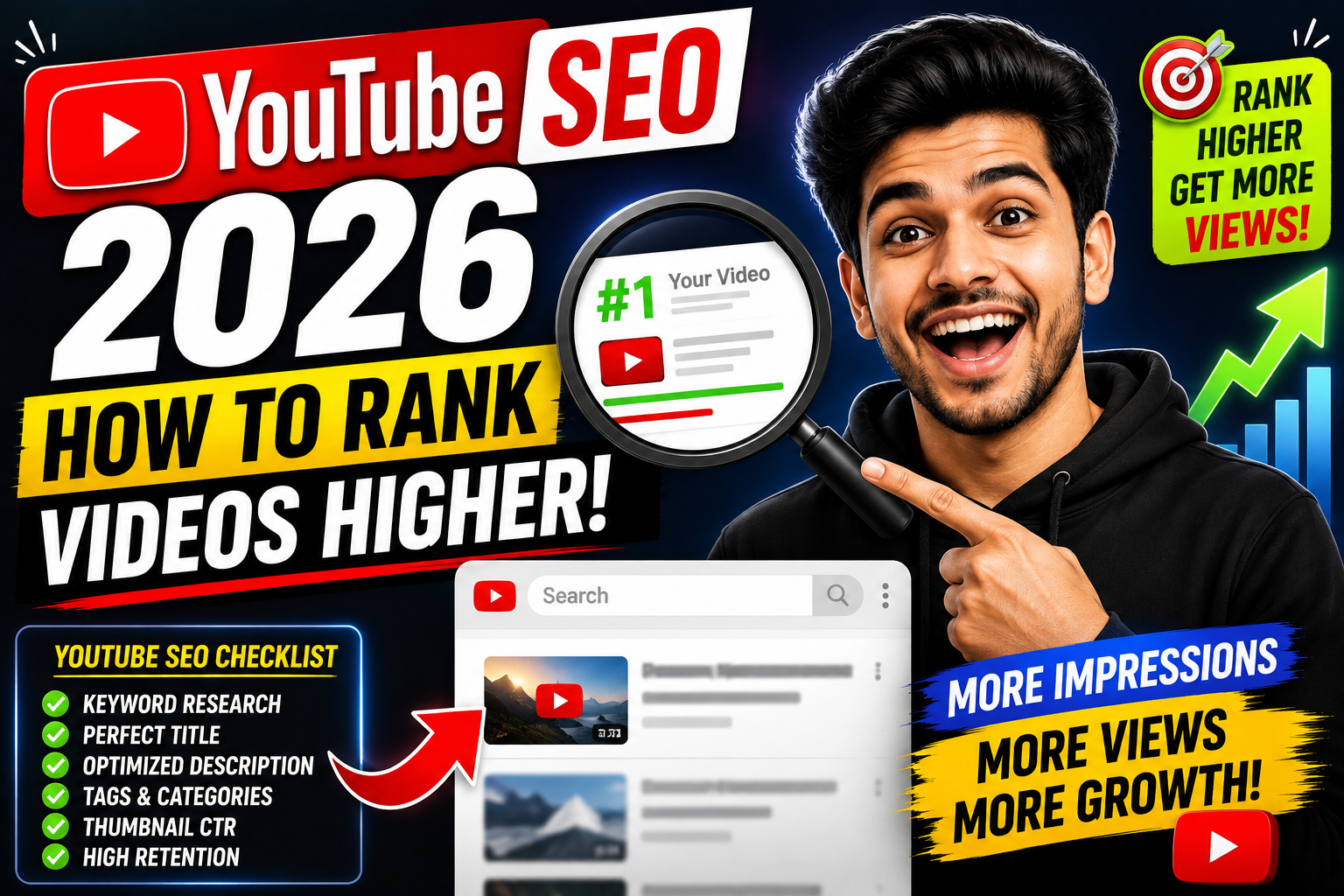
YouTube SEO 2026 is more important than ever for creators who want their videos to appear in search results, reach new viewers and generate consistent views. Simply uploading a video and adding a few keywords is no longer enough. You need to understand what people are searching for, create content that satisfies their intent, and package that content with an attractive title and thumbnail.
YouTube says its search system primarily considers relevance, engagement and quality when determining which videos appear for a search. Relevance can include how well the title, description, tags and video content match a viewer’s query.
At the same time, YouTube recommendations are highly personalized. The platform considers viewer behavior and whether people choose to watch, continue watching and enjoy the content.
So, if you’re wondering how to rank YouTube videos higher in 2026, the strategy is no longer about stuffing keywords everywhere. It’s about combining YouTube keyword research, strong packaging, viewer retention and valuable content.
What Is YouTube SEO?
YouTube SEO is the process of optimizing your videos so that YouTube can better understand the content and connect it with viewers who are searching for or interested in that topic.
It includes optimizing:
- Video titles
- Descriptions
- Keywords
- Video content
- Thumbnails
- Chapters
- Playlists
- Audience retention
- Engagement
- Overall viewer satisfaction
Think of YouTube SEO like putting a sign outside a store.
The keywords tell YouTube what the store sells. The thumbnail and title convince people to enter. The video itself determines whether they stay.
You need all three.
How YouTube Search Ranking Works in 2026
YouTube identifies three major elements for search ranking:
1. Relevance
Does your video actually match what the viewer searched for?
YouTube can examine information such as your title, description, tags and video content to understand relevance.
2. Engagement
Do people actually watch the video after finding it?
Watch time and other engagement signals can help YouTube understand whether a video satisfies a particular search.
3. Quality
Does the content demonstrate useful expertise, authority and trustworthiness?
This becomes particularly important for topics where viewers need reliable information.
Therefore, simply repeating a keyword 20 times won’t guarantee a higher ranking.
1. Start With YouTube Keyword Research
Before recording your video, determine what your audience actually searches for.
Instead of choosing a broad topic like:
you could target a more specific search query:
“How to Get More Views on YouTube Shorts in 2026.”
The second topic tells you exactly what the viewer wants.
You can use YouTube’s search suggestions to discover related queries. YouTube’s search predictions are influenced by factors such as popularity, similarity and trending searches.
Look for keywords that:
- Match your niche
- Have clear search intent
- Solve a specific problem
- Are relevant to your audience
- You can realistically create better content around
2. Choose One Primary Keyword
One common mistake beginners make is trying to target dozens of unrelated keywords in one video.
Instead, choose one primary keyword.
For example:
Primary keyword: YouTube SEO 2026
Then use closely related secondary phrases naturally:
- YouTube SEO tips
- how to rank YouTube videos
- YouTube search ranking
- YouTube keyword research
- how to get more YouTube views
This gives your video a clear topical focus.
3. Create a Search-Friendly Video Title
Your title is one of the first things both viewers and YouTube encounter.
A strong SEO title should clearly communicate what the viewer will get.
For example:
Weak:
“Some YouTube Tips You Should Know”
Better:
“YouTube SEO 2026: How to Rank Videos Higher”
The second title is more specific and contains the primary keyword naturally.
YouTube itself recommends using searchable titles when you want to reach viewers searching for a particular topic, while curiosity-driven titles can work well for viewers who aren’t actively searching.
4. Don’t Stuff Keywords Into Your Title
SEO doesn’t mean repeating the same phrase unnecessarily.
Avoid titles such as:
“YouTube SEO 2026 | YouTube SEO Tips | YouTube SEO Ranking | YouTube SEO Guide”
It looks unnatural and can reduce the appeal of your video.
Instead, write a title that sounds like something a real person would want to click.
For example:
“YouTube SEO 2026: 10 Ways to Rank Your Videos Higher”
Clear. Relevant. Clickable.
5. Write an Optimized Description
Your video description gives YouTube and viewers additional context.
YouTube recommends using the first few lines to describe the video because that is what viewers see before expanding the description. It also recommends creating unique descriptions and prominently featuring one or two main terms in the title and description.
A good description can include:
- Primary keyword
- Secondary keywords
- Short video summary
- Important links
- Chapters
- Related resources
- Social links where appropriate
Don’t turn your description into a wall of keywords.
Write for humans first.
6. Use YouTube Tags Correctly
Tags still exist, but they aren’t as important as many creators believe.
According to YouTube, your title, thumbnail and description are more important for discovery, while tags generally play a minimal role. Tags can be particularly useful when a topic or name is commonly misspelled.
So don’t spend hours searching for hundreds of tags.
Use a small number of highly relevant terms and focus most of your effort on the video itself.
7. Create Better Thumbnails
Imagine YouTube as a crowded shopping street.
Your title is the store name.
Your thumbnail is the shop window.
If the window doesn’t attract attention, people may walk past.
YouTube says 90% of its best-performing videos have custom thumbnails, and recommends keeping thumbnail designs clear, readable and not overly complicated.
A strong thumbnail should:
- Have one clear visual idea
- Use readable text
- Create curiosity
- Match the video’s promise
- Work well on mobile screens
- Avoid unnecessary clutter
For example, instead of putting 20 words on a thumbnail, use:
“RANK HIGHER!”
Then let the title provide the detailed context.
8. Improve Your First 30 Seconds
SEO can get people to your video.
But your introduction needs to convince them to stay.
YouTube’s current guidance emphasizes the importance of the opening seconds because viewers decide quickly whether to continue watching. It recommends making sure the introduction delivers on the promise made by the title and thumbnail.
Avoid spending the first 30 seconds saying:
“Hey guys, welcome back to my channel…”
Instead, get straight to the value.
For example:
“If your YouTube videos are getting impressions but very few views, these five SEO changes could make a major difference. Let’s start with the one most creators overlook.”
Now the viewer has a reason to continue.
9. Focus on Audience Retention
Getting someone to click isn’t enough.
You also need them to watch.
YouTube Analytics provides audience-retention information that can help creators identify where viewers leave videos and where they remain engaged.
Look for:
- Large drop-offs
- Strong retention sections
- Repeated viewing
- Moments where viewers skip
- Engagement patterns
If viewers consistently leave during long introductions, shorten them.
If a particular section keeps people watching, consider creating more content around that format.
10. Don’t Make Videos Longer Just for SEO
There is no universal ideal YouTube video length.
YouTube explicitly advises creators to make videos as long as necessary to deliver the value effectively rather than adding filler simply to increase duration.
A useful eight-minute video can outperform a boring 20-minute video.
The question isn’t:
“How long should my video be?”
Ask:
“How long does my audience need to get the answer?”
That is a much better SEO strategy.
11. Use Related Videos to Build a Content Cluster
One video can attract viewers.
A collection of related videos can build a channel.
Suppose your niche is YouTube marketing.
You could create:
- YouTube SEO 2026
- YouTube Thumbnail Tips
- How to Get More Shorts Views
- YouTube Keyword Research
- YouTube Analytics Guide
- YouTube Monetization Guide
These videos support one another.
Use playlists, end screens and relevant links to help viewers discover related content.
The longer a viewer continues finding useful videos on your channel, the stronger your overall content ecosystem becomes.
12. Use YouTube Analytics to Improve SEO
Don’t guess what is working.
Look at your data.
YouTube Analytics can show:
- Impressions
- Click-through rate
- Views
- Watch time
- Average view duration
- Traffic sources
- Unique viewers
- Audience retention
You can also see whether viewers found your content through YouTube Search, suggested videos, browse features, Shorts Feed and other sources.
This information helps answer an important question:
Is the problem getting clicks—or keeping viewers?
If impressions are high but CTR is weak, improve the packaging.
If CTR is strong but viewers leave quickly, improve the video.
13. Understand CTR Correctly
Click-through rate is important, but don’t obsess over one number.
YouTube explains that CTR should be interpreted alongside impressions and traffic sources. CTR can decrease as YouTube exposes a video to a broader audience because those new viewers may be less likely to click than your core audience.
Therefore:
High CTR + low impressions doesn’t automatically mean success.
You need to understand the complete picture.
14. Optimize for Search Intent
Imagine someone searches:
“How to edit YouTube Shorts on phone.”
They don’t want a 20-minute history of YouTube.
They want an answer.
Your video should immediately address that need.
This is called search intent.
Before recording, ask:
What exactly does the person want after typing this keyword?
Then build the video around that answer.
15. Build Authority in One Niche
YouTube’s search system considers quality signals related to expertise, authoritativeness and trustworthiness.
This doesn’t mean you need to be famous.
It means your content should demonstrate genuine knowledge and provide useful information.
Instead of jumping between:
- Gaming
- Beauty
- Technology
- Finance
- Cooking
try building recognizable expertise around one audience or closely related group of topics.
Consistency makes it easier for viewers—and the platform—to understand what your channel is about.
16. Don’t Ignore Competition
Sometimes a video performs well but still doesn’t get massive reach.
Why?
Competition.
YouTube ranks your content against other videos that a viewer might watch, and topic interest and competition can influence how much exposure a video receives.
That’s why you should study competing videos.
Ask:
- What topics are they covering?
- What questions aren’t they answering?
- Are their thumbnails better?
- Is their introduction faster?
- Are they providing more useful examples?
- Can you explain the topic more clearly?
Don’t copy them.
Improve upon the experience.
17. Update Older Videos Strategically
Older videos don’t necessarily need to remain untouched.
If a video has weak CTR and fewer impressions than usual, YouTube says changing the title or thumbnail can sometimes shift performance because viewers may respond differently to the new presentation.
However, don’t change videos that are already performing well without a reason.
Instead, identify underperforming videos and experiment carefully.
18. YouTube SEO Mistakes to Avoid
Avoid these common mistakes:
Keyword Stuffing
Repeating keywords doesn’t automatically improve rankings.
Clickbait
A misleading title may attract clicks but disappoint viewers.
Long Introductions
Don’t make viewers wait for the information promised in the title.
Overloaded Thumbnails
Too much text can make a thumbnail difficult to understand.
Ignoring Analytics
Without data, you’re essentially guessing.
Chasing Every Trend
A trending topic isn’t useful if it doesn’t match your audience.
Making Videos Too Long
Never add unnecessary content simply to increase watch time.
YouTube SEO Checklist for 2026
Before publishing your next video, check:
☑ Primary keyword selected
☑ Search intent understood
☑ Keyword included naturally in title
☑ Unique description written
☑ Relevant tags added where useful
☑ Custom thumbnail created
☑ Strong opening hook
☑ Video delivers the promised value
☑ Relevant chapters added when useful
☑ Related videos linked through playlists/end screens
☑ Analytics reviewed after publishing
☑ Retention drops identified
☑ CTR and impressions evaluated together
Final Thoughts
YouTube SEO 2026 isn’t about finding a secret keyword or tricking the algorithm.
It’s about creating a video that is relevant to a search, attractive enough to click, useful enough to watch and satisfying enough to recommend.
YouTube’s current search system emphasizes relevance, engagement and quality, while its recommendation systems focus heavily on viewer personalization, performance and satisfaction.
That means creators should stop thinking only about keywords.
Think about the complete viewer journey:
Search → Click → Watch → Enjoy → Continue Watching
If you can consistently improve each step, your chances of growing through YouTube Search and recommendations become much stronger.
The creators who succeed in 2026 won’t necessarily be the ones who upload the most videos. They will be the ones who understand their audience, solve real problems, package their ideas effectively and continuously improve based on data.