
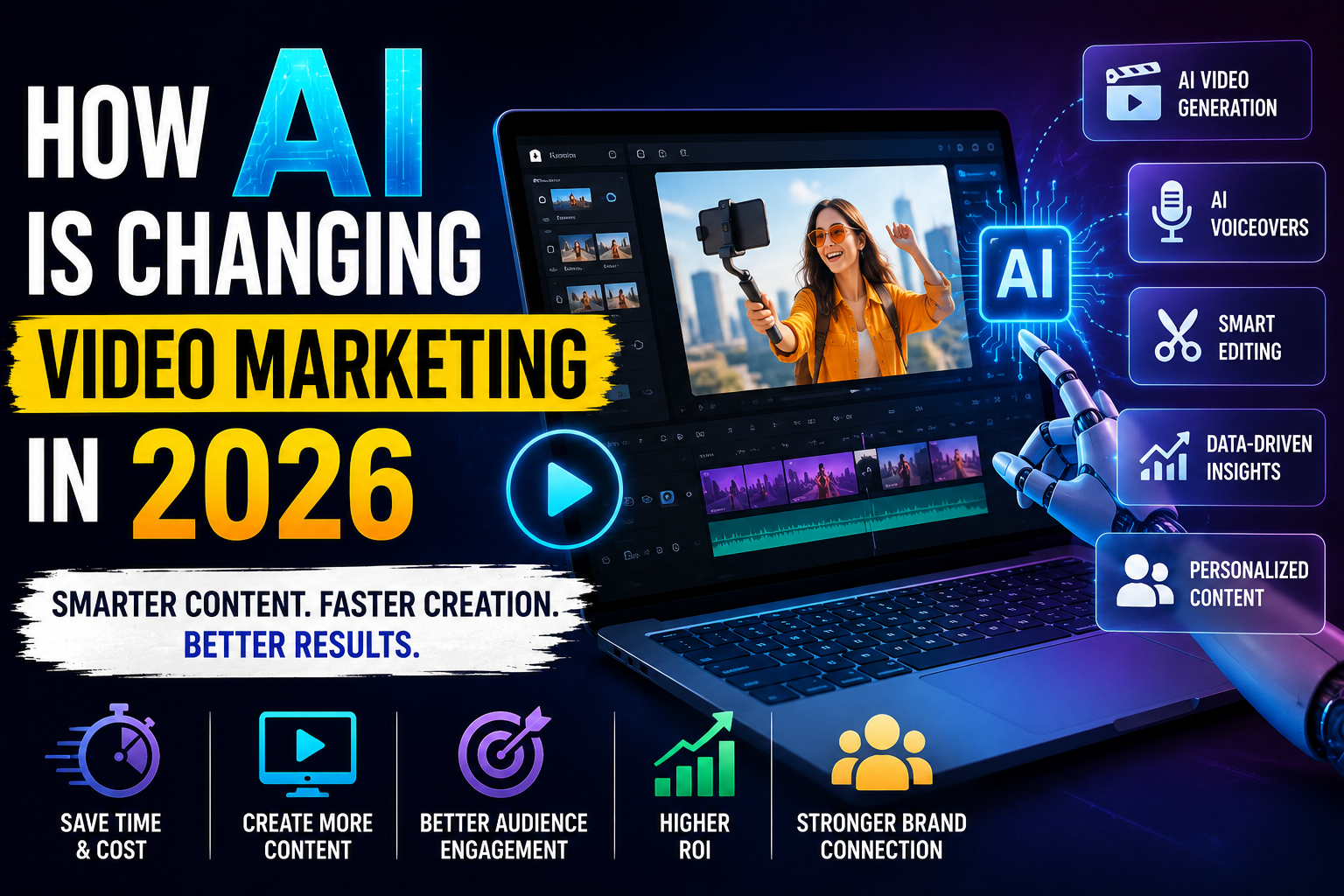
Artificial intelligence is changing the way businesses create, edit, distribute and measure video content in 2026. What once required a camera crew, professional editors, voice artists and hours of post-production can now begin with a simple text prompt and an AI-assisted workflow.
From AI-generated video clips and automated editing to personalized advertisements, AI avatars, voiceovers and smarter content recommendations, artificial intelligence is becoming part of everyday video marketing.
Major platforms and creative software companies are also adding AI directly into their video workflows. YouTube has introduced new AI-powered creation and discovery features, while Adobe now offers generative video and sound tools inside Premiere. Meta has also expanded AI-assisted video editing and creative tools.
But AI is not simply replacing traditional video production. The bigger change is that marketers can produce more content, test more ideas and personalize campaigns faster.
So, how exactly is AI changing video marketing in 2026? Let’s explore the biggest trends, benefits, challenges and strategies businesses should know.
AI Is Making Video Production Faster
Traditional video production can take days or even weeks.
A marketing team may need to write a script, organize a shoot, record footage, edit clips, add music, create subtitles and prepare different versions for multiple platforms.
AI can shorten several of these steps.
Modern AI video tools can help marketers generate footage, create voiceovers, remove unwanted elements, produce captions and suggest edits. Adobe’s Generative Media Tool, for example, allows users to generate video clips and sound effects directly inside Premiere’s editing timeline.
This means marketers can experiment without constantly moving between different applications.
For a small business, that can make professional-looking video content much more accessible.
AI Video Generation Is Becoming More Practical
One of the biggest changes in 2026 is the improvement of generative video.
Instead of starting with existing footage, marketers can describe a scene and use an AI model to create video content.
For example, a travel company could generate a cinematic visual of a beach destination for an advertisement. A fashion brand could create concept visuals before organizing a real photoshoot.
Academic research published in 2026 also highlights the rapid development of video-generation systems, including advances in multimodal and autoregressive models that can create increasingly coherent and detailed video content.
However, marketers should treat generated footage as a creative tool rather than an automatic replacement for real-world content.
Real people, authentic experiences and original brand storytelling can still create stronger emotional connections.
AI Is Transforming Video Editing
Editing is one of the areas where AI can save marketers significant time.
AI-assisted editing can help identify scenes, remove unwanted sections, generate captions, improve audio and create different versions of the same video.
Adobe’s latest Premiere tools allow creators to generate video and sound effects within the editing timeline and then continue refining the generated material like other editable clips.
Meta has also introduced AI-powered editing features that can transform elements such as clothing, locations and lighting in short-form videos.
For social media marketers, this matters because one campaign may require multiple versions.
A single long video can become:
- Instagram Reels
- YouTube Shorts
- Facebook videos
- Website clips
- Product advertisements
- Video teasers
- Story content
AI can help turn one piece of content into several marketing assets.
AI Is Helping Marketers Create More Personalized Videos
Personalization is another major opportunity.
Instead of creating one generic advertisement for everyone, marketers can use AI to develop different creative variations for different audiences.
For example, a fitness company could create separate versions for:
- Beginners
- Weight-training enthusiasts
- Runners
- Older adults
- Home-workout audiences
The core product remains the same, but the message, visuals or examples can change.
This approach allows marketers to test different creative ideas without producing every version manually.
AI can analyze campaign performance and help marketers identify which creative elements generate stronger engagement.
The result is a shift from “create one video and hope it works” to “create, test, learn and improve continuously.”
AI Is Changing Short-Form Video Marketing
Short-form video has become one of the most important formats for digital marketing.
Instagram Reels, YouTube Shorts and other vertical-video platforms constantly demand fresh content.
AI can help marketers maintain this content volume.
Meta has continued expanding AI-powered creative tools for video and says its recommendation systems are also increasingly focused on timely and original content. In the U.S., Meta reported that 75% of Instagram recommendations in Q4 2025 came from original posts.
For marketers, this creates an important lesson: AI can help produce content faster, but originality still matters.
Simply generating hundreds of generic videos may not build a successful brand.
AI should help marketers increase creativity rather than replace it.
AI Is Making YouTube Marketing Smarter
YouTube is also integrating AI into both video discovery and creation.
In 2026, YouTube announced new AI-powered features including conversational search and tools that help users remix Shorts. Its new Ask YouTube experience allows users to ask more complex questions and discover relevant videos across YouTube’s catalogue.
For marketers, these developments highlight the importance of creating useful and relevant video content.
A video should answer a real question or solve a real problem.
For example, instead of producing a generic video titled “Our New Smartphone,” a technology company could create:
“5 Things to Know Before Buying This Smartphone.”
That approach provides viewers with useful information while naturally introducing the product.
AI Is Helping Businesses Create Video Ads
Advertising is another area undergoing major changes.
AI can help marketers generate multiple versions of advertisements and test different headlines, visuals, voiceovers and calls to action.
Imagine an online fashion store creating ten versions of a 20-second advertisement.
One version could focus on price.
Another could highlight quality.
Another could emphasize comfort.
Another could target a seasonal trend.
Instead of guessing which message will work, marketers can test multiple creative approaches and use campaign data to improve future advertisements.
This makes video advertising more experimental and data-driven.
AI Avatars and Synthetic Voices Are Growing
AI avatars can allow businesses to create presenter-style videos without recording a person for every piece of content.
A company could use an AI presenter for:
- Product explanations
- Training videos
- Tutorials
- News-style updates
- Customer onboarding
- Internal communications
AI voice technology can also create narration in multiple languages.
This can be particularly useful for businesses targeting multilingual audiences.
However, companies should clearly consider consent, brand identity and transparency when using synthetic people or voices.
An AI presenter may reduce production costs, but audiences can quickly lose trust if a brand uses artificial content deceptively.
AI Is Making Video Localization Easier
Global brands increasingly need content in multiple languages.
Traditionally, localization required separate voice actors, translators and editing teams.
AI can simplify parts of this process by helping marketers translate scripts, generate subtitles, create voiceovers and adapt content for different audiences.
For Indian businesses, this could be particularly valuable.
A brand could create a campaign in English and then adapt it for Hindi, Gujarati, Bengali, Tamil, Telugu or other regional audiences.
Localization can help businesses reach audiences that a single-language campaign might miss.
However, human review remains important because literal translation does not always capture local expressions, cultural context or tone.
AI Is Improving Video Analytics
AI is not only changing how marketers create videos. It is also changing how they understand performance.
Marketing teams can use AI-assisted analytics to identify patterns in:
- Watch time
- Audience retention
- Click-through rates
- Engagement
- Conversions
- Drop-off points
- Audience interests
Suppose viewers consistently stop watching a product video after ten seconds.
That could indicate that the introduction is too slow.
A marketer can then test a shorter opening.
This creates a continuous feedback loop:
Create → Publish → Analyze → Improve → Repeat
That cycle can help businesses develop stronger content over time.
AI Can Reduce Video Marketing Costs
Professional video production can become expensive.
Businesses may need cameras, lighting equipment, studios, actors, editors, designers and other specialists.
AI does not eliminate all these costs, but it can reduce the amount of manual work required for certain tasks.
A small company can use AI to develop storyboards, draft scripts, generate concept visuals and create initial edits before investing in a larger production.
This can make experimentation cheaper.
Instead of spending a large budget on one advertisement, a business could test several concepts first and invest more heavily in the idea that performs best.
The Biggest Problem: Low-Quality AI Content
AI also creates a major challenge.
When everyone can generate videos quickly, the internet can become flooded with repetitive and low-quality content.
This is already influencing platform policies.
YouTube announced in 2026 that it was improving its AI disclosure system and emphasized transparency around generative AI content.
Industry coverage has also highlighted growing efforts by major platforms to reduce low-quality or mass-produced AI content.
For marketers, the lesson is simple:
AI-generated does not automatically mean high-quality.
A poorly written script with artificial visuals will still produce a poor marketing video.
Trust and Transparency Matter More Than Ever
Consumers are becoming more aware of AI-generated media.
That means businesses need to think carefully about transparency.
If an advertisement uses a synthetic person, artificial voice or heavily generated footage, marketers should consider whether viewers could misunderstand what they are seeing.
This is especially important for industries such as healthcare, finance, education and news.
Regulation is also becoming more important. For example, the European Union’s AI Act is introducing transparency requirements for certain AI-generated or manipulated content, including requirements affecting synthetic media.
Marketers should therefore monitor regulations in the countries where they operate.
Human Creativity Still Matters
Despite all these developments, AI has not eliminated the need for creative thinking.
AI can generate a video.
It cannot automatically understand why a particular story matters to a specific audience.
The strongest marketing campaigns still require:
- A clear brand identity
- Original ideas
- Emotional storytelling
- Audience understanding
- Strong strategy
- Human judgment
In fact, as AI makes production easier, creative ideas may become even more valuable.
When everyone can create a video, the brands with something meaningful to say can stand out.
How Businesses Should Use AI for Video Marketing in 2026
Businesses should not adopt AI simply because it is trending.
Instead, start with specific problems.
For example:
Problem: Video editing takes too long.
AI solution: Use AI-assisted editing and automated captions.
Problem: One video needs multiple versions.
AI solution: Create different formats and creative variations.
Problem: Content production is expensive.
AI solution: Use AI for scripts, storyboards and initial concepts.
Problem: Videos are not performing well.
AI solution: Analyze audience retention and test different openings.
This approach keeps AI connected to actual marketing goals.
The Future of AI Video Marketing
AI video marketing will likely become even more automated.
Instead of using separate tools for scripting, filming, editing, voiceovers and analytics, marketers may increasingly work through connected AI workflows.
A marketer could eventually provide a campaign brief and have AI help create the script, storyboard, visuals, voiceover, multiple edits and performance variations.
Adobe is already moving toward this type of integrated creative workflow, while YouTube and Meta continue adding AI capabilities directly to their creator and video ecosystems.
But automation will not remove the need for strategy.
The brands that succeed will likely be those that combine AI efficiency with human creativity, originality and trust.
Final Verdict
How AI is changing video marketing in 2026 is not simply a story about machines creating videos.
It is a story about changing the entire marketing workflow.
AI can help businesses generate ideas faster, create video assets, edit footage, personalize campaigns, translate content, analyze performance and produce more variations.
At the same time, marketers face new challenges involving authenticity, copyright, transparency, platform policies and low-quality AI content.
The smartest approach is therefore not to replace human creativity with AI.
Instead, businesses should use AI as a creative co-pilot.
Let AI handle repetitive production tasks while people focus on strategy, storytelling, brand identity and emotional connection.
In 2026, the competitive advantage may not belong to the company that uses the most AI. It may belong to the company that uses AI intelligently while still creating content that feels genuinely human.