
Instagram Reels have evolved from simple entertainment videos into a powerful discovery and commerce channel for businesses. In 2026, brands are using short-form video to introduce products, demonstrate benefits, build trust, answer customer questions, and move viewers toward purchases.
For businesses, however, getting views is only the beginning. A Reel with 100,000 views can generate little revenue if viewers don’t know what to do next. The real goal is to create a journey from attention to interest, trust, action, and purchase.
This is especially relevant in India. Meta reported in June 2026 that 97% of people surveyed watch video on its platforms daily, while Reels had particularly strong usage among Gen Z, women, and premium audiences. Meta also reported that Reels drove stronger product discovery and influenced purchase decisions across several categories.
So, how can you turn Instagram Reels into sales in 2026?
1. Start With a Strong Hook
The first few seconds of a Reel determine whether someone keeps watching or scrolls away.
Instead of beginning with a long introduction, immediately give viewers a reason to pay attention.
For example:
- “Don’t buy this smartphone before watching.”
- “3 mistakes costing your business customers.”
- “Here’s how we reduced our skincare routine to three products.”
- “The easiest way to style this outfit.”
- “This ₹999 product solved my biggest problem.”
A good hook should create curiosity, highlight a problem, promise useful information, or communicate a clear benefit.
Your opening should make the viewer think:
“This is relevant to me.”
2. Focus on Problems, Not Just Products
One of the biggest mistakes businesses make is treating Reels like traditional advertisements.
Simply showing a product and saying “Buy now” is rarely enough.
Instead, create content around the customer’s problem.
For example, a fitness brand could create a Reel about:
“Why your home workouts aren’t producing results.”
The product can then naturally appear as part of the solution.
A skincare company could create:
“3 reasons your moisturizer isn’t working.”
Then demonstrate how its product addresses the issue.
This approach makes the Reel educational or entertaining first and promotional second.
3. Demonstrate the Product
Product demonstrations are among the easiest ways to connect Reels with purchases.
Don’t simply show what the product looks like. Show what it does.
You can create videos such as:
- Before-and-after demonstrations
- Product tutorials
- Unboxing videos
- Step-by-step guides
- Product comparisons
- “How it works” videos
- Real-world use cases
- Problem-and-solution videos
For example, an electronics brand selling a fast charger could demonstrate how quickly it charges compatible devices, explain its features, and then provide a clear purchasing path.
The viewer should be able to understand the product’s value without needing to read a long description.
4. Make Your Reels Search-Friendly
Instagram is increasingly important for discovery, so businesses should think about Instagram SEO when creating Reels.
Use relevant keywords naturally in:
- Spoken dialogue
- On-screen text
- Captions
- Descriptions
- Relevant hashtags
For example, if you sell running shoes in India, a Reel could naturally include phrases such as:
“Best running shoes for beginners in India”
and
“Affordable running shoes for daily workouts.”
Avoid filling captions with unrelated keywords. Your content should remain natural and useful.
5. Use a Clear Call to Action
A Reel should tell viewers what to do next.
A weak CTA is:
“Check us out.”
A stronger CTA is:
“Tap the link in our bio to see today’s collection.”
Other useful CTAs include:
- “Shop the product now.”
- “Send us a DM for details.”
- “Comment ‘PRICE’ and we’ll send the details.”
- “Save this before you buy.”
- “Visit our website to order.”
- “Message us on WhatsApp for availability.”
The right CTA depends on your sales process.
If your product requires consultation, encourage DMs. If it can be purchased immediately, direct viewers to the product page.
6. Create Reels for Every Stage of the Buying Funnel
Not every Reel should directly sell something.
A strong Instagram sales strategy uses different types of content for different stages.
Awareness Reels
These introduce your brand to new people.
Examples:
- Industry tips
- Trending topics
- Educational content
- Entertaining videos
Consideration Reels
These help people evaluate your product.
Examples:
- Product comparisons
- Demonstrations
- Reviews
- Tutorials
- FAQs
Conversion Reels
These encourage immediate action.
Examples:
- Limited-time offers
- Product launches
- Discounts
- Testimonials
- New arrivals
- Special bundles
This creates a content funnel instead of expecting every Reel to generate an instant purchase.
7. Use Customer Reviews and UGC
People often trust other customers more than polished advertisements.
User-generated content can show your product being used by real people in real situations.
Ask customers to create:
- Unboxing videos
- Reviews
- Tutorials
- Before-and-after videos
- Product reactions
- Experience videos
Creator partnerships can also help businesses build credibility.
Meta reported in 2026 that creators play a major role in product discovery and that Reels can be an important part of the path from discovery to purchase.
8. Partner With the Right Creators
You don’t necessarily need a celebrity influencer.
A smaller creator with an audience that closely matches your target customer can be more useful.
For example, a local beauty brand might work with several beauty creators whose followers are interested in skincare rather than paying for one large general-interest celebrity.
Look for creators with:
- Relevant audiences
- Strong engagement
- Authentic content
- Consistent posting
- Good communication
- Appropriate brand values
The goal isn’t simply to maximize followers.
The goal is to reach potential buyers.
9. Add Offers That Create Urgency
Sometimes viewers need a reason to buy now rather than later.
Reels can promote:
- Limited-time discounts
- Launch offers
- Free shipping
- Bundles
- Seasonal sales
- First-order discounts
- Exclusive creator codes
For example:
“Use code REEL10 for 10% off until Sunday.”
A specific offer gives viewers a measurable reason to act.
However, don’t manufacture fake scarcity. Your promotions should be genuine and clearly communicated.
10. Connect Reels With Messaging
Some customers aren’t ready to purchase immediately.
They may have questions about:
- Price
- Size
- Availability
- Shipping
- Warranty
- Customization
- Product compatibility
Messaging can bridge this gap.
Meta has highlighted messaging as an important part of India’s commerce journey, and its 2026 retail research reported strong performance from businesses using Business Messaging and Click-to-WhatsApp solutions.
For businesses selling products that require conversation, a Reel can create interest while WhatsApp or Instagram messaging completes the conversion.
11. Retarget People Who Show Interest
Not everyone who watches a Reel will purchase immediately.
Some viewers may:
- Watch the entire video
- Visit your profile
- Interact with your content
- Visit your website
- Add a product to their cart
- Start a conversation
These people may already have higher purchase intent.
Businesses can use appropriate Meta advertising and measurement tools to reconnect with audiences who have demonstrated interest.
This creates a funnel such as:
Reel → Website Visit → Retargeting → Offer → Purchase
Instead of relying on one video to generate the entire sale, you create multiple opportunities for conversion.
12. Use Multiple Reels for the Same Product
Don’t assume one Reel is enough.
A single product can generate dozens of content ideas.
For example, a smartphone brand could create:
- Five best features
- Camera test
- Battery test
- Gaming performance
- Comparison with competitors
- Hidden features
- Common mistakes
- Customer review
- Unboxing
- Price and offer
This gives potential customers multiple reasons to discover and evaluate the product.
It also lets you test different hooks and creative styles.
13. Track Sales, Not Just Views
Views are useful, but they don’t pay the bills.
Businesses should monitor metrics such as:
- Profile visits
- Website clicks
- Product page visits
- Add-to-cart actions
- Leads
- DMs
- WhatsApp conversations
- Purchases
- Conversion rate
- Cost per acquisition
- Return on ad spend
A Reel with 20,000 views and 100 purchases may be more valuable than one with 500,000 views and zero sales.
The right question isn’t:
“How many people watched?”
It’s:
“How many relevant people took the next step?”
14. Test Different Reel Formats
Don’t rely on one creative style.
Test:
Talking-head videos: Great for expertise and trust.
Product demonstrations: Excellent for showing benefits.
Customer testimonials: Useful for social proof.
Educational videos: Good for attracting people through valuable information.
Comparison videos: Useful for buyers evaluating options.
Behind-the-scenes content: Helps humanize the brand.
Creator videos: Can provide authenticity and social proof.
Track which formats generate the strongest combination of engagement and business results.
15. Turn Winning Reels Into Ads
If an organic Reel performs particularly well, consider testing it as paid creative.
The advantage is that you already have evidence that the content can attract attention.
You can then experiment with:
- Different audiences
- Different CTAs
- Different offers
- Different landing pages
- Different versions of the creative
Meta also offers creator-focused advertising formats, including Partnership Ads, which allow brands to use creator content in performance campaigns with appropriate permissions.
Instagram Reels Sales Funnel Example
Here’s a simple example for an online fashion business:
Reel 1: “5 summer outfits under ₹2,000.”
↓
Reel 2: Show three outfits being styled.
↓
Reel 3: Customer review and try-on.
↓
Reel 4: “Everything is 20% off this weekend.”
↓
CTA: “Tap the link to shop.”
↓
Retarget: Show an offer to people who interacted but didn’t purchase.
This approach moves customers from discovery → interest → trust → urgency → purchase.
Common Mistakes That Stop Reels From Generating Sales
Avoid these mistakes:
Too Much Promotion
If every Reel feels like an advertisement, viewers may lose interest.
Weak Hooks
A slow introduction can cause viewers to scroll away.
No CTA
People cannot take action if you don’t tell them what to do.
Poor Product Demonstration
Don’t make customers guess how your product solves their problem.
Ignoring Comments
Comments can reveal objections, questions, and future content ideas.
Measuring Only Views
High reach doesn’t necessarily mean high revenue.
Inconsistent Content
One viral Reel isn’t a complete marketing strategy.
How to Turn Instagram Reels Into Sales: Final Strategy
A successful Reel-to-sales strategy can be summarized as:
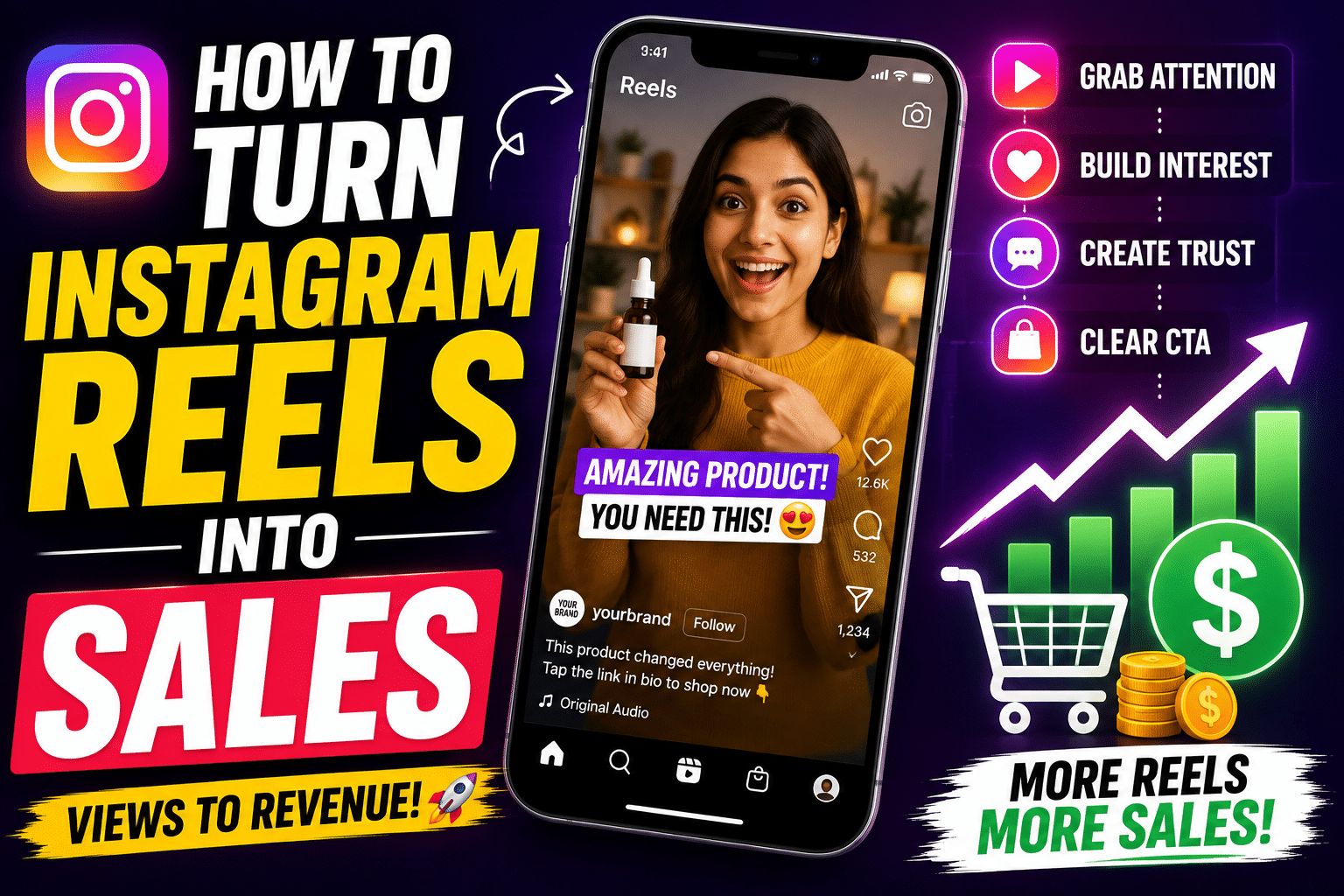
Hook → Problem → Solution → Demonstration → Proof → Offer → CTA → Follow-up
First, capture attention with a strong hook. Then explain a problem your target customer understands. Introduce your product as a solution, demonstrate its value, provide social proof, and give viewers a clear reason to act.
Finally, track what happens after the Reel.
Meta’s recent India research reinforces the commercial potential of this approach: its 2026 data says Reels has a significant role in product discovery and purchase decisions, while its 2026 retail research reported stronger brand-intent lift and lower acquisition costs for retail brands using Reels and creators.
Conclusion
Instagram Reels can be much more than a source of views. When strategically designed, they can become an important part of your sales funnel.
The key is to stop thinking of every Reel as a standalone video and start thinking of it as one step in the customer’s buying journey.
Create content that attracts the right audience, solves real problems, demonstrates your product, builds trust, and provides a simple next step.
In 2026, the brands that win with Instagram Reels won’t necessarily be the ones creating the most videos. They’ll be the ones that understand how to turn attention into trust—and trust into action.