
Introduction
Getting thousands of video views can feel exciting. But views alone do not necessarily create revenue.
A business can publish a video that receives thousands of impressions while generating very few leads or sales.
That is where a video marketing funnel becomes important.
A video marketing funnel connects content with the different stages of the customer journey. Instead of creating videos only to attract attention, marketers create specific content for people who are discovering a brand, considering a solution, preparing to buy or returning as existing customers.
The goal is simple:
Turn attention into action.
What Is a Video Marketing Funnel?
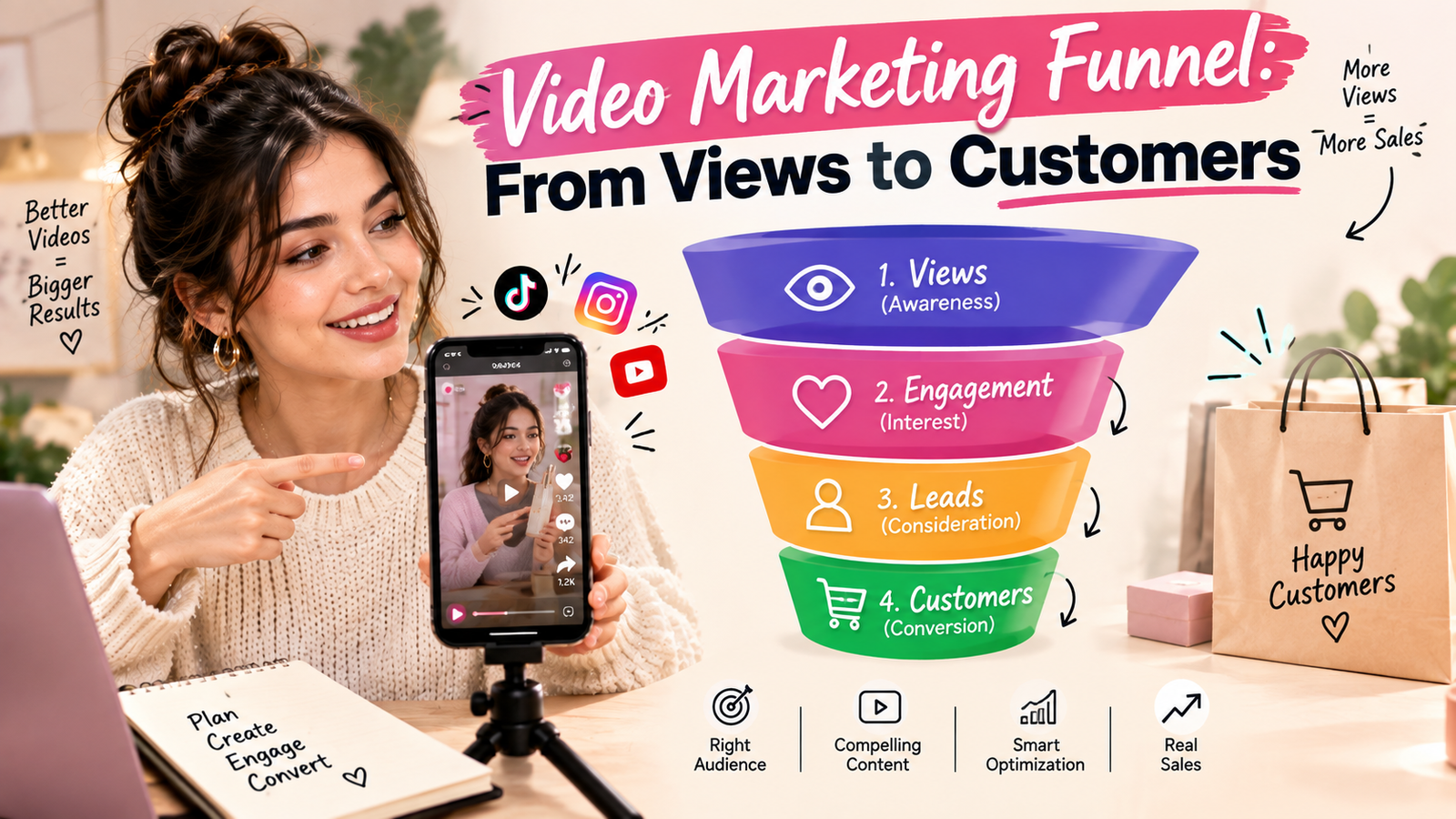
A video marketing funnel is a customer journey that uses video content at different stages of the buying process.
A simple funnel looks like this:
Awareness → Interest → Consideration → Conversion → Loyalty
Each stage requires a different type of video.
Someone discovering your brand for the first time does not need the same video as someone who has already visited your product page.
Stage 1: Awareness
The awareness stage is about attracting new audiences.
At this point, people may not know your brand or understand that they have a problem you can solve.
Useful awareness videos include:
- Short-form videos
- Educational videos
- Trend-based videos
- Problem-focused content
- Entertaining videos
- Industry tips
- Beginner guides
The objective is not always to make an immediate sale.
Instead, introduce the problem, topic or category.
Example of Awareness Content
Suppose you sell fitness trackers.
An awareness video might be:
“Five health and fitness metrics beginners should understand.”
The video provides useful information while introducing the topic.
A product does not have to dominate the video.
Stage 2: Interest
Once people know the topic or brand, the next step is building interest.
This is where educational content becomes especially valuable.
Create videos that answer:
- How does this work?
- What should I look for?
- What mistakes should I avoid?
- What features matter?
- Which option is suitable for beginners?
At this stage, your audience is becoming more informed.
Stage 3: Consideration
Now the viewer is actively evaluating options.
Comparison videos can work well here.
For example:
“Budget fitness tracker vs premium fitness tracker.”
Other useful videos include:
- Product demonstrations
- Detailed reviews
- Case studies
- Tutorials
- FAQs
- Customer testimonials
- Expert explanations
The goal is to remove uncertainty.
Stage 4: Conversion
At the conversion stage, the customer is close to taking action.
The video should make the next step clear.
Conversion content can include:
- Product demos
- Offer videos
- Testimonials
- Product comparisons
- Limited-time campaigns
- Shopping videos
- Personalized videos
A clear CTA is essential.
Examples include:
“Explore the product.”
“Book a demo.”
“Start your free trial.”
“Shop now.”
Stage 5: Loyalty
The funnel does not end when someone buys.
Existing customers can become repeat buyers and advocates.
Create videos such as:
- Product tutorials
- Setup guides
- Maintenance tips
- Advanced tutorials
- Customer community videos
- New product announcements
Helpful post-purchase content can improve the customer experience.
Why Views Are Not Enough
Views are an awareness metric.
They do not tell the entire business story.
A video with 100,000 views may produce fewer customers than a highly targeted video with 10,000 views.
That is why marketers should connect video analytics with business outcomes.
For B2B marketing, modern ROI measurement increasingly focuses on actions such as clicks, leads, pipeline movement and revenue rather than views alone.
Match the Video to the Funnel Stage
A common mistake is publishing the same type of video for every audience.
Instead, create content for each stage.
| Funnel Stage | Video Goal | Content Type |
|---|---|---|
| Awareness | Attract | Short-form, educational |
| Interest | Educate | Tips, explainers |
| Consideration | Build confidence | Reviews, demos |
| Conversion | Drive action | Product/offer videos |
| Loyalty | Retain | Tutorials, customer content |
This makes the strategy more organized.
Use Retargeting
Retargeting can connect different funnel stages.
For example:
Someone watches an awareness video.
Later, they see a product demonstration.
After visiting the website, they see a testimonial.
This creates a more connected customer journey.
Use Strong CTAs
Every video does not need a sales CTA.
Awareness videos might use:
“Follow for more tips.”
Consideration videos might use:
“See the full comparison.”
Conversion videos might use:
“Shop now.”
The CTA should match the viewer’s level of intent.
Build Content Clusters
Instead of creating random videos, build content around one topic.
For example, a smartphone brand could create:
- Smartphone buying mistakes
- Best phone features for students
- Camera comparison
- Battery test
- Product demonstration
- Customer review
- Purchase guide
Together, these videos create a content journey.
Measure Funnel Performance
Useful metrics include:
Awareness
- Reach
- Impressions
- Views
- Watch time
Interest
- Engagement
- Profile visits
- Website clicks
- Content interactions
Consideration
- Product-page visits
- Demo requests
- Lead forms
- Add-to-cart activity
Conversion
- Purchases
- Revenue
- Conversion rate
- Cost per acquisition
Loyalty
- Repeat purchases
- Retention
- Referrals
- Customer engagement
Create Videos Based on Search Intent
Video can also target questions people are actively searching for.
Examples:
- “How to choose a laptop”
- “Best smart TV for gaming”
- “How to use a fitness tracker”
- “How to edit Instagram Reels”
Search-focused video content can attract people with a specific problem.
Personalization Can Improve the Funnel
Different customers have different needs.
A beginner may need a basic explainer.
An advanced customer may want technical details.
A returning customer may need information about a new product.
Brands can create different video paths based on customer behavior.
AI and the Video Funnel
AI can make funnel content easier to produce.
Marketers can use AI to brainstorm:
- Awareness topics
- Video hooks
- FAQs
- Product explanations
- CTA variations
- Follow-up content
OpenAI’s marketing guidance describes ChatGPT as useful for campaign planning, content creation, generating variations for testing and analyzing performance data.
Common Funnel Mistakes
Chasing Only Viral Views
A viral video is not automatically a successful marketing campaign.
Selling Too Early
A new viewer may need education before a sales pitch.
No Follow-Up
If viewers engage but never receive another relevant piece of content, momentum can disappear.
Measuring Only Engagement
Engagement matters, but business outcomes matter too.
Creating Content Without a Journey
Random videos make it harder to move audiences toward a clear action.
Final Thoughts
A video marketing funnel gives brands a structured way to turn content into business results.
Instead of asking only, “How many people watched?”
Ask:
“What should this viewer do next?”
Once every video has a clear role in the customer journey, marketing becomes easier to organize and measure.
The strongest video strategy is not necessarily the one with the most views. It is the one that connects the right content with the right audience at the right stage of the buying journey.