
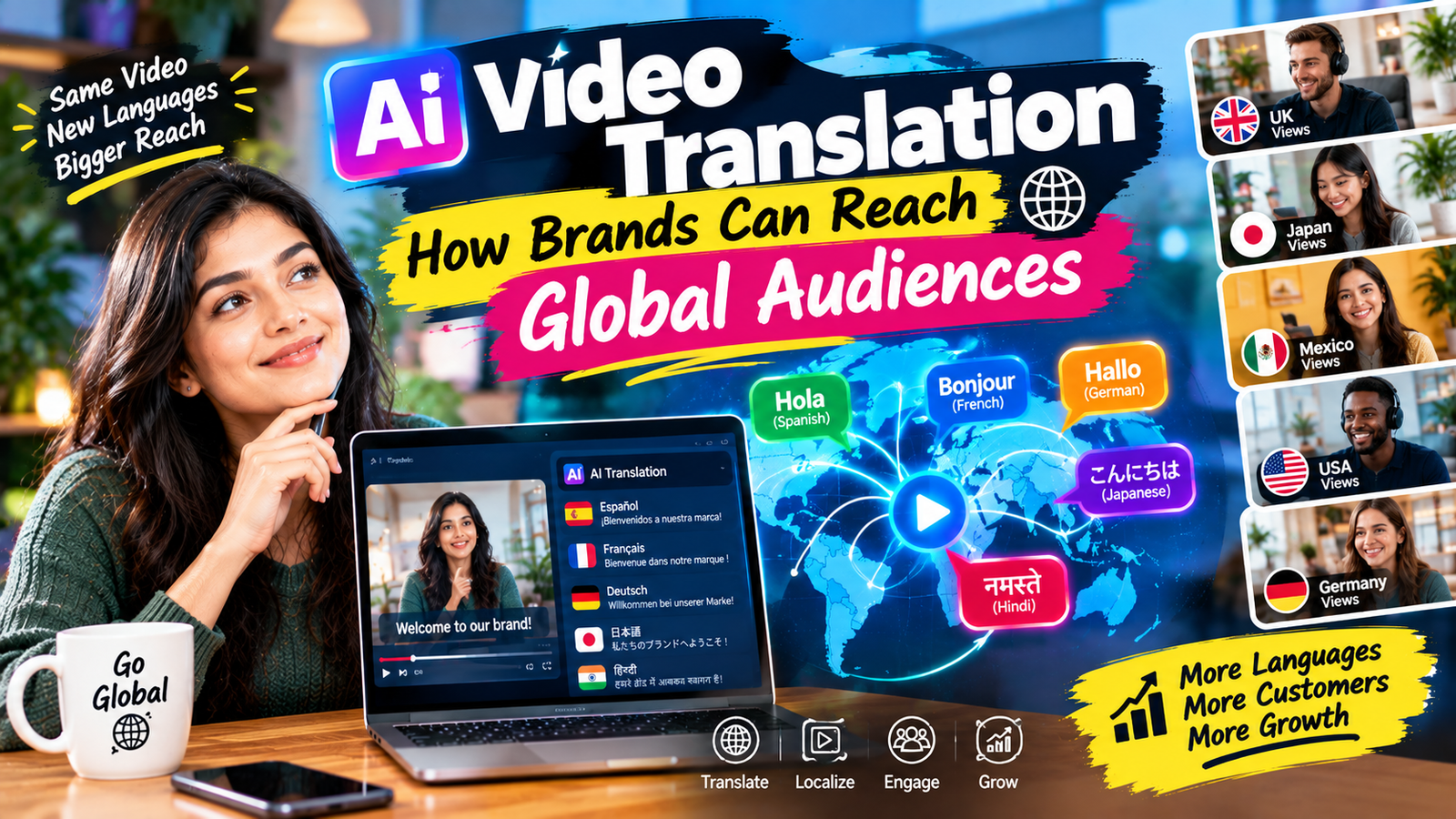
AI video translation is changing how brands communicate with audiences around the world. In the past, taking a marketing video into another country often required professional translators, voice actors, recording studios, editors, and separate production teams. That process could take weeks and become expensive when a brand wanted to support several languages.
In 2026, artificial intelligence is making multilingual video production much faster. AI-powered systems can transcribe speech, translate scripts, generate dubbed voices, create subtitles, and in some cases synchronize translated speech with a speaker’s lip movements.
For brands, this means one video can potentially become a global marketing asset without completely recreating the original production.
So, how does AI video translation work, and how can businesses use it effectively?
What Is AI Video Translation?
AI video translation uses artificial intelligence to convert video content from one language into another.
A typical workflow includes several stages:
- Speech recognition converts the original audio into text.
- AI translates the text into the target language.
- A synthetic or cloned voice produces the translated speech.
- Subtitles can be generated automatically.
- Advanced systems can synchronize speech with the speaker’s mouth movements.
- The final video is reviewed before publication.
This makes it possible to create multilingual versions of advertisements, tutorials, product demonstrations, webinars, educational videos, and social media content.
YouTube, for example, expanded its auto-dubbing system to 27 languages in 2026. YouTube also reported that more than 6 million viewers were watching at least 10 minutes of auto-dubbed content each day as of December 2025.
Why AI Video Translation Matters for Brands
Language can be a major barrier to international growth.
A company may have an excellent product and strong video campaign, but audiences may not fully understand the message if the content is available only in one language.
Traditional localization can require separate production processes for each market.
AI changes that workflow.
Instead of starting from zero for every language, marketers can begin with one original video and create localized versions from the same source.
This can help brands expand their content strategy without multiplying their production workload.
1. Reach New International Audiences
The biggest benefit of AI video translation is simple: more people can understand your content.
A technology company with an English product tutorial could create versions for audiences who speak Hindi, Spanish, French, German, Japanese, or other supported languages.
The original video remains the foundation, while AI helps adapt the message for different audiences.
This can be particularly useful for brands selling products internationally.
2. Create Multilingual Videos Faster
Traditional dubbing can involve several stages of coordination.
A company may need to:
- Hire translators
- Review translations
- Hire voice actors
- Record audio
- Synchronize dialogue
- Edit the video
- Add subtitles
- Review the final version
AI can automate or accelerate several of these steps.
YouTube’s current auto-dubbing system can translate videos into dozens of languages, while its Expressive Speech feature supports eight languages and aims to preserve more of the original speaker’s emotion and delivery.
For marketers publishing frequently, faster localization can make a major difference.
3. Reduce Repeated Production Work
Imagine a brand creates a two-minute product video.
Without AI, producing versions for ten markets could mean arranging multiple voice recordings and editing each version separately.
With an AI-assisted workflow, the original video can become the foundation for multiple language versions.
That doesn’t mean every step should be completely automated. Human review remains important, especially for campaigns where brand messaging and cultural details matter.
However, AI can significantly reduce repetitive work.
4. AI Dubbing Can Preserve the Original Voice
Modern AI video translation can go beyond subtitles.
Some systems can generate a translated voice that resembles the original speaker’s vocal characteristics.
This can create a more consistent brand experience.
For example, if a company’s founder presents an English-language product announcement, an AI dubbing system may allow audiences in other markets to hear a translated version while maintaining elements of the original voice.
Brands should obtain appropriate permission before cloning or reproducing someone’s voice.
Voice identity is increasingly becoming an important part of digital rights and brand protection.
5. Lip-Sync Translation Makes Videos Feel More Natural
One challenge with traditional dubbing is that the spoken language and the speaker’s mouth movements don’t always match.
AI-powered lip-sync technology attempts to address this problem.
YouTube has been testing and developing technology that adjusts lip movements to better match translated audio.
When done well, this can make translated videos feel more natural.
However, brands should still review the final output. AI-generated lip movements and translations can occasionally produce unnatural results.
6. Subtitles Still Matter
Dubbing isn’t the only solution.
Subtitles can be useful when brands want to maintain the original voice while making a video accessible to another language audience.
They are particularly useful for:
- Social media videos
- Interviews
- Educational content
- Product demonstrations
- Short-form videos
- News-style content
A strong multilingual strategy can therefore combine subtitles and dubbed versions depending on the audience and platform.
7. AI Translation Helps Brands Localize Content
Translation and localization are not exactly the same.
Translation changes the language.
Localization adapts the content so it feels appropriate for a particular market.
For example, a slogan that works perfectly in English may sound unnatural when translated word-for-word into another language.
AI can provide a strong first draft, but human language experts can improve cultural references, humor, expressions, and brand messaging.
This is especially important for advertising campaigns.
A technically correct translation isn’t always an effective marketing message.
8. India Is a Major Opportunity
AI video translation can be particularly valuable in multilingual markets such as India.
Brands may need to communicate with audiences across English, Hindi, Gujarati, Bengali, Marathi, Tamil, Telugu, Kannada, Malayalam, Punjabi, and other languages.
Instead of producing completely separate campaigns from the beginning, companies can use AI to create localized versions of existing content.
This could help businesses reach regional audiences while maintaining a consistent overall brand identity.
The technology is also becoming relevant to Indian entertainment. Reuters reported in April 2026 that AI-assisted dubbing across India’s many languages was becoming part of the country’s broader AI-driven media transformation.
9. AI Translation Can Expand Social Media Reach
Social media makes multilingual video particularly valuable.
A brand might publish a successful English-language Reel and discover that viewers from other countries are engaging with it.
Instead of creating a completely new campaign, marketers can translate the successful video.
The same concept can then be adapted for:
- Instagram Reels
- YouTube Shorts
- TikTok
- Website videos
This creates an efficient content localization cycle.
10. Human Review Is Still Essential
AI translation has improved significantly, but it is not perfect.
Problems can still occur with:
- Names
- Technical terminology
- Accents
- Slang
- Cultural references
- Humor
- Brand slogans
- Context
- Multiple speakers
A small translation mistake can change the meaning of an advertisement.
Therefore, brands should use AI as part of the production workflow rather than treating it as an unquestioned replacement for professional review.
YouTube itself notes that auto-dubbing may not always be perfect and gives creators options to review, unpublish, or delete dubbed tracks.
Best Practices for AI Video Translation
Brands can get better results by following a few simple practices.
Start With a Clear Original Script
A clear source video makes translation easier.
Avoid unnecessary slang, unclear references, and overly complicated sentences.
Review Every Translation
Have a native speaker or qualified language reviewer check important marketing videos.
Keep Brand Terminology Consistent
Create a glossary of product names, technical terms, slogans, and key phrases.
Adapt Rather Than Translate Literally
The goal is to communicate the same message naturally, not simply replace every word.
Check Audio and Lip Sync
Listen carefully to the translated audio and watch for pronunciation or synchronization problems.
Measure Each Market
Track watch time, engagement, clicks, conversions, and audience retention by language.
A translated video that performs well in one market may require a different strategy in another.
The Future of AI Video Translation
AI video translation is moving beyond simple subtitles.
The combination of translation, expressive voice generation, lip synchronization, and multilingual publishing is creating a new form of global video marketing.
YouTube is already expanding this direction. In September 2026, it announced plans to pilot live auto-dubbing, allowing viewers to listen to live content in their preferred language.
This points toward a future where language barriers become less significant for online video.
For brands, that could mean global campaigns become easier to localize and distribute.
Final Thoughts
AI video translation is giving brands a practical way to take existing content to international audiences.
Instead of producing every language version from scratch, companies can use AI to assist with transcription, translation, dubbing, subtitles, voice generation, and lip synchronization.
However, successful localization requires more than technology. Brands still need human review, cultural awareness, clear messaging, and a strong understanding of each target market.
The smartest approach is to combine AI’s speed and scalability with human creativity and language expertise.
In 2026, global video marketing is becoming less about speaking one language to everyone and more about making the same brand message feel natural to audiences wherever they are.