
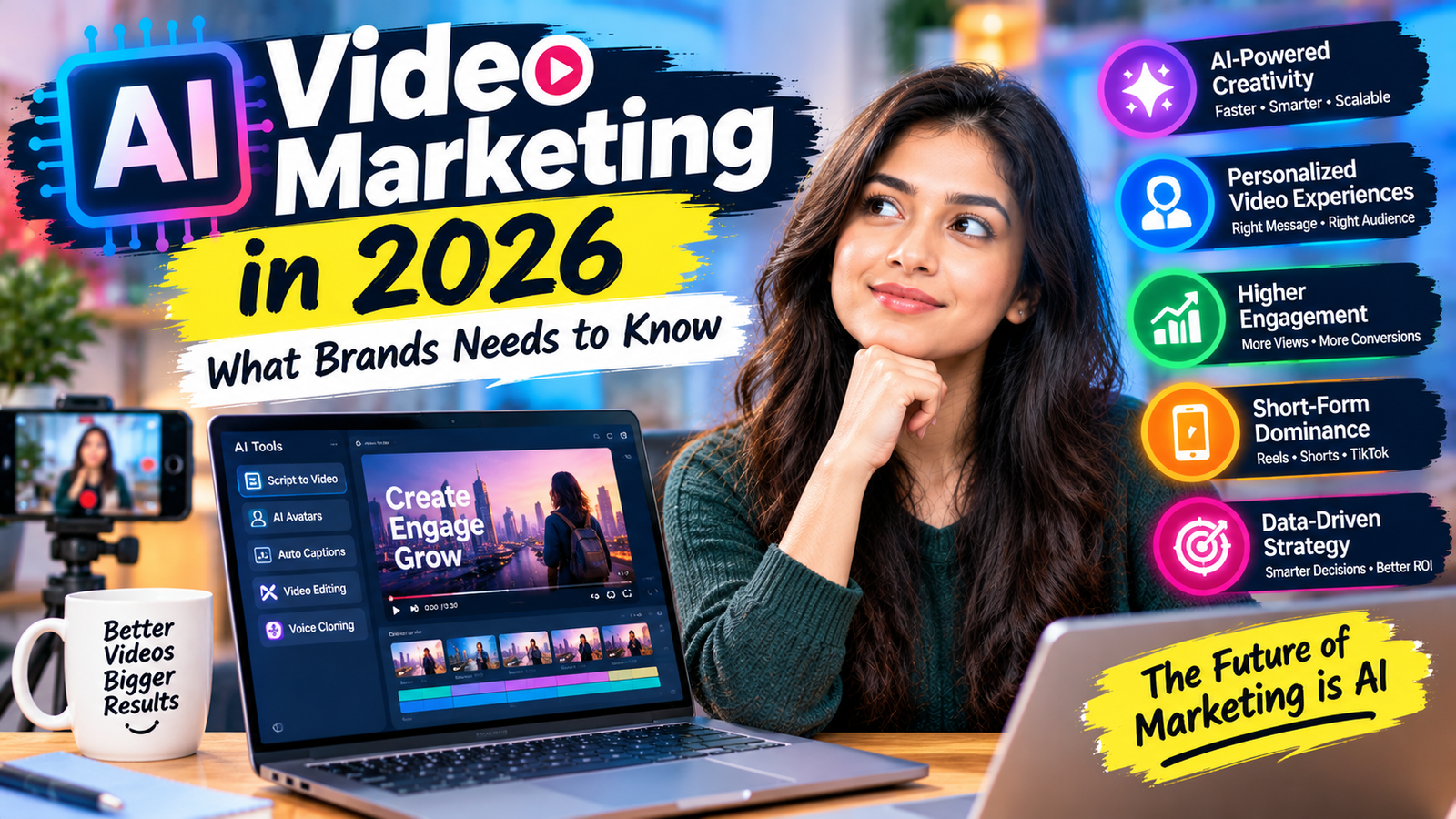
AI video marketing in 2026 is changing how brands plan, create, publish, and measure video content. From automated video editing and AI-generated scripts to personalized advertisements and virtual presenters, artificial intelligence is becoming part of the modern marketing workflow.
Video remains one of the most important formats for attracting attention online. However, producing quality videos can require significant time, money, and creative resources. AI helps brands reduce some of that workload while giving marketers new ways to experiment with content.
So, what does AI video marketing really mean for brands in 2026? More importantly, how can businesses use it without making their content feel robotic or repetitive?
Let’s explore the biggest changes brands need to understand.
What Is AI Video Marketing?
AI video marketing refers to using artificial intelligence to support different stages of video marketing.
Instead of relying entirely on manual production, marketers can use AI to help with:
- Video scripts
- Content ideas
- Storyboards
- Voiceovers
- Captions and subtitles
- Video editing
- Translations
- Personalization
- Thumbnail creation
- Audience analysis
- Performance optimization
The goal isn’t necessarily to replace creative teams. Instead, AI can handle repetitive tasks while marketers focus more on strategy, storytelling, branding, and audience relationships.
Why AI Video Marketing Matters in 2026
The biggest advantage of AI is speed.
Traditional video production may involve brainstorming, scripting, filming, editing, reviewing, captioning, and publishing. Each step can take hours or even days.
AI tools can shorten several of these stages. A marketer can generate multiple script ideas, turn written content into video concepts, create captions automatically, and produce different versions for different platforms.
This makes experimentation easier.
For example, a brand could test several opening hooks for the same product instead of spending an entire production cycle creating one version.
More testing can help marketers understand which messages attract attention and encourage action.
1. AI Is Making Video Production Faster
One of the biggest AI video marketing trends in 2026 is faster content production.
AI-powered tools can help transform a simple idea into a structured video workflow. Marketers can begin with a topic, product description, blog post, or campaign brief.
AI can then assist with:
- Script outlines
- Scene suggestions
- Voice generation
- Captions
- Transitions
- Background music selection
- Short-form versions
This is particularly useful for small businesses and creators that don’t have large production teams.
However, speed should not become the only goal. Publishing more videos does not automatically mean producing better marketing.
2. AI Personalization Is Becoming More Important
Personalization is another major area to watch.
Instead of creating one video for everyone, brands can create variations designed for different audiences.
For example, a clothing company might create separate versions of a campaign for college students, working professionals, and fitness audiences.
The core product remains the same, but the messaging, visuals, language, or call-to-action can change.
AI can make this type of content variation easier to manage.
The result is a more flexible video strategy where brands can communicate with different audience segments without producing every variation completely from scratch.
3. AI Video Editing Can Save Time
Editing is often one of the most time-consuming parts of video production.
AI editing features can help marketers identify important moments, remove unwanted sections, generate captions, improve audio, resize content, and create shorter clips.
This is especially useful when a brand produces long-form content.
Imagine recording a 30-minute interview. Instead of manually searching through the entire recording for short clips, AI-assisted tools can help identify potential highlights.
Those highlights can then become Shorts, Reels, TikTok-style videos, or social media posts.
4. AI Is Changing Short-Form Video
Short-form video continues to be an important format for digital marketing.
People scroll quickly, which means brands often have only a few seconds to capture attention.
AI can help marketers experiment with different:
- Hooks
- Video lengths
- Captions
- Visual styles
- Calls-to-action
- Story structures
For example, one product could have several different opening lines.
Version A could start with a question.
Version B could start with a surprising fact.
Version C could immediately demonstrate the product.
AI can help create and organize these variations, while performance data can help marketers understand how audiences respond.
5. AI Voiceovers and Digital Presenters
AI-generated voiceovers have also become more practical for marketing teams.
Brands can use AI voices for product explainers, educational videos, tutorials, advertisements, and social content.
Some platforms also provide digital avatars or virtual presenters.
These technologies can be useful when a company needs frequent educational content but does not always have someone available to appear on camera.
Still, brands should consider authenticity carefully.
A highly polished AI presenter may look impressive, but audiences can also respond negatively if content feels impersonal. The best approach depends on the brand, audience, and purpose of the video.
6. AI Is Making Video Localization Easier
Global brands often need to adapt videos for different markets.
Previously, localization could involve separate voice actors, translators, editors, and production teams.
AI can simplify parts of this process by assisting with:
- Translation
- Subtitles
- Voiceovers
- Transcription
- Language variations
This allows marketers to adapt successful campaigns for multiple languages more efficiently.
However, automated translation should still be reviewed by humans, especially when campaigns involve cultural references, humor, slang, or sensitive topics.
7. AI Can Help With Video SEO
Creating a video is only half the job. People also need to discover it.
AI can help marketers identify relevant keywords, organize video descriptions, generate captions, suggest titles, and analyze audience questions.
For example, a technology brand creating a smartphone tutorial might use related search terms to structure its video title and description.
AI can also help identify recurring questions in customer feedback. Those questions can become future video topics.
This creates a useful cycle:
Customer questions → video ideas → content → audience feedback → new video ideas.
8. AI Analytics Can Improve Marketing Decisions
AI isn’t only useful for creating videos.
It can also help marketers understand performance.
Instead of looking only at total views, marketers can examine metrics such as:
- Watch time
- Audience retention
- Click-through rate
- Engagement
- Conversion rate
- Drop-off points
- Returning viewers
Suppose a video receives thousands of views but most viewers leave during the first few seconds.
That information may indicate that the opening needs improvement.
AI-powered analytics can help identify patterns across multiple videos, giving marketers more information for future campaigns.
9. Human Creativity Still Matters
AI can generate content quickly, but that doesn’t mean brands should hand over their entire creative process to machines.
Strong marketing still requires human understanding.
A marketer needs to know:
- What the audience actually cares about
- What the brand represents
- Which emotions the campaign should create
- What makes the product different
- Which stories feel authentic
AI can generate ten possible ideas in seconds. Humans still need to decide which idea fits the brand.
The strongest strategy in 2026 is therefore not simply AI instead of humans.
It is AI plus human creativity.
10. Challenges Brands Should Consider
AI video marketing also comes with challenges.
One major concern is originality. If thousands of brands use similar AI tools and prompts, content can start looking and sounding alike.
There are also concerns around copyright, privacy, misinformation, synthetic media, and the use of someone’s voice or likeness.
Brands should establish clear internal rules before using AI-generated content.
They should also review AI outputs carefully rather than publishing everything automatically.
A human approval stage can help protect brand quality and reduce mistakes.
How Brands Can Build an AI Video Strategy
Businesses don’t need to automate everything immediately.
A practical approach is to start with repetitive tasks.
For example:
Step 1: Use AI for brainstorming.
Step 2: Use AI to create initial script drafts.
Step 3: Let human marketers refine the messaging.
Step 4: Use AI-assisted editing and captioning.
Step 5: Create multiple versions for different platforms.
Step 6: Measure audience performance.
Step 7: Use those insights to improve future videos.
This approach gives brands the benefits of AI without removing human oversight.
The Future of AI Video Marketing
AI video marketing is likely to become increasingly integrated into everyday marketing workflows.
Instead of treating AI as a separate tool, brands may use it throughout the entire content lifecycle—from the first idea to campaign analysis.
The biggest opportunity may not simply be producing videos faster. It could be creating more relevant videos for specific audiences while learning from performance data more quickly.
Brands that understand this distinction can build smarter content systems rather than simply producing larger volumes of videos.
Final Thoughts
AI video marketing in 2026 is transforming the way brands approach content creation, personalization, editing, localization, SEO, and analytics.
AI can save time and make experimentation easier, but technology alone does not guarantee successful marketing.
Great video content still needs a strong idea, clear storytelling, authentic communication, and a deep understanding of the audience.
The most effective strategy is to let AI handle repetitive and time-consuming tasks while human marketers remain responsible for creativity, strategy, brand voice, and final decisions.
In 2026, the question isn’t simply whether brands should use AI for video marketing. The bigger question is how intelligently they can combine AI capabilities with human creativity.