

Introduction
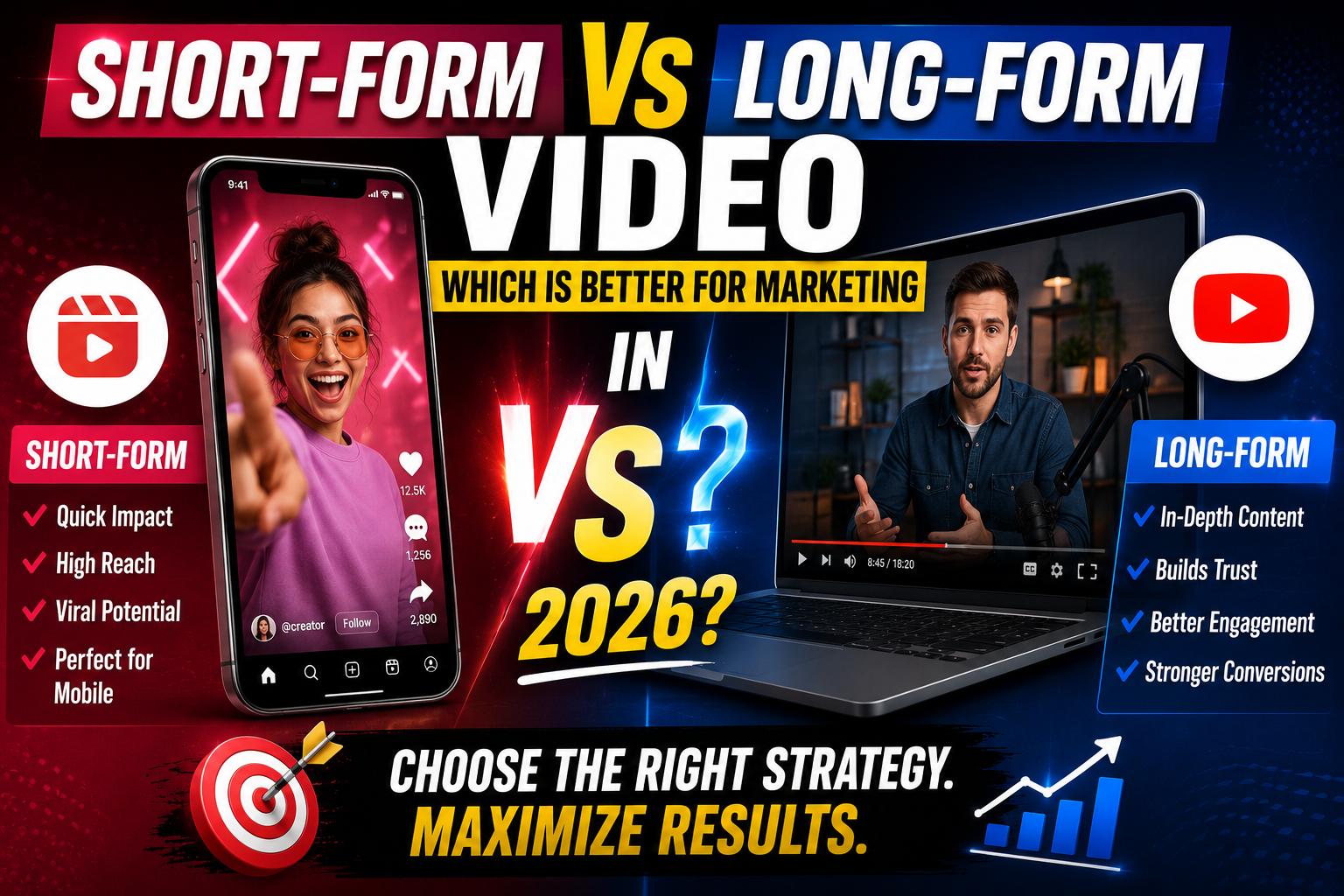
Video marketing has become one of the most important ways for businesses to attract attention, educate customers, build trust, and generate sales. But marketers face one major question in 2026: Should you invest in short-form videos or long-form content?
Short videos such as Instagram Reels, YouTube Shorts, and TikTok-style clips are designed to capture attention quickly. Long-form videos, including YouTube tutorials, webinars, product demonstrations, interviews, and educational videos, provide more time to explain a topic and build a deeper relationship with viewers.
The good news is that businesses don’t necessarily have to choose one. Current 2026 marketing guidance increasingly points toward using both formats strategically, with short-form content helping discovery and long-form content providing depth and conversion opportunities.
So, short-form vs long-form video—which is better for marketing in 2026? The answer depends on your goals.
What Is Short-Form Video Marketing?
Short-form video marketing involves creating brief videos designed for quick consumption. Popular formats include Instagram Reels, YouTube Shorts, TikTok videos, and similar vertical content.
These videos usually focus on one idea, question, tip, product feature, trend, or entertaining moment.
For example, a beauty brand might create a 20-second Reel showing three skincare mistakes. A technology company could publish a 30-second video explaining one useful smartphone feature.
The primary strength of short-form video is fast discovery. Viewers can encounter content from accounts they don’t already follow, making short-form platforms powerful tools for reaching new audiences.
What Is Long-Form Video Marketing?
Long-form video marketing uses longer videos to provide detailed information, entertainment, education, or storytelling.
Examples include:
- YouTube tutorials
- Product reviews
- Webinars
- Interviews
- Podcasts
- Online courses
- Product demonstrations
- Case studies
- Brand documentaries
Instead of trying to communicate everything in a few seconds, long-form content gives businesses room to answer questions and overcome customer objections.
This makes it especially useful when the buying decision requires research or trust.
Short-Form vs Long-Form Video: Quick Comparison
| Factor | Short-Form Video | Long-Form Video |
|---|---|---|
| Main Goal | Discovery and awareness | Education and conversion |
| Typical Platforms | Reels, Shorts, TikTok | YouTube, webinars, podcasts |
| Attention Span | Quick consumption | Deeper viewing |
| Production | Usually faster | Usually more time-consuming |
| Reach | Excellent for new audiences | Stronger through search and existing audiences |
| Storytelling | Limited | Extensive |
| SEO Potential | Growing | Strong, especially for searchable topics |
| Trust Building | Moderate | Strong |
| Product Education | Basic | Detailed |
| Best For | Awareness and engagement | Consideration and conversion |
Neither format wins in every category. They solve different marketing problems.
Why Short-Form Video Is Powerful in 2026
Short-form video has become a major part of digital consumption, particularly on mobile devices.
Meta reported in June 2026 that 97% of surveyed users in India watched videos on its platforms daily, while 89% of surveyed Gen Z users engaged with Reels daily. The same research highlighted Reels as a major discovery and commerce surface.
That makes short-form video particularly attractive for brands targeting younger and mobile-first audiences.
Another advantage is production speed. A business can potentially create several short videos from one longer piece of content.
For example, a 20-minute product interview could become:
- Five educational Shorts
- Three Instagram Reels
- Two product clips
- Several quote videos
This content-repurposing strategy allows businesses to get more value from a single production session.
Advantages of Short-Form Video Marketing
1. Faster Audience Discovery
Short-form platforms are built around recommendation feeds, which can expose content to people who aren’t already following a brand.
2. Easier to Consume
A viewer can learn a quick tip, discover a product, or understand an idea in less than a minute.
3. More Opportunities to Experiment
Because short videos are generally faster to produce, marketers can test different hooks, topics, formats, and messaging.
4. Strong Social Engagement
Short videos can encourage shares, comments, saves, and conversations when the content is entertaining or useful.
5. Excellent for Brand Awareness
Short-form content can introduce a business to potential customers before they are ready to make a purchase.
Where Short-Form Video Falls Short
Short-form content isn’t perfect.
The biggest limitation is depth.
If you’re selling a complicated product, a 30-second video may not provide enough information for someone to make a purchase decision.
Short videos can generate millions of views without necessarily producing the same level of trust or conversion as a detailed video.
This is why marketers should avoid measuring short-form success only through views.
A Reel with 100,000 views isn’t necessarily better than a Reel with 20,000 views if the smaller video generates significantly more qualified leads or customers.
Why Long-Form Video Still Matters in 2026
Some marketers assumed short-form video would replace long-form content. Instead, both formats continue to play different roles.
Sprout Social’s 2026 analysis found audiences interact with Shorts and long-form YouTube content in relatively similar proportions, reinforcing the value of having a strategy that includes both.
Long-form video provides something short-form content struggles to deliver: time.
That additional time allows a brand to demonstrate expertise, answer objections, tell stories, explain products, and build credibility.
A customer researching a ₹1 lakh product, for example, may prefer a detailed review rather than a 20-second promotional clip.
Advantages of Long-Form Video Marketing
1. Builds Trust
Longer videos allow businesses to demonstrate knowledge and expertise.
2. Better for Complex Topics
Tutorials, comparisons, demonstrations, and educational content often need more time.
3. Stronger Customer Education
A detailed product video can explain features, benefits, limitations, use cases, and alternatives.
4. Supports Search Discovery
YouTube’s searchable ecosystem makes long-form videos valuable for questions people may continue searching months or even years after publication.
5. Supports Conversions
Long-form videos can move viewers further through the buying journey because they provide more context before a purchase.
Where Long-Form Video Falls Short
Long-form content generally requires more planning and production effort.
A high-quality 15-minute video might involve research, scripting, filming, editing, graphics, thumbnails, audio production, and optimization.
It can also be harder to convince a new viewer to watch a long video if they have never heard of your brand.
This is where short-form content can help.
Short-Form vs Long-Form for SEO
When it comes to video SEO, both formats have opportunities.
Short-form videos can capture discovery through social feeds and increasingly through platform search.
Long-form videos, however, have an advantage for detailed search queries because they can answer broader questions and cover a topic comprehensively.
For example:
Short-form:
“3 mistakes when buying a laptop.”
Long-form:
“Complete Laptop Buying Guide for Students in 2026.”
The Short may attract attention, while the long-form video can provide the complete answer.
The smartest strategy is often to connect the two.
Which Format Is Better for Brand Awareness?
For pure brand awareness, short-form video generally has the advantage.
A 20-second Reel can introduce your brand to someone who has never heard of you.
For example, a fashion brand could use short videos to showcase styling ideas, seasonal trends, product transformations, and customer reactions.
Once viewers become interested, longer content can provide additional information.
Which Format Is Better for Conversions?
For complex purchases, long-form video often has an advantage because it gives customers more information before they make a decision.
Imagine selling a software product.
A 30-second video might show the product’s most impressive feature.
A 12-minute tutorial can demonstrate the entire workflow, answer common questions, show real use cases, and explain why the product is worth buying.
That deeper information can help move viewers from curiosity to consideration.
The Best Strategy: Use Both Together
Instead of asking “Short-form or long-form?”, businesses should ask:
“How can short-form and long-form content work together?”
A strong 2026 strategy can look like this:
Short-form → Discovery → Long-form → Trust → Conversion
For example, create a detailed YouTube video about a topic. Then extract several short clips from it.
The Shorts can highlight:
- A surprising fact
- A useful tip
- A common mistake
- A key statistic
- A controversial opinion
- A product feature
Each Short can introduce viewers to the broader topic and encourage interested people to explore the full video.
This hub-and-spoke approach is increasingly recommended in 2026 video marketing strategies.
How Businesses Can Create a Hybrid Video Strategy
Here’s a simple workflow:
Step 1: Create One Strong Long-Form Video
Start with a valuable topic that answers a real audience question.
Step 2: Identify the Best Moments
Find the strongest insights, questions, demonstrations, and hooks.
Step 3: Turn Them Into Shorts
Create several short videos around those moments.
Step 4: Optimize Each Format
Use appropriate titles, captions, keywords, descriptions, and visuals for each platform.
Step 5: Connect the Content
Where appropriate, direct interested viewers from short-form content toward the deeper long-form resource.
Step 6: Analyze Results
Track reach, retention, engagement, website visits, leads, and conversions rather than focusing only on views.
Which Video Format Should Your Business Choose?
Choose short-form video if your primary goal is:
- Increasing brand awareness
- Reaching new audiences
- Growing social media accounts
- Testing content ideas
- Promoting trends
- Creating frequent social content
Choose long-form video if your goal is:
- Educating customers
- Building authority
- Answering complex questions
- Demonstrating products
- Generating qualified leads
- Supporting high-consideration purchases
If you want sustainable growth, use both.
Conclusion
So, short-form vs long-form video—which is better for marketing in 2026?
There is no universal winner.
Short-form video is excellent for reach, discovery, attention, and brand awareness. Long-form video is stronger for education, trust, authority, and deeper conversion opportunities.
The smartest marketing strategy doesn’t treat them as competitors. Instead, it uses them as different stages of the same customer journey.
Create long-form content that provides genuine value, then turn its strongest ideas into short-form videos that attract new viewers. Use those short videos as entry points and your long-form library as the deeper destination.
In 2026, the winning video strategy isn’t about choosing between short and long. It’s about using the right format for the right marketing goal—and making both formats work together.