
Running a small business in 2026 means competing for attention across an increasingly crowded digital space. At the same time, customers are spending more time discovering products, services and brands through short-form video.
Instagram Reels, YouTube Shorts and other vertical-video formats have therefore become important tools for businesses that want to reach potential customers. Moreover, short-form video is increasingly connected to product discovery and social commerce.
The good news is that small businesses don’t need expensive cameras or large production teams. Instead, a smartphone, a clear strategy and consistent ideas can be enough to create useful marketing videos.
So, what does an effective video marketing strategy for small businesses in 2026 look like?
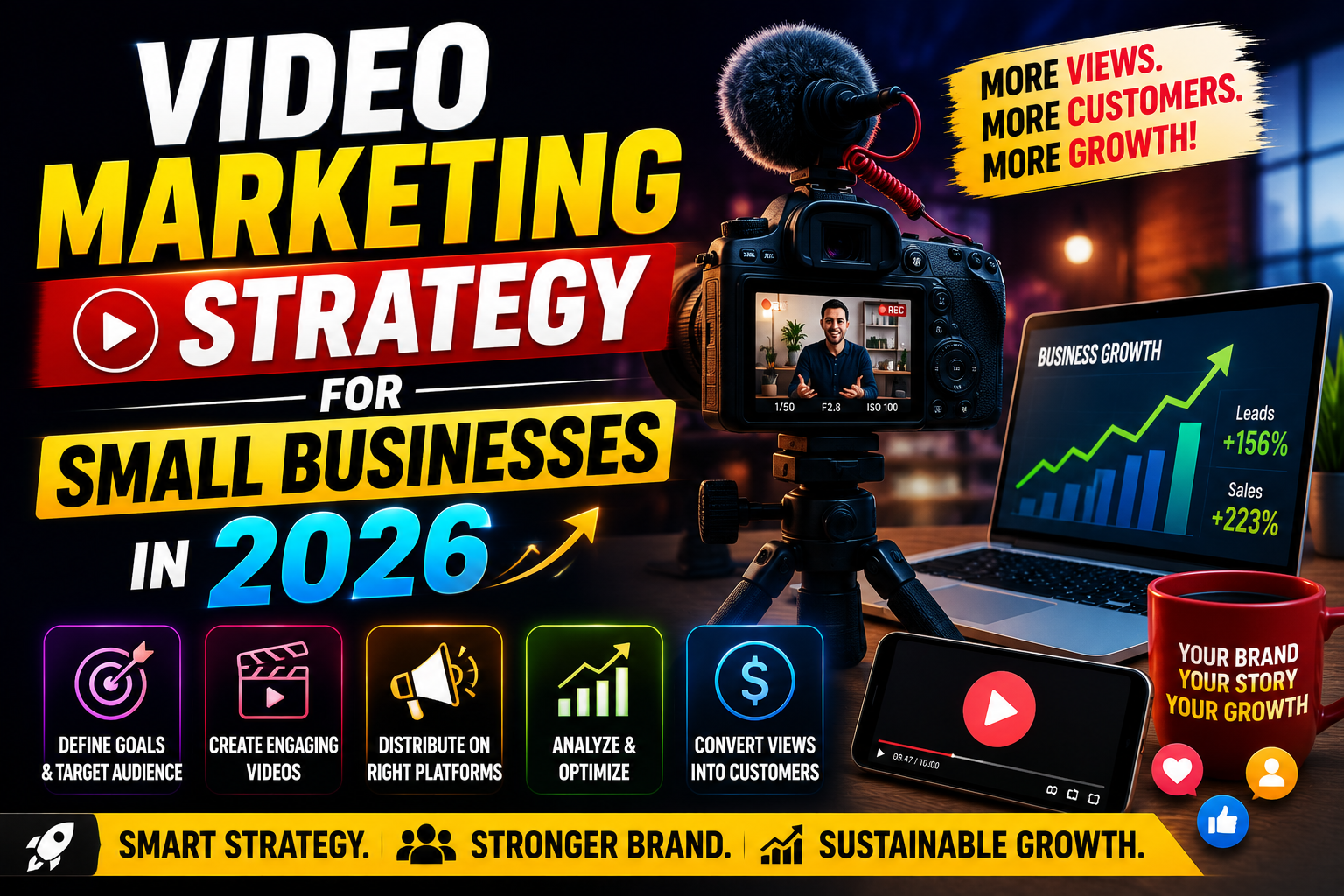
The answer starts with understanding your audience. From there, businesses can choose suitable platforms, create useful content, measure performance and gradually improve their strategy.
What Is Video Marketing for Small Businesses?
Video marketing means using video content to promote a business, product, service or brand. For small businesses, it can be a practical way to explain what you offer while building familiarity with potential customers.
For example, a bakery could show how its cakes are made. Similarly, a clothing store could demonstrate different ways to style one outfit.
A technology business might create product tutorials. Meanwhile, a local salon could publish hair-care tips and customer transformations.
Video can therefore support several marketing goals, including:
- Building brand awareness
- Attracting new customers
- Demonstrating products
- Answering common questions
- Generating leads
- Increasing website traffic
- Building trust
- Encouraging purchases
Most importantly, your videos should have a clear purpose rather than simply filling your social media calendar.
. Start With a Clear Marketing Goal
Before recording anything, decide what you want your video to achieve. Otherwise, you may collect views without producing meaningful business results.
For example, awareness-focused videos can introduce your brand to new audiences. On the other hand, educational videos can position your business as a helpful source of information.
If your goal is lead generation, include a clear action such as visiting your website or sending a message. Likewise, sales-focused videos can demonstrate products, answer objections and explain benefits.
A simple marketing funnel can look like this:
Video → Interest → Trust → Enquiry → Purchase
Therefore, every video should have a purpose within your broader marketing strategy.
2. Choose the Right Video Platforms
Small businesses don’t necessarily need to publish on every social network. In fact, managing too many platforms can reduce the quality and consistency of your content.
Instead, identify where your target customers spend their time.
Instagram Reels
Instagram can work especially well for beauty, fashion, food, lifestyle, retail and local businesses. Additionally, visually appealing products can be demonstrated effectively through short videos.
YouTube Shorts
YouTube Shorts can help businesses reach viewers through short educational, entertaining and product-focused videos.
YouTube Long-Form
Longer videos are useful when customers need detailed explanations, tutorials, comparisons or reviews.
Facebook can still be useful for local businesses and community-focused content. Therefore, it may be worth considering if your audience is active there.
The best platform isn’t necessarily the one with the biggest audience. Rather, choose the platform where your potential customers are most likely to engage.
3. Make Short-Form Video a Priority
Short-form video should be an important part of your 2026 video marketing strategy. For example, a business can answer one customer question in a 20-second Reel instead of creating a five-minute explanation.
A bakery might publish:
“Three cakes to order for your next birthday.”
A salon could create:
“Three hair mistakes you should avoid.”
Likewise, a clothing store might post:
“Three ways to style one white shirt.”
The key is to keep the idea focused. As a result, viewers can quickly understand what they are learning or why they should continue watching.
Short-form video is also closely connected with product discovery and social commerce in 2026.
4. Create Videos That Solve Customer Problems
Your audience doesn’t necessarily want another advertisement. Instead, people often want answers to questions they already have.
Think about the problems your customers frequently mention.
A skincare company could explain how to build a simple routine. Similarly, a restaurant could show customers which dishes are best for different occasions.
A fitness business might demonstrate beginner exercises. Meanwhile, a technology retailer could explain how to choose the right smartphone.
This approach creates useful content rather than constant promotion.
Consequently, customers have a reason to watch your videos even when they aren’t ready to buy immediately.
5. Use Strong Video Hooks
Social media users scroll quickly. Therefore, your opening needs to capture attention as soon as possible.
Consider hooks such as:
- “Before you buy this, watch this.”
- “Three mistakes small businesses make on Instagram.”
- “Here’s why your videos aren’t getting views.”
- “Don’t make this mistake when buying a smartphone.”
- “This simple trick can save you money.”
- “What nobody tells you about starting a small business.”
A strong hook creates curiosity or communicates a benefit. However, avoid misleading clickbait because the video still needs to deliver what the opening promises.
6. Show the Human Side of Your Business
Small businesses have an advantage that large corporations sometimes struggle to reproduce: personality.
Show the people behind your company. For example, introduce employees, explain how products are made or record a normal day at your business.
Behind-the-scenes videos can also reveal the work that customers don’t normally see. In addition, you can share your business story and explain why you started the company.
A simple smartphone video can sometimes feel more personal than a highly polished advertisement.
As a result, customers may find it easier to connect with the people behind the brand.
7. Use User-Generated Content
User-generated content, commonly called UGC, allows customers to become part of your marketing strategy.
For example, customers could share:
- Unboxing videos
- Product reviews
- Tutorials
- Before-and-after experiences
- Testimonials
- Product styling
- First impressions
With appropriate permission, your business can repurpose suitable customer videos.
Moreover, UGC provides social proof because potential customers can see real people interacting with your product.
This strategy works particularly well for beauty, fashion, food, technology, fitness and lifestyle businesses.
8. Create a Video Content Series
You don’t need a completely new concept for every video. Instead, develop recurring themes that can continue over several posts.
For example:
“Small Business Tips – Part 1”
“Small Business Tips – Part 2”
“Small Business Tips – Part 3”
Another option could be:
“Behind Our Business – Episode 1”
“Behind Our Business – Episode 2”
Series-based content can make planning easier. At the same time, viewers may become interested in returning for the next instalment.
The growing popularity of short, serialized vertical video also shows how audiences are becoming comfortable with episodic mobile-first storytelling.
9. Use AI to Save Time
Artificial intelligence is becoming increasingly useful for content production. For small businesses, AI can help reduce the time required for repetitive tasks.
You can use AI-assisted tools for:
- Generating video ideas
- Creating script outlines
- Writing captions
- Adding subtitles
- Editing clips
- Repurposing long videos
- Translating content
- Brainstorming hooks
However, AI shouldn’t remove your brand’s personality. Instead, use it as a production assistant while keeping your own experience and voice at the centre.
Authenticity is especially important because audiences can become skeptical when AI-generated content feels artificial or low-quality. Recent creator-industry reporting shows that AI-heavy brand promotions can trigger audience backlash.
Therefore, efficiency should never come at the expense of trust.
10. Make Your Videos Search-Friendly
Video marketing and SEO increasingly work together. As a result, businesses should make their videos easy for both audiences and platforms to understand.
Use relevant keywords naturally in:
- Video titles
- Captions
- Descriptions
- Spoken content
- On-screen text
- Hashtags
For example, a bakery in Ahmedabad could use a title such as:
“Best Chocolate Cake in Ahmedabad: What Makes It Special?”
That headline provides more context than simply writing:
“Our New Cake!”
In addition, local businesses should include relevant location terms when appropriate.
11. Experiment With Regional Languages
India’s diverse audience creates an opportunity for businesses to produce videos in regional languages. Depending on your customers, this might include Hindi, Gujarati, Marathi, Tamil, Telugu, Bengali, Kannada or Malayalam.
A local business can therefore communicate in the language its customers use every day.
Bilingual videos can also work well when appropriate. For example, a business could explain a product in Hindi while using English keywords on screen.
The objective isn’t to use a language because it is trendy. Rather, choose the language that makes your target audience feel comfortable.
12. Repurpose One Video Into Multiple Content Pieces
Creating new content every day can become exhausting. Fortunately, one strong video can often become several pieces of content.
Imagine that you record a five-minute YouTube video about your product.
From that single recording, you could create:
- Three Instagram Reels
- Three YouTube Shorts
- Several Stories
- One blog article
- A newsletter
- Short educational clips
Consequently, your content production becomes more efficient.
However, adapt each piece to its platform rather than uploading the exact same version everywhere.
13. Use Videos to Generate DMs and Leads
For many small businesses, views aren’t the final objective. Ultimately, the goal is often to generate conversations, enquiries and sales.
Your video can include calls to action such as:
“DM us for the price.”
“Message us on WhatsApp to place an order.”
“Visit our store today.”
“Click the link in our bio to learn more.”
Such CTAs give viewers a clear next step.
Moreover, social commerce is increasingly connecting short-form content with product discovery and purchasing behaviour.
14. Don’t Ignore Long-Form Video
Short-form content is excellent for discovery. However, long-form video can provide more room for detailed education and storytelling.
For example, a beauty brand could publish:
Short video: “Three skincare mistakes.”
Then, the same business could create:
Long video: “Complete Beginner’s Skincare Routine.”
A technology company could use a similar approach:
Short: “Three reasons to buy this laptop.”
Long: “Complete Laptop Review.”
As a result, short-form content can attract attention while long-form content builds deeper trust.
15. Measure the Right Metrics
Views can look impressive. Nevertheless, they don’t tell the entire story.
Track metrics such as:
- Views
- Reach
- Watch time
- Average viewing duration
- Likes
- Comments
- Shares
- Saves
- Profile visits
- Website clicks
- Leads
- Sales
Suppose one video receives 100,000 views but generates no enquiries. Meanwhile, another receives 10,000 views and produces 20 potential customers.
For a business, the second video may be more valuable.
Therefore, measure business outcomes rather than focusing only on vanity metrics.
Simple 30-Day Video Marketing Plan
If you’re starting from zero, a simple monthly plan can make the process easier.
Week 1: Introduce Your Business
Start with videos about your company, products, team and story. This way, new viewers can quickly understand who you are.
Week 2: Create Educational Content
Answer common customer questions and share practical tips. Meanwhile, monitor which topics attract the strongest engagement.
Week 3: Add Social Proof
Share testimonials, customer reviews, UGC and behind-the-scenes content. As a result, potential customers can see evidence of your product or service in action.
Week 4: Focus on Conversion
Demonstrate products, explain benefits and address common objections. Finally, include clear calls to action that encourage viewers to contact or buy from you.
At the end of the month, compare the results. Then, identify your three strongest videos and create more content around their topics.
Common Video Marketing Mistakes to Avoid
Small businesses can lose opportunities by making a few common mistakes.
Avoid:
- Posting without a clear goal
- Making every video an advertisement
- Using long introductions
- Ignoring audio quality
- Copying competitors
- Posting inconsistently
- Focusing only on views
- Using irrelevant trends
- Creating videos without customer value
- Trying to manage too many platforms
- Ignoring comments and DMs
Most importantly, don’t wait for every video to become perfect.
A useful video published consistently can be more valuable than a perfect video that never gets published.
Conclusion
A successful Video Marketing Strategy for Small Businesses in 2026 doesn’t require a huge advertising budget or a professional production studio.
Start with a smartphone and a clear understanding of your customers. Then, choose the platforms that fit your audience and create videos that answer questions, solve problems or entertain.
Short-form content can help you attract attention. Meanwhile, long-form videos can build deeper trust and explain complex products or services.
AI can speed up production. However, authentic stories and real human experiences should remain at the heart of your content.
Most importantly, measure more than views. Look at watch time, shares, saves, enquiries, website visits and sales to understand whether your videos are actually helping the business.
The most effective strategy is therefore simple:
Understand your audience → Create useful videos → Publish consistently → Measure results → Improve → Repeat.
In 2026, small businesses don’t need to outspend large companies to compete for attention. Instead, they can use authentic, helpful and strategically planned video content to build relationships with customers and turn viewers into buyers.