
Introduction
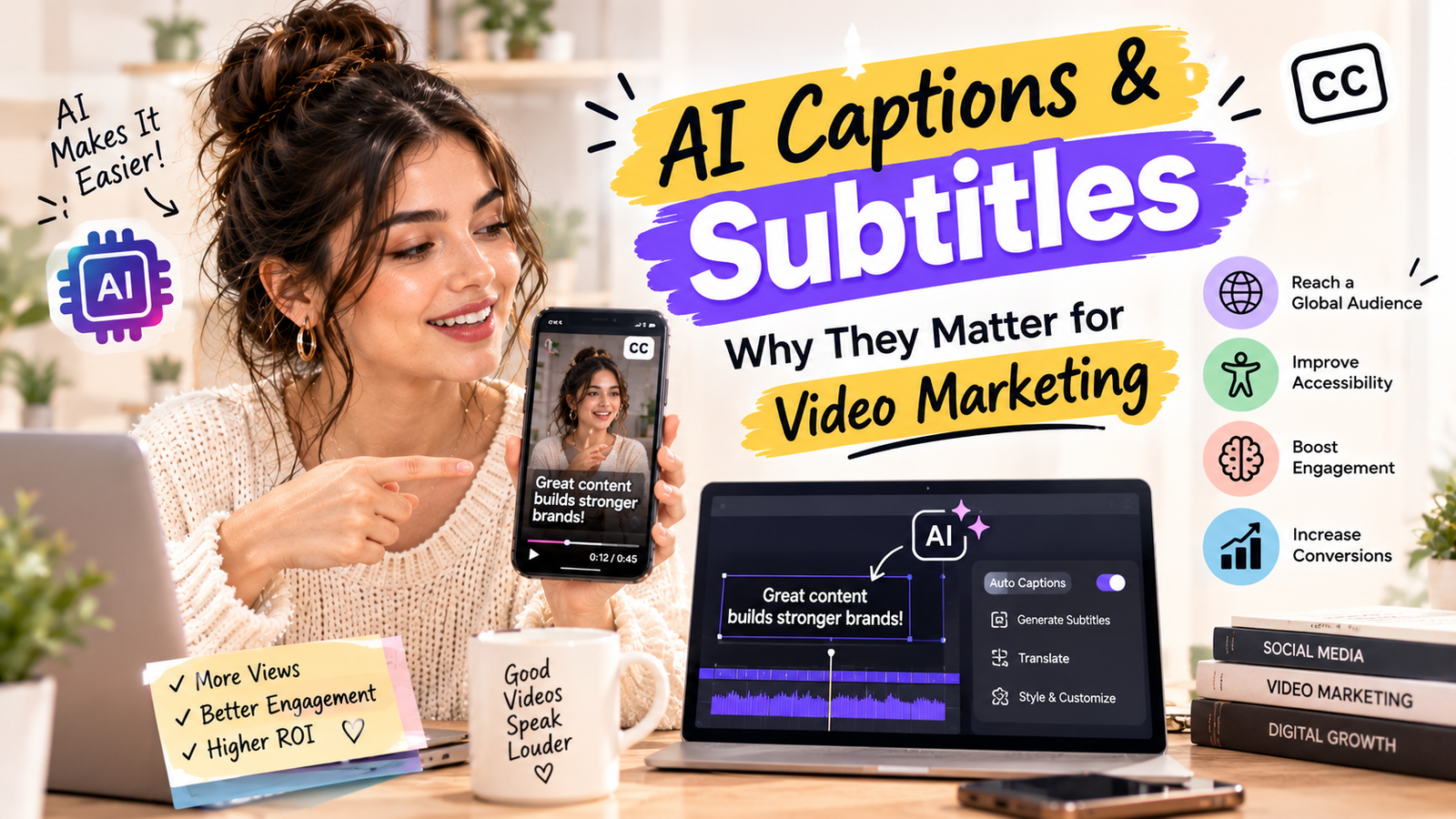
Video has become one of the most important formats in digital marketing. However, not every viewer watches videos with sound.
People watch videos in offices, classrooms, public transport, bedrooms and other environments where audio may be inconvenient.
That makes AI captions and subtitles an important part of modern video marketing.
AI can help marketers generate captions quickly, translate content into different languages and create multiple versions of video content.
But captions are not only about convenience. They can also support accessibility, comprehension and content distribution.
What Are AI Captions?
AI captions are automatically generated text representations of spoken dialogue and relevant audio.
Speech-recognition technology analyzes the audio and converts speech into text.
Marketers can then review and edit the generated captions before publishing.
Captions vs Subtitles
The terms are sometimes used interchangeably, but there is a useful distinction.
Captions generally aim to represent spoken content and may include important non-speech sounds.
Subtitles are usually focused on translating or displaying spoken dialogue for viewers who may understand the audio language but prefer reading it.
For international marketing, subtitles can be especially useful.
Why Captions Matter for Social Video
Many people scroll through social media with the sound turned down or off.
A video that depends completely on spoken audio can lose its message in that situation.
Captions solve this problem by keeping the key information visible.
For example:
Instead of hearing:
“This smartphone has a 5,000 mAh battery.”
The viewer can read:
5,000 mAh battery
The core message remains understandable.
Captions Improve Accessibility
Accessible content allows more people to understand and interact with a video.
Captions can help people who are:
- Deaf or hard of hearing
- Watching without sound
- Learning a language
- Having difficulty understanding speech
- Watching in noisy environments
Accessibility should therefore be treated as part of content quality rather than an afterthought.
AI Makes Caption Production Faster
Manually transcribing every video can take significant time.
AI tools can automatically generate an initial transcript.
Marketers can then:
- Upload the video
- Generate captions
- Review the transcript
- Correct errors
- Adjust timing
- Style the captions
- Export the final video
This workflow can save production time.
Always Review AI Captions
AI transcription is useful, but it is not perfect.
Errors can occur with:
- Brand names
- Product names
- Accents
- Technical terminology
- Background noise
- Multiple speakers
Therefore, review captions before publishing.
One incorrect word can change the meaning of a sentence.
Captions Can Strengthen Short-Form Videos
Short-form videos need to communicate quickly.
Captions can reinforce important points visually.
For example:
Problem: Battery drains too quickly.
Solution: Use these three settings.
The viewer can follow the structure even without audio.
Use Captions Strategically
Do not place enormous paragraphs on screen.
Instead:
- Keep sentences short
- Highlight important words
- Match text timing with speech
- Use readable typography
- Avoid covering important product visuals
The goal is clarity.
Captions and SEO
Captions and transcripts can also support content discoverability depending on the platform.
Use natural topic language rather than stuffing keywords into captions.
For example, a video about “AI video marketing tools” should naturally discuss that topic.
The content should remain useful for people first.
Multilingual Video Marketing
AI subtitles can make content easier to adapt for international and multilingual audiences.
A single video can potentially be translated into:
- Hindi
- Gujarati
- Spanish
- French
- German
- Portuguese
- Other supported languages
However, translation should be reviewed for cultural and linguistic accuracy.
Direct machine translation can sometimes sound unnatural.
AI Captions for Indian Brands
India has a multilingual digital audience.
Brands targeting different regions can use subtitles and localized video versions to make content more accessible.
For example, a national ecommerce company might create a product video in English and provide regional-language subtitles.
This can help the same core content reach more viewers.
Captions Can Improve Retention
When viewers can read and hear the message, information may be easier to follow.
Captions can also emphasize important moments.
For example:
“WAIT — before you buy a laptop, check this.”
The text itself creates a visual cue.
Use Captions in Product Videos
Product marketers can use captions to highlight:
- Price
- Features
- Benefits
- Specifications
- Offers
- Instructions
- Customer questions
This is especially useful for short videos where viewers need to understand the product quickly.
AI and Caption Personalization
AI can help marketers create different caption styles for different audiences.
For example:
- Short social captions
- Detailed subtitles
- Translated versions
- Educational transcripts
- Accessibility-focused captions
This turns one video into multiple content assets.
Common Caption Mistakes
Tiny Text
If viewers cannot read it, the caption has little value.
Too Much Text
Long blocks can distract from the video.
Incorrect Transcription
Always review AI output.
Poor Timing
Captions should appear at the right moment.
Covering the Product
Do not place text over critical visuals.
Ignoring Translation Quality
Localized captions need human review.
AI Captions and Brand Voice
Captions should match the tone of the video.
A premium brand may prefer clean, minimal text.
A youth-focused brand may use more energetic formatting.
Consistency helps strengthen brand identity.
The Future of AI Captions
AI caption technology is becoming part of a larger automated video workflow.
Instead of manually creating one video, marketers can increasingly produce:
Video → Transcript → Captions → Translation → Short Clips → Social Versions
This can dramatically increase content production efficiency.
Final Thoughts
AI captions and subtitles are no longer just optional additions to video marketing.
They help brands make content easier to understand, more accessible and more adaptable for different audiences.
The best approach is not to rely blindly on AI. Use AI to create the first version, then review and improve it.
When captions are accurate, readable and strategically designed, they become a simple but powerful part of a modern video marketing strategy.