
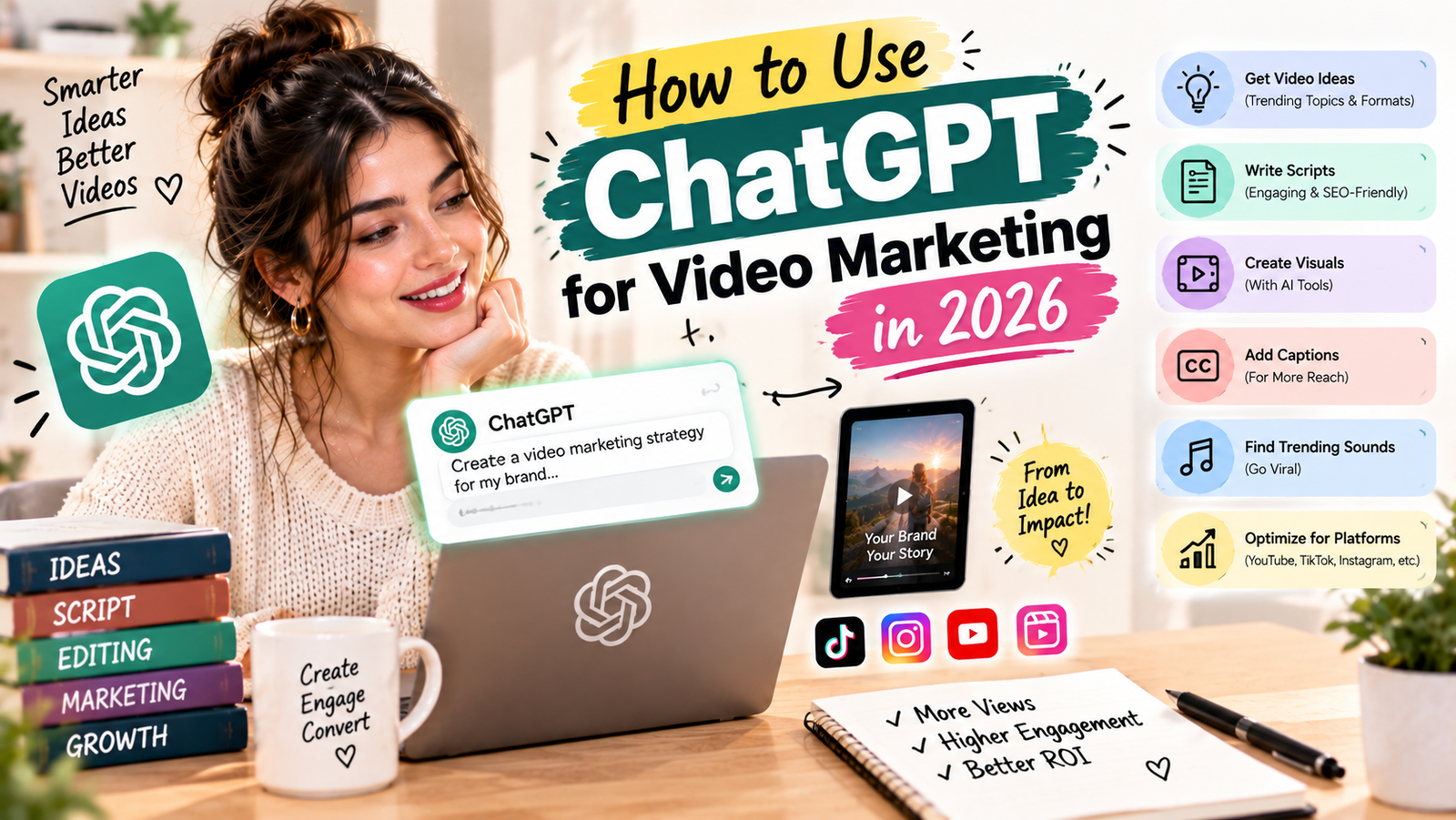
How to Use ChatGPT for Video Marketing in 2026
Creating video content consistently can be challenging. Marketers need ideas, scripts, hooks, captions, content calendars and performance insights.
This is where ChatGPT for video marketing can become useful.
Instead of treating ChatGPT as a replacement for creativity, marketers can use it as a brainstorming and production assistant.
OpenAI’s 2026 guidance for marketing teams describes ChatGPT as useful for campaign planning, content creation, generating variations for testing and summarizing performance information.
From YouTube videos to Instagram Reels, ChatGPT can support several stages of the video marketing workflow.
1. Generate Video Ideas
Start by giving ChatGPT information about:
- Your industry
- Audience
- Platform
- Product
- Content goal
- Brand tone
For example:
“Give me 30 Instagram Reel ideas for a smartphone accessories brand targeting college students in India.”
The more specific the prompt, the more useful the ideas are likely to be.
2. Find Content Pillars
Instead of publishing random videos, create content pillars.
For example, a technology brand could use:
- Product education
- Buying guides
- Tips
- Comparisons
- Troubleshooting
- News
- Customer stories
Ask ChatGPT to create video ideas under each pillar.
This makes content planning easier.
3. Write Video Scripts
ChatGPT can turn an idea into a structured script.
Provide:
- Video length
- Platform
- Audience
- Tone
- CTA
For example:
“Write a 30-second Instagram Reel script explaining why smartphone batteries drain quickly. Use simple language and a strong opening.”
Then refine the result.
4. Create Better Hooks
Hooks are critical for short-form video.
Ask ChatGPT for 20 alternatives.
Useful formats include:
- “Stop doing this if…”
- “Before you buy…”
- “Three mistakes…”
- “Did you know…?”
- “Here is why…”
The marketer can then select and improve the strongest options.
5. Write Video Titles
ChatGPT can generate title variations for YouTube and other platforms.
Instead of one title, create several options based on different search intents.
For example:
- How to Use AI for Video Marketing
- AI Video Marketing Guide for Beginners
- How Brands Use AI to Create Better Videos
Always prioritize accuracy and relevance over clickbait.
6. Create YouTube Descriptions
ChatGPT can create structured descriptions containing:
- Video summary
- Key points
- Chapters
- CTA
- Relevant keywords
- Related resources
Review all generated information before publishing.
7. Create Captions
ChatGPT can turn a long video transcript into:
- Instagram captions
- LinkedIn posts
- YouTube descriptions
- Short summaries
- Social snippets
This allows one video to support multiple platforms.
8. Build a Content Calendar
Tell ChatGPT:
- Posting frequency
- Platforms
- Audience
- Content pillars
- Campaign dates
It can organize these inputs into a calendar.
For example:
Monday: Educational Reel
Wednesday: Product demonstration
Friday: Customer story
Sunday: FAQ
The marketer can then adjust the calendar based on actual performance.
9. Repurpose Long-Form Videos
One of the best uses of ChatGPT is content repurposing.
Give it a transcript and ask for:
- Five Shorts ideas
- Three Reels
- One LinkedIn post
- One blog outline
- Ten social hooks
This can help marketers extend the value of existing content.
10. Create Video FAQs
Ask ChatGPT to identify common questions about a product or service.
Turn each question into a short video.
For example:
“Can this laptop run editing software?”
“What is the battery life?”
“Does it support fast charging?”
FAQ videos can address customer concerns before purchase.
11. Develop Video Campaigns
ChatGPT can help organize a campaign around a central theme.
For example:
Campaign: Back-to-College Technology
Videos:
- Best gadgets for students
- Laptop buying tips
- Phone accessories students need
- Budget tech setup
- Student productivity apps
This creates a connected content series.
12. Improve Scripts
You do not always need ChatGPT to write from scratch.
Give it your existing script and ask it to:
- Make the introduction stronger
- Remove unnecessary words
- Simplify language
- Improve transitions
- Make the CTA clearer
Human-written content can become more polished through this process.
13. Create Multiple Audience Versions
The same product may need different messaging.
For beginners:
“Three easy ways to improve your phone battery.”
For professionals:
“Five battery optimization settings for heavy daily smartphone users.”
ChatGPT can help adapt the same topic to different audiences.
14. Analyze Video Performance
You can provide performance data and ask ChatGPT to summarize patterns.
For example:
- Retention rates
- Click-through rates
- Conversion rates
- Engagement
- Watch time
AI can help turn numbers into questions worth investigating.
However, marketers should verify any conclusions against the original analytics.
15. Create Better Prompts
A weak prompt:
“Write a video script.”
A stronger prompt:
“Write a 45-second Instagram Reel script for Indian college students about choosing a budget laptop. Start with a question, use simple language, mention three buying factors and end with a CTA to read the full guide.”
Specific prompts create clearer results.
16. Use ChatGPT for Video SEO
ChatGPT can help brainstorm:
- Primary keywords
- Long-tail keywords
- Video titles
- Descriptions
- FAQs
- Topic clusters
However, keyword suggestions should be checked against actual search and platform data.
AI should support SEO research, not replace it.
17. Create Different CTAs
Ask ChatGPT to generate CTAs for different funnel stages.
Awareness:
“Follow for more practical tips.”
Consideration:
“Watch the full comparison.”
Conversion:
“Explore the product.”
Retention:
“Subscribe for more tutorials.”
The CTA should match the user’s intent.
18. Don’t Let AI Remove Your Brand Personality
This is one of the most important rules.
If every video sounds like it was written by AI, your content can become forgettable.
Add:
- Personal examples
- Customer stories
- Brand opinions
- Original footage
- Humor
- Industry experience
Use ChatGPT for assistance while keeping your own voice.
19. Fact-Check AI-Generated Content
AI can make mistakes.
This matters especially for:
- Product specifications
- Pricing
- Statistics
- Current events
- Technical claims
- Legal information
Always verify important factual claims before publishing.
20. Build a Repeatable Workflow
A useful workflow is:
Research → Idea → Script → Shoot → Edit → Caption → Publish → Analyze → Improve
ChatGPT can support several stages without becoming the entire process.
Final Thoughts
ChatGPT for video marketing can help marketers work faster and produce more consistent content.
Use it for brainstorming, scripting, hooks, content calendars, repurposing, captions, SEO ideas and performance summaries.
But remember that the best marketing still needs human judgment.
Use AI for speed. Use your experience for authenticity. Use analytics for decisions.
That combination can create a more efficient video marketing workflow in 2026.