

Introduction
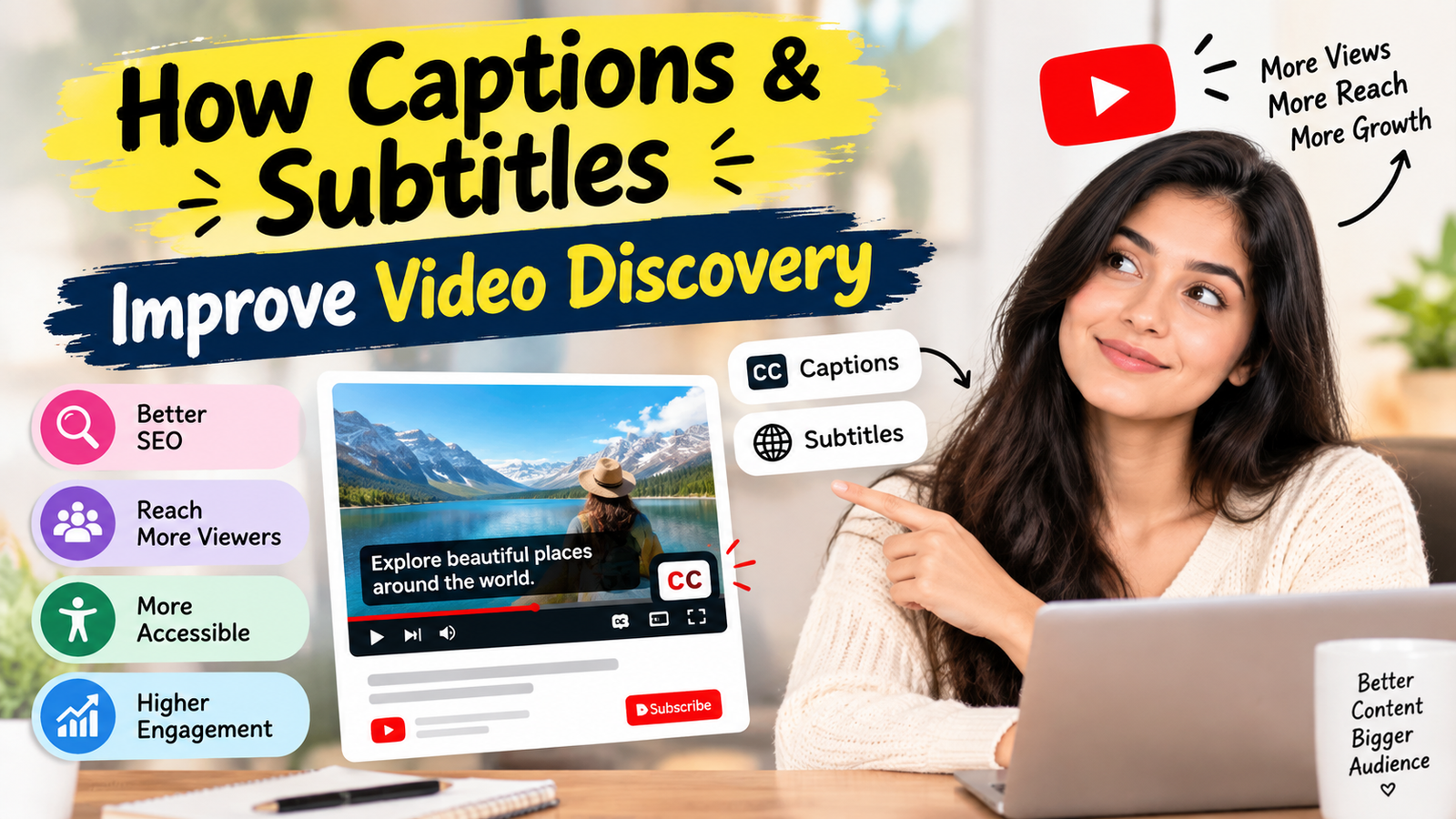
Video has become one of the most important formats for digital marketing, but creating a great video does not automatically guarantee that people will discover it. Captions and subtitles can help make video content easier to understand, more accessible, and more engaging across different platforms.
Many viewers watch videos without sound, especially when they are scrolling through social media in public places, at work, or during short breaks. Others may have hearing difficulties or speak a different language from the video’s original audio.
Adding captions gives these viewers another way to understand your message. At the same time, accurate text can provide platforms with additional context about your video.
So, can captions and subtitles really improve video discovery? They can contribute to a stronger overall video strategy by improving accessibility, viewer experience, content understanding, and opportunities for search visibility.
What Are Captions and Subtitles?
Although people often use the terms interchangeably, captions and subtitles have slightly different purposes.
Captions generally display spoken dialogue along with relevant audio information. They can help viewers understand a video even when they cannot hear the audio.
Subtitles usually focus primarily on translating or displaying spoken dialogue. They are particularly useful when a viewer does not understand the language being spoken.
For example, an English marketing video could have English captions for accessibility and Spanish subtitles for viewers who speak Spanish.
Both formats can make video content more useful to a wider audience.
Why Captions Matter for Video Marketing
Modern audiences consume video in many different environments. Someone might watch a Reel while sitting in a waiting room. Another person may view a YouTube video while commuting. In these situations, sound may be turned off.
Captions allow the message to remain understandable.
For marketers, this creates an opportunity to communicate with viewers who might otherwise scroll past a video because they cannot listen to it.
Captions can also reinforce important points. When viewers hear a statement and see the same message displayed as text, the information can become easier to follow.
Captions Can Help Videos Reach More Viewers
Video discovery depends on several factors, including relevance, viewer behavior, content quality, search optimization, and platform-specific signals.
Captions do not act as a magic ranking button. However, they can support discoverability as part of a broader video SEO strategy.
Text associated with a video can help provide additional context about its subject. When captions accurately reflect what the video discusses, they can reinforce the topics and phrases associated with the content.
For example, imagine a video titled:
“Instagram Reels SEO Tips for Beginners”
The video might discuss keywords, captions, hashtags, search intent, and content optimization. Accurate captions reinforce those topics and make the video’s message clearer.
Captions Improve Accessibility
Accessibility is one of the biggest reasons to add captions.
Not every viewer can comfortably listen to audio. People with hearing loss may depend on captions to understand video content.
However, accessibility benefits extend beyond hearing ability.
Viewers may watch videos in:
- Libraries
- Offices
- Public transportation
- Waiting rooms
- Schools
- Cafes
- Shared homes
In these environments, watching with sound may not be practical.
Captions allow people to follow the content without depending entirely on audio.
Captions Support Silent Viewing
Silent viewing has become particularly important on social media.
Users often scroll through feeds with their phone volume turned down. If a video depends completely on spoken audio, its message may be lost before the viewer decides whether to turn the sound on.
Captions solve part of this problem.
A strong opening sentence displayed on screen can immediately communicate the video’s value.
For example:
“Your Reels are getting views but no sales? Here’s what might be wrong.”
A viewer can understand the hook even without sound.
This can help your video communicate its main idea faster.
Captions Can Improve Viewer Understanding
Fast-speaking presenters, technical explanations, interviews, and educational videos can sometimes be difficult to follow.
Captions provide a visual reference.
Viewers can read important terms while listening to the speaker. They can also better understand names, technical words, statistics, and phrases that might otherwise be unclear.
For educational and business content, this can make complex information easier to consume.
Creators can also highlight important words through carefully designed on-screen text.
Captions and Video SEO
Video SEO involves optimizing video content so that users can discover it through search engines and video platforms.
Titles, descriptions, thumbnails, keywords, engagement, relevance, and content quality all play important roles.
Captions can complement these elements by providing a written representation of the video’s spoken content.
For example, a video about “AI video marketing tools” may naturally mention terms such as:
- AI video generators
- AI video editing
- marketing automation
- video creation tools
- content marketing
Accurate captions can help preserve these terms in the video’s text-based content.
However, creators should never deliberately stuff unrelated keywords into captions. The text should accurately represent what the video actually says.
Captions Can Support Social Media Discovery
Social platforms have increasingly become search destinations.
Users search for tutorials, product recommendations, reviews, recipes, news, educational content, and entertainment directly inside social apps.
That means marketers need to think beyond traditional search engines.
A video should clearly communicate its topic through its title, description, spoken content, captions, and on-screen text.
For example, instead of beginning a video with a vague statement such as:
“You won’t believe this!”
a creator could use:
“Three Instagram Reels SEO mistakes that reduce your reach.”
The second approach immediately communicates the topic.
Subtitles Can Expand Your Global Audience
Subtitles can also help brands reach international audiences.
Suppose a company creates an English-language product tutorial. Adding subtitles in Hindi, Spanish, French, German, or another relevant language can make the content accessible to additional audiences.
This is particularly valuable for businesses targeting international customers.
Instead of creating completely separate videos for every market, brands can sometimes adapt existing content with translated subtitles.
Of course, translations should be accurate and culturally appropriate. Poorly translated subtitles can create confusion and damage credibility.
Captions Can Increase Content Engagement
Captions make videos easier to consume in different situations.
When viewers can follow the content without sound, they have more flexibility over how and where they watch.
Better comprehension can also encourage viewers to continue watching.
For short-form content, the first few seconds are particularly important. A clear caption can communicate the hook immediately.
Consider these two openings:
“Want better videos?”
versus:
“Use these 5 video SEO techniques to improve discoverability.”
The second message gives viewers a clearer reason to continue watching.
How to Create Effective Video Captions
Adding captions is not enough. Quality matters.
Follow these practices when creating captions:
Keep Captions Easy to Read
Avoid putting too much text on the screen at once. Break longer sentences into manageable sections.
Match the Timing
Captions should appear when the words are spoken. Delayed captions can confuse viewers.
Check Accuracy
Automatic transcription tools can make mistakes, especially with names, technical terms, accents, and industry-specific vocabulary.
Always review automatically generated captions before publishing.
Highlight Important Information
For short-form videos, emphasize important words or phrases when appropriate.
Maintain Visual Consistency
Use readable fonts, appropriate sizing, and sufficient contrast. Captions should be visible without distracting from the main content.
Captions vs On-Screen Text
Captions and on-screen text serve different purposes.
Captions generally represent spoken dialogue. On-screen text can highlight headlines, statistics, calls to action, or important visual information.
Using both can create a stronger viewing experience.
For example, a marketing tutorial might use captions for the presenter’s speech while displaying a large on-screen heading such as:
“Step 1: Find Your Target Keyword”
This combination helps viewers follow the video visually.
Common Caption Mistakes to Avoid
Some caption problems can reduce the quality of your content.
Too much text: Large blocks of text can overwhelm viewers.
Poor timing: Captions that appear too early or too late make videos difficult to follow.
Automatic errors: AI-generated captions should always be reviewed.
Low contrast: Text that blends into the background can become impossible to read.
Keyword stuffing: Captions should reflect actual spoken content rather than artificially repeating keywords.
Ignoring mobile viewers: Captions should remain readable on smaller screens.
Best Practices for YouTube, Reels and Shorts
Different platforms have different viewing experiences, but several principles work across most channels.
For YouTube, focus on accurate captions, searchable titles, useful descriptions, and clear video structure.
For Instagram Reels, prioritize short, readable captions and strong opening text because viewers often scroll quickly.
For YouTube Shorts, make the opening seconds clear and use captions that reinforce the main message.
For TikTok and similar short-form platforms, captions can help viewers understand the video even when audio is muted.
Always check how captions appear on mobile devices before publishing.
Final Thoughts
Captions and subtitles are more than accessibility features. They can become an important part of a modern video marketing and discovery strategy.
They help viewers understand videos without sound, support accessibility, improve content clarity, and provide additional context around a video’s subject.
However, captions alone will not make a video successful. Strong topics, useful information, compelling hooks, good thumbnails, accurate keywords, and consistent publishing still matter.
The best approach is to treat captions as one part of a complete video SEO strategy.
Create content people genuinely want to watch. Make that content easy to understand. Add accurate captions and relevant subtitles. Then optimize the surrounding title, description, and metadata.
When these elements work together, your videos become easier for people to understand, access, and discover across today’s increasingly video-first digital landscape.